
Houston added 43,217 residents in one year, a gain large enough to rank second among all U.S. cities. That was the count on July 1, 2024, according to the U.S. Census Bureau. It explains why the city feels less like a fixed destination than a place still being built in real time.
The surprise isn’t just size. Nearly half of residents age 5 and older speak a language other than English at home. The city also moves freight, tourists, astronauts, commuters, and convention crowds at a scale most visitors don’t clock until they arrive. In my view, that mix is what makes the city harder to stereotype than New York or Los Angeles.
This guide looks at the facts behind that momentum, the neighborhoods and attractions that give it shape. The practical details that can make or break a first visit.
Houston at a Glance
Houston isn’t just big. It’s still adding people at a scale few U.S. cities can match.
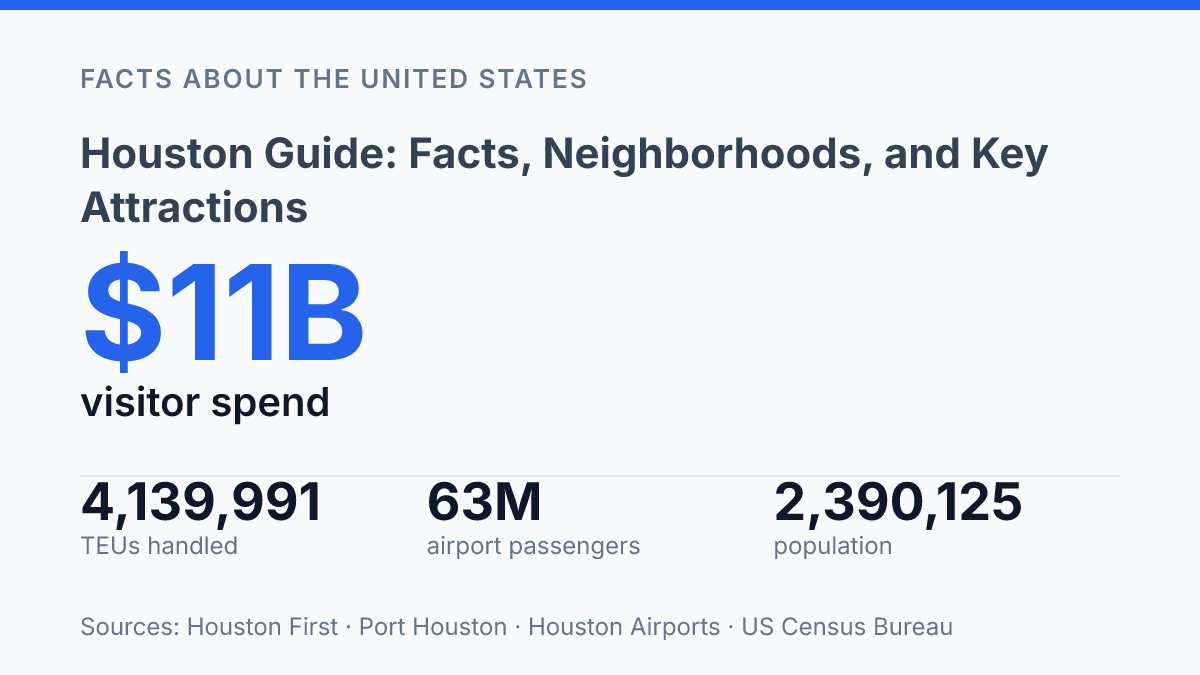
The city gained 43,217 residents in one year and reached 2,390,125 people on July 1, 2024, according to the U.S. Census Bureau.
That keeps Houston fourth in the country and first in Texas. But the sharper point is momentum: a city this large is still growing like a place with room to run. In my view, that’s what makes the number matter.
Why the city’s economy matters
More than half of all Texas seaport trade moves through one local gateway, a reminder that this city’s influence is measured in ships as much as skylines. According to the Texas Comptroller’s 2024 port profile, the Port of Houston handled 52% of all Texas seaport trade and supported a $171.1 billion GDP contribution. Its 2024 annual report also listed a record 53,066,219 tons handled, plus 4,139,991 TEUs, meaning containers crossed the 4 million mark for the first time.
The metro’s job engine rests on energy, health care, and aerospace, not a single boomtown bet. Energy still anchors engineering, refining, chemicals, and global trading.
Health care adds research, training, and specialized medicine at a scale few regions can match. Aerospace gives the economy federal depth and technical talent that don’t follow the same cycle as oil prices.
Space is not just a visitor attraction here. NASA’s Johnson Space Center runs Mission Control, trains astronauts, and remains central to U.S. human spaceflight, from International Space Station operations to the next generation of lunar missions. That role matters because it ties the metro to national science policy, defense-adjacent contracting, universities. A skilled workforce that reaches far beyond tourism.
The surprise is that this range creates both power and disorder. In my view, Houston’s strength is its range. That same mix makes the city less tidy than the usual success story.
Growth here comes with traffic, heat, and long commutes. The economy works because different sectors pull in different directions, but daily life can feel stretched by the same scale that makes the place rich.
Best places to see in the city
A single district packs 19 museums into a compact area. The city’s signature sights still refuse to behave like a neat downtown checklist.
the Houston Museum District gives visitors the clearest cultural starting point. Its strength isn’t one famous stop.
It’s the concentration: art, science, history, photography, and children’s exhibits sit close enough that you can compare very different institutions without crossing half the city. That density matters in a place where distance can shape the whole day.
Sports add a different kind of landmark. Minute Maid Park anchors the east side of downtown as the home of the Astros and one of the city’s most recognizable event venues. Even if you don’t catch a game, the ballpark’s location makes it part of the downtown experience rather than a detached suburban arena.
Green space is where the city surprises people. Hermann Park covers 445 acres near the central city, with shaded paths, gardens, a lake, and easy access to nearby cultural stops. It feels planned, not accidental. That’s a useful break in a city known more for highways and heat than picnic lawns.
The space center near Clear Lake belongs in the same conversation, even though it sits well outside the inner loop. Its 2024 Mission Impact report said it engaged over 1.2 million visitors and ranked No. 17 among the 20 most visited museums in the U.S. That number explains why it remains one of the region’s defining visitor stops.
Still, the best approach is selective. Pick a cultural cluster, a park, a game, or a space-focused trip based on what you actually care about. In my honest opinion, the city’s best stops are spread out, and that’s the catch; Houston rewards planning more than wandering.
Getting around and what catches visitors off guard
A cross-town errand can take longer than the flight that brought you in, especially if you trust the map more than the traffic pattern.
The METRORail is useful in the right corridor. It doesn’t cover the city the way rail systems do in denser places. METRO recorded 75,859,165 annual unlinked passenger trips and average weekday ridership of 239,034 in 2024, according to the Federal Transit Administration.
That sounds large. It is. Still, visitors should treat transit as one tool, not the whole plan.
In my humble opinion, Houston is easier to enjoy when you accept that cars still rule the day. That convenience comes with a tradeoff: the city can feel bigger than it looks on a map.
Rideshares, rental cars, and hotel location matter more here than in cities where you can improvise on foot. If you plan two or three stops in different areas, check drive times at the hour you’ll actually travel.
Weather catches people faster than distance. High summer heat and humidity don’t just make afternoons uncomfortable. They change how long you want to walk, how often you’ll need water, and whether an outdoor plan still feels smart after lunch.
Locals build shade, air-conditioning, and short hops into the day. You should too.
Heavy rain is the other surprise. Flooding risk is part of trip planning here because intense storms can turn underpasses, feeder roads, and low-lying streets into bad choices quickly. That doesn’t mean you need to panic. It means you should watch alerts, avoid driving through water, and leave room in the schedule when rain is in the forecast.
The local rhythm rewards flexibility. Dinner may be across a freeway.
A “nearby” stop may still need a car. And when the weather turns, the best plan is the one you can change without wrecking the day.
What the city’s scale should change about your plans
Treat the city as a set of distances, not a single downtown checklist. That one shift will save you time, money, and patience.
The next version of this place is already being written through airports, transit routes, park investments. The port. In 2024, Port Houston crossed 4 million TEUs for the first time at its public terminals.
That sounds like an industry stat. It tells you something bigger: movement defines the city.
That can be thrilling. It can also punish lazy planning.
Pick fewer areas, leave room between stops, and let the neighborhoods do more of the work than the checklist. In my honest opinion, the best Houston trip isn’t the fullest one. It’s the one that understands scale before scale starts pushing back.
Frequently Asked Questions
Q: What is Houston best known for?
A: Houston is best known for its energy industry, Texas Medical Center, and NASA’s Johnson Space Center. It’s a big city with serious economic weight. It doesn’t feel like a single-purpose place. That mix is what gives it real character.
Q: Which neighborhoods in Houston are best for first-time visitors?
A: Downtown, Midtown, Montrose. The Museum District are strong picks if you want easy access to major sights and good food. Downtown gives you the skyline and central transit; Montrose brings more independent spots and a looser feel. In my humble opinion, if you only have a short stay, Montrose usually gives you the best balance.
Q: How many days do you need to explore Houston?
A: Two to three days is enough for a solid first look at the city. You can cover a few museums, a neighborhood or two, and one major attraction without rushing too hard. More time helps, though, because Houston spreads out fast.
Q: What are the top things to do in Houston?
A: The Space Center, Museum District, Hermann Park. The Houston Zoo are the usual starting points. They give you a clean mix of science, culture, and outdoor space. The surprise is how much variety you get in one trip without sticking to one part of town.
Q: Is Houston easy to get around without a car?
A: Not really. You can use METRORail and buses for some areas, but Houston is built for driving, and distances can be long between major stops. If you want to see more than one neighborhood in a day, a car makes life much easier.