
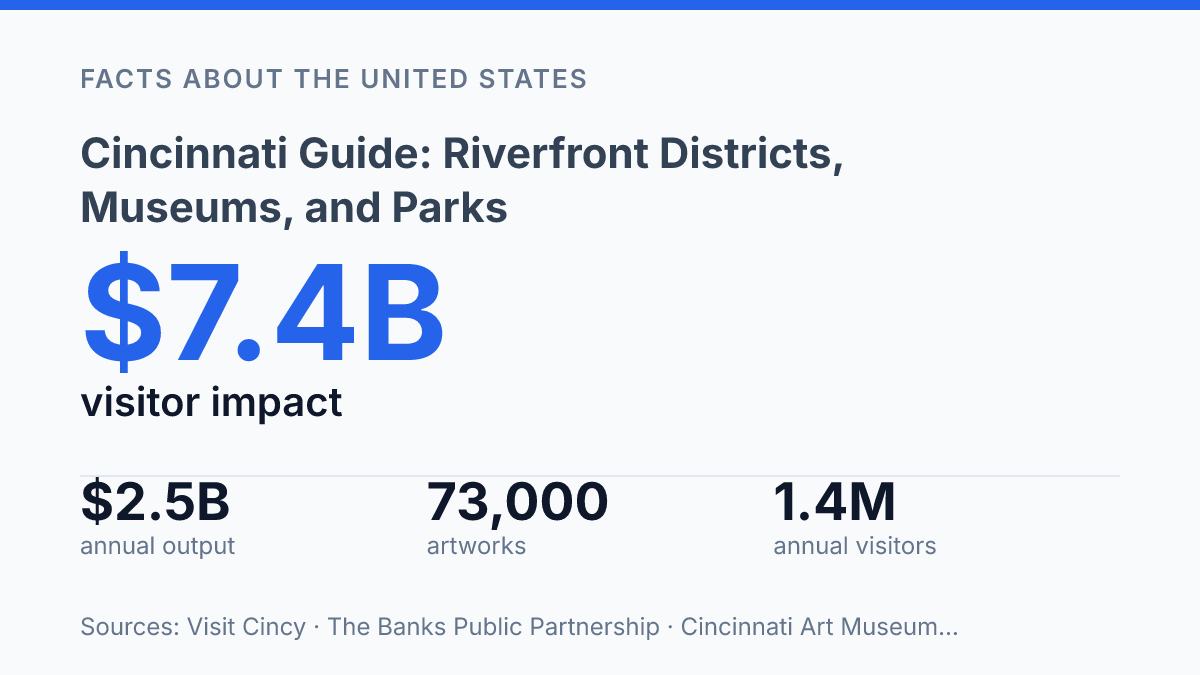
Cincinnati’s travel market is measured at county scale: Hamilton County’s visitor economy reached $7.4 billion in total economic impact, with $4.5 billion in direct visitor spending and support for 48,365 jobs. Those figures help explain why a guide to the city is also a guide to active reinvestment. The central riverfront is being reshaped around The Banks, where approved plans call for about 1,800 residential units and more than 140,000 square feet of retail and restaurant space.
North of downtown, Over-the-Rhine and Findlay Market show how historic fabric, food commerce, and housing growth now overlap within a 362-acre district. The city’s museums, zoo, parks, and hilltop art collection add a different scale: civic institutions that make the route between riverfront districts and neighborhood anchors more than a sightseeing circuit.
Cincinnati on the Ohio River
Few inland cities owe as much of their street pattern and economic orientation to a single watercourse as Cincinnati, whose downtown faces Kentucky across the Ohio River. The city sits in southwestern Ohio, at a point where river access historically made movement easier than travel across the surrounding hills. That setting helped make the riverfront the logical place for early landing points, warehouses, roads, and later rail connections, while upland areas developed with different levels of access and density.
The river’s value has always been practical as well as symbolic. As part of a navigable system linking the interior Midwest to the Mississippi River basin, the Ohio River connected the city to regional trade routes rather than leaving it dependent only on overland corridors. In that respect, the city belongs to a broader group of river-oriented places such as Louisville and Pittsburgh, where downtown form, industry, and transportation patterns also reflect the advantages and constraints of river valleys.
Topography helps explain why growth did not spread evenly outward from the waterfront. Flat land near the river supported concentrated commercial activity, while steep slopes and narrow valleys shaped where major routes could be built efficiently. This geography made some districts highly accessible and left others more separated by elevation, creek valleys, or limited crossings, a pattern still visible in the way central streets, bridges, and hillside neighborhoods relate to one another.
The modern riverfront remains an active development zone rather than only a historic edge. At The Banks, the central waterfront district between downtown and the river, existing activity generates about $2.5 billion in annual economic output, according to WCPO and The Banks Public Partnership. That figure shows how the river continues to function as an economic spine: it supports recreation and identity, but it also concentrates investment where land, visibility, and transport access converge.
Over-the-Rhine and Findlay Market
Few American urban districts pair preservation and reinvestment as visibly as Over-the-Rhine, a 362-acre neighborhood where 19th-century buildings remain central to both its identity and its visitor appeal. The district’s German-American heritage is still legible in its dense blocks, narrow storefronts, churches, brewery-related structures, and walkable street pattern. That preserved urban fabric gives the area a distinct character that differs from newer entertainment zones because the appeal rests as much on architecture and continuity as on individual businesses.
Within the district, Findlay Market functions as both a historic public market and a working food and craft destination. Its mix of produce vendors, prepared-food stalls, specialty shops, and maker-oriented retail helps explain why the market draws about 1.4 million visitors annually. Recent research also estimated its economic impact at $370,587,529 from 2021 to 2023, with $141,364,079 attributed to 2023 alone, showing that the market’s role extends beyond heritage tourism into measurable local commerce.
The same qualities that make the area attractive also shape current planning pressures. More than $1 billion has been invested in the district since revitalization efforts began in 2003, including more than $200 million in recent years, while the area around the market has seen over $505.4 million in capital investment across 53 projects. Those figures help explain renewed storefront activity and added housing, but they also point to recurring questions about congestion, commercial change, and neighborhood costs as historic districts become more intensely visited.
Tourism data places this neighborhood-level change within a wider economic context: Hamilton County’s visitor economy reached $7.4 billion in total economic impact, including $4.5 billion in direct visitor spending, a 2.7% year-over-year increase, and support for 48,365 jobs, according to Visit Cincy. For Over-the-Rhine and the market district, that broader demand helps sustain small vendors and restoration activity while intensifying the need to manage growth without weakening the historic character that draws visitors in the first place.
Major cultural sites worth seeing
Two of the city’s highest-profile cultural stops sit far enough apart that they reward planning by geography rather than by a single walking itinerary. Cincinnati Museum Center occupies Union Terminal, the art deco former rail station whose half-dome facade and rotunda make the building itself part of the visit. Inside, the institution combines a history museum, a museum of natural history and science, and a children’s museum, so it functions less like a single-gallery stop than a multi-part cultural complex suited to mixed-age groups and longer visits.
Union Terminal’s setting also changes the pace of a museum day. Rather than clustering with the most central riverfront sites, it sits west of the downtown core, which makes it practical to treat as a dedicated destination. That arrangement can be an advantage for visitors prioritizing indoor exhibits, since the center’s mix of local history, science displays, and child-focused spaces can absorb a substantial block of time without requiring multiple transfers between institutions.
North of the city center, Cincinnati Zoo & Botanical Garden serves a different role: part conservation institution, part botanical setting, and part family attraction. Its recent Elephant Trek expansion opened in fall 2024 as a five-acre habitat with a 22,000-square-foot elephant center, 1-million-gallon stormwater tanks, a 200,000-gallon elephant pool, and a 165 kW solar array on the elephant barn, according to the zoo’s 2025 annual report. Those details show how modern zoo projects increasingly combine animal care, visitor circulation, water management, and energy infrastructure rather than focusing only on exhibit space.
Taken together, these institutions show why the city’s cultural itinerary is best understood as a set of anchors rather than a compact museum row. The Museum Center is strongest for layered indoor programming in a landmark building, while the zoo rewards a separate north-side trip with outdoor grounds and large-scale habitat design. The distinction matters because the most efficient visit is usually organized around one major attraction at a time, not around trying to compress every cultural site into a single downtown route.
Cincinnati Art Museum and its collection
A collection of more than 73,000 works gives the Cincinnati Art Museum a scale unusual enough to make it one of the city’s major cultural institutions rather than a single-theme attraction. According to the museum’s own reporting, its holdings span 6,000 years, which places ancient objects, European and American painting, decorative arts, photography, fashion, design, and works from multiple global traditions within the same institutional frame. The result is a collection organized less around one school or period than around breadth across time, geography, and medium.
That range changes how the museum is best understood. Its value is not only in individual highlights, but in the ability to compare how different cultures and eras approached materials, representation, ritual, status, and everyday life. A visitor moving through the galleries may encounter objects separated by thousands of years and made for entirely different purposes, which gives the museum an educational role broader than a conventional fine-art showcase.
Breadth also creates a practical limit. A collection covering so many periods and regions cannot be absorbed evenly in one visit, so the strongest experience often comes from selecting a few galleries or themes rather than treating the museum as a checklist. The institution’s public-facing role is reinforced by programming as well: the Cincinnati Museum Association reported that Learning & Interpretation welcomed 56,805 visitors to 918 programs and tours in 2023–2024, showing that the collection is used not only for display but also for structured engagement with art history and visual culture.
Why the Investment Pattern Matters
The most useful way to read the city over the next several years is as a set of connected public choices, not a fixed itinerary. Riverfront lots, market-district housing, museum programming, and park access will shape whether recent spending produces only larger crowds or a more legible civic core.
The figures are large enough to attract attention, but their practical meaning will be found in smaller measures: how easy it is to move between districts, whether historic buildings retain active street life, and whether cultural institutions remain accessible as investment rises around them. The guide, then, is not only about where to go; it is a way to track how a river city turns capital projects into public value.
Frequently Asked Questions
Q: What is Cincinnati best known for?
A: Cincinnati is known for its setting on the Ohio River, its historic riverfront districts, and major cultural institutions. Over-the-Rhine is especially associated with 19th-century architecture and Findlay Market, which has food and craft vendors.
Q: Is Over-the-Rhine worth visiting in Cincinnati?
A: Over-the-Rhine is one of the city’s most notable districts because it combines preserved 19th-century architecture with a dense concentration of local businesses. Findlay Market is a central draw, especially for visitors interested in food, crafts, and neighborhood history.
Q: What museums are in Cincinnati?
A: The Cincinnati Museum Center includes history, science, and children’s museums inside the art deco Union Terminal. The Cincinnati Art Museum is another major stop, with works spanning 6,000 years.
Q: How far is the Cincinnati Zoo from downtown?
A: The Cincinnati Zoo & Botanical Garden is north of the city center and is often grouped with other major attractions in the area. Its location makes it accessible as part of a broader visit that includes downtown districts and nearby cultural sites.
Q: What can visitors do along the Cincinnati riverfront?
A: The riverfront is a key part of the city’s geography and helps shape how districts are connected. Visitors typically combine waterfront views with nearby museums, parks, and historic neighborhoods to make the most of a short stay.