
Boston counted an estimated 672,973 residents on July 1, 2025, yet its regional weight is better measured by the 5.03 million people in the Boston-Cambridge-Newton metro area in 2024. That contrast explains why a city with fewer than 700,000 residents can function as the political center of Massachusetts, a major New England employment hub, and one of the country’s most recognizable education and medical centers.
The city’s influence is also historical rather than only statistical: it was founded on Sept. 17, 1630, incorporated as a city in 1822, and later became home to milestones such as Boston Common, Boston Latin School, and the first U.S. subway. The most useful facts about the city connect these layers, showing how population, institutions, tourism, and history combine to give it a role larger than its municipal boundaries suggest.
Why Boston matters in Massachusetts and New England
A city of fewer than 700,000 residents can still set the political agenda for Massachusetts and anchor much of New England’s economy. Boston is the state capital and the largest municipality in Massachusetts, so its role is both institutional and practical: state government is centered there, while employers, universities, hospitals, media organizations, and arts institutions give the city reach beyond municipal boundaries. The city’s scale remains compact by national standards; according to the U.S. Census Bureau, 2026/V2025 data page, its July 1, 2025 population estimate was 672,973, slightly below the 2020 Census count of 675,647, a -0.8% change from the 2020 estimates base.
The Massachusetts capital functions as New England’s main economic and cultural center because it concentrates decision-making, specialized labor, and institutions that serve audiences across state lines. This regional role is not based only on population size; it comes from the combination of state government, professional services, higher education, health care, finance, publishing, research, and major cultural organizations. The result is a city whose influence is felt across a six-state region, even though New England contains several distinct metropolitan economies.
Compared with Providence, Hartford, and Portland, the Massachusetts capital has a broader mix of regional functions in one place. Providence has significant higher-education and medical institutions, Hartford remains closely associated with insurance, finance, and state government, and Portland serves as Maine’s principal urban economy and cultural center.
Those cities are not satellites; they shape their own states and specialized industries. The difference is that the Massachusetts capital combines more of these roles at once, making it the leading regional hub while still sharing New England’s economic and civic influence with other metros.
How many people live in the city and metro area?
The most common population mismatch is not an error: one figure counts a compact municipality, while the other counts a labor-market region of about five million people. Within the city limits, recent census data place the population at over 675,000 residents, a figure that reflects the municipality itself rather than the wider network of suburbs, satellite cities, and commuter communities around it.
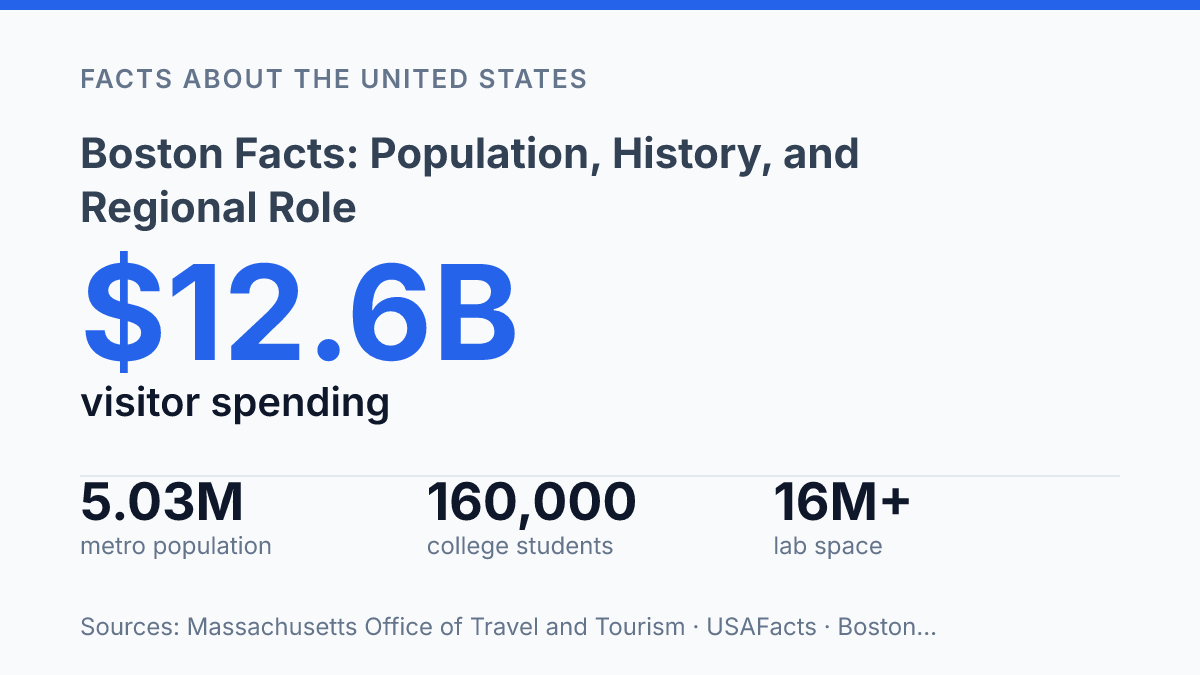
The broader scale appears in the metropolitan count. According to USAFacts, the Boston-Cambridge-Newton, MA-NH metropolitan area had 5.03 million residents in 2024, making it the 11th most populous metro area in the United States and equal to about 1.5% of the national population. That measure is designed to capture an integrated regional area, not just the political boundary of the central city.
This distinction explains why population figures for the same place can appear to differ sharply across sources. City-limit totals are useful for understanding municipal services, local elections, zoning, and neighborhood-level planning.
Metro-area totals better describe the region’s practical daily scale, including commuting patterns, shared housing markets, hospital and university catchment areas, airport use, and cultural attendance. The result is a city that is comparatively small on paper but anchors a much larger urban region in everyday activity.
What happened after its founding in 1630?
A settlement founded on the narrow Shawmut Peninsula became one of the main political pressure points of the British Atlantic within little more than a century. English colonists founded the settlement on Sept. 17, 1630, according to the city’s official timeline, and its sheltered harbor soon helped make it a significant colonial port. Maritime trade, religious institutions, printing, and town governance gave the town influence beyond its physical size, especially in a colony where local meetings and public argument carried unusual civic weight.
That colonial importance made the town a focal point in the imperial crisis that led to the American Revolution. Resistance to British taxation and military presence was not confined to one event; it developed through public meetings, pamphleteering, commercial protest, and confrontations around the harbor and civic buildings. Episodes remembered through the 1770 massacre near the Old State House, the 1773 destruction of taxed tea, and the 1775–1776 siege fixed the city’s revolutionary identity in national memory without requiring it to stand in for the whole war.
The Freedom Trail now makes that concentrated history visible as an urban route linking churches, meeting halls, burial grounds, and government sites associated with colonial and revolutionary life. Nearby open spaces and civic landmarks also show how early town planning left a durable imprint on the street pattern and public realm. The result is a city where historical interpretation is not limited to museums; it is embedded in ordinary movement through older neighborhoods.
This inherited identity is a cultural and tourism asset, but it also affects how the city changes. Preservation review, landmark protections, archaeological sensitivity, and public attachment to historic streetscapes can influence the scale, materials, and timing of new construction. That does not prevent development, but it means growth often has to be negotiated alongside the visible remains of the colonial and revolutionary city.
Main industries and institutions that shape the city
Education and medical institutions alone generate $69.5 billion in annual economic activity in the city, according to a 2025 regional Chamber of Commerce analysis. That activity supports more than 353,000 jobs and produces $35 billion in employee compensation, which helps explain why the local economy is often described through its “eds and meds” base. The effect reaches beyond payroll because hospitals, research centers, suppliers, laboratories, real estate firms, and professional services all connect to the same institutional system.
The wider metro area extends that system through universities with global research reputations, including Harvard University and MIT in Cambridge as well as major institutions within the city itself. Municipal planning data reported about 30 colleges and universities enrolling approximately 160,000 students in 2024, including about 94,000 students who also lived in the city. This concentration supplies employers with skilled graduates, supports research partnerships, and helps sustain demand for housing, transit, retail, and cultural activity.
Health care and biotechnology form the most visible applied-science side of the economy. Municipal business data citing CBRE reported more than 16 million square feet of commercial life-science lab space by the end of 2024, while companies in the city-Cambridge life-sciences cluster secured $55.9 billion in venture capital from 2019 to 2024. The Longwood Medical and Academic Area illustrates the scale of this ecosystem: its institutions employed 73,000 people, served more than 24,000 students, and received $1.3 billion in NIH funding in FY 2024.
Financial services and higher education also act as stabilizing anchors, with banking, asset management, insurance, university administration, and research operations providing high-skill employment across economic cycles. The same concentration that gives the area national influence also raises operating pressures, especially through high housing costs and expensive office or laboratory space. Those costs do not erase the region’s advantages, but they can shape hiring, expansion decisions, and the ability of younger workers and growing firms to remain near its core institutions.
Why the regional scale changes the answer
The clearest way to understand the city is to treat municipal data as only one layer of evidence. Population counts show the limits of the city proper, while spending, employment, student enrollment, medical research, and metro-area data show how influence spreads across Greater Boston and into New England.
That distinction matters for policy, business planning, housing debates, and transportation, because decisions made inside a compact capital city often depend on workers, patients, students, visitors, and companies located far beyond its legal borders. Future changes in lab space demand, university enrollment, and healthcare employment will likely explain more about the region’s direction than the city population figure alone.
Frequently Asked Questions
Q: What is Boston best known for?
A: Boston is known as the capital and most populous city of Massachusetts, and it plays a central role in New England’s economy and culture. Its long history, including a founding date of 1630, also makes it one of the oldest major cities in the United States.
Q: How many people live in Boston?
A: The city has a population of over 675,000 residents. That figure is much smaller than the greater metropolitan area, which is home to roughly 5 million people, showing how far Boston’s influence extends beyond the city proper.
Q: Why is Boston considered important in New England?
A: Boston serves as the economic and cultural hub of New England. Its size, institutional concentration, and regional connections give it a role that extends well beyond municipal boundaries.
Q: When was Boston founded?
A: Boston was founded in 1630. That early founding places it among the oldest continuously significant cities in the country and helps explain its deep historical importance.
Q: Is Boston the largest city in Massachusetts?
A: Yes. Boston is the capital and the most populous city in Massachusetts, so it holds both political and demographic prominence within the state. That combination helps explain why it is also a major regional center.