
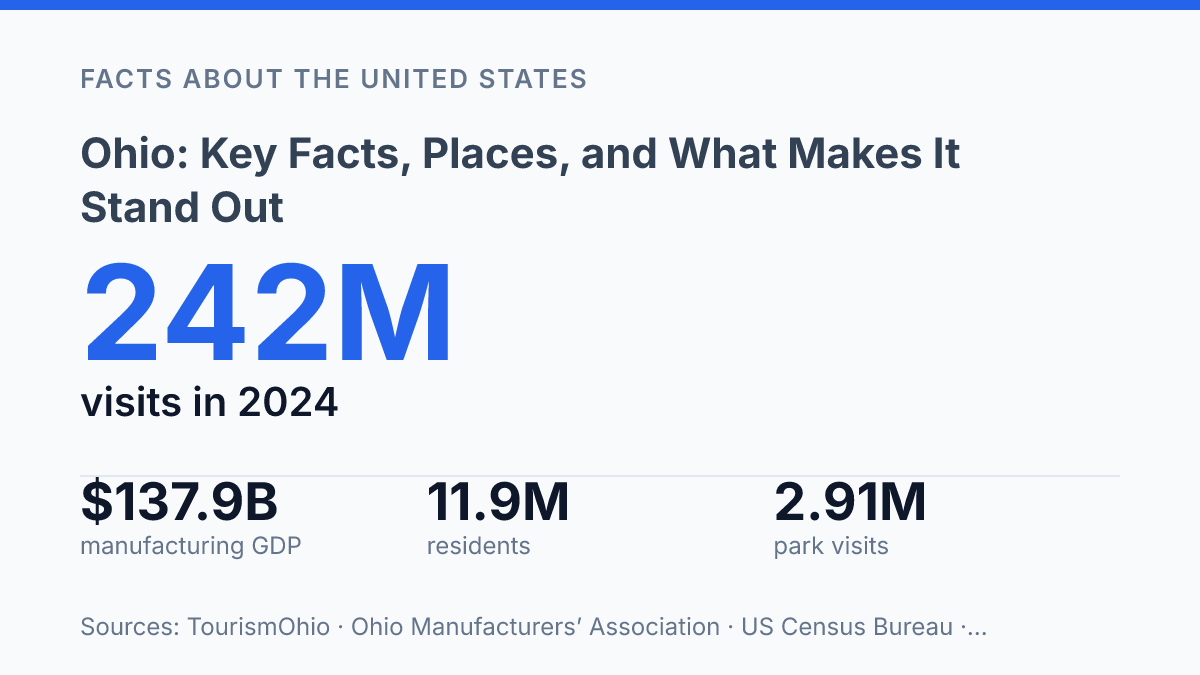
Ohio packs 11,900,510 residents into 40,858.76 square miles, yet its influence is easier to spot in ballots, factory output, exports, and visitor counts than in size alone. The state drew 242 million visits in 2024, produced $137.9 billion in manufacturing GDP, and still sent 5,851,387 ballots into the 2024 presidential count. That mix is the point: this isn’t just a Midwest state people pass through between coasts.
It’s a place where Cuyahoga Valley can rank among the country’s most-visited national parks, Cincinnati can lead major metro export totals in the state, and earthworks built roughly 2,000 to 1,600 years ago can gain UNESCO recognition. The facts tell a more textured story, from population and geography to politics, business, cities, landmarks, and the identity that ties them together.
Quick facts about Ohio’s size, people, and location
With 11,799,448 residents in the 2020 U.S. Census, Ohio had more people than Michigan, which counted about 10.1 million, but fewer than Pennsylvania, which topped 13 million. That puts the state in a middle position among its neighbors: not the largest in the region, but big enough that its economy, elections, roads, and cities carry real weight across the Midwest.
Its capital is Columbus, located near the center of the state and often treated as one of the main anchors of the Midwest. For a current snapshot, the state had 11,900,510 residents as of July 1, 2025, across 40,858.76 square miles of land, with about 288.8 people per square mile in 2020 census geography, according to U.S. Census Bureau, 2025 Ohio QuickFacts. In plain terms, that’s a fairly compact, heavily populated state rather than a wide-open one.
The state sits between the Great Lakes and the Appalachian region, which helps explain why it often feels connected to several parts of the country at once. It borders Pennsylvania to the east, West Virginia and Kentucky to the south, Indiana to the west, and Michigan to the northwest, with Lake Erie forming much of its northern edge. So while people sometimes treat it as flyover country, its location makes it more like a crossroads: close to major markets, neighboring several distinct regions, and tied directly to the Great Lakes through its northern shoreline.
Why Ohio matters in U.S. politics and business
For more than half a century, picking the state’s winner was close to picking the president: from 1964 through 2016, it backed the national winner every time. That streak covered the 2000s and 2010s, including the close Bush elections, the Obama wins, and Donald Trump’s 2016 victory, which is why national reporters treated it as a presidential bellwether state for so long. The pattern broke in 2020, but the state still draws attention because it remains a large, high-turnout prize; in 2024, it had 17 electoral votes and 5,851,387 ballots cast, according to the National Archives and the Secretary of State’s election data.
Business attention is just as justified. Manufacturing alone produced $137.9 billion in GDP in 2024, made up 16.5% of the private economy, ranked fifth nationally in output, and supported more than 687,000 jobs, according to 2025 data from the state manufacturers’ association. That base includes everything from autos and plastics to machinery and food products, with Honda’s large vehicle and powertrain operations anchored around Marysville and East Liberty serving as a clear example of how deeply production is tied into the state’s economy.
The corporate mix goes well beyond factory floors. Cincinnati is home to Procter & Gamble, one of the best-known consumer goods companies in the country, while aerospace, healthcare, and finance also carry real weight through employers such as GE Aerospace, major hospital systems, and large regional banks. The trade side is significant too: goods exports reached $55.9 billion in 2025, and Canada was the largest market at $17.5 billion, according to the Office of the U.S. Trade Representative.
Moving goods is part of the reason that mix works. The Port of Cleveland connects Great Lakes shipping with international routes, while the interstate network gives businesses multiple truck corridors across the state. I-70 is a key east-west route, and I-71 links three major urban markets from southwest to northeast, which helps explain why logistics, warehousing, and suppliers cluster along those corridors.
The catch is that this broad economy isn’t evenly felt everywhere. Like many Midwestern states, it has dealt with manufacturing job losses, older industrial communities trying to reinvent themselves, and political differences between metro areas and rural counties. That contrast is a big part of why the state keeps showing up in national conversations about work, trade, elections, and economic change.
Cities, landmarks, and places people actually visit
The state drew 242 million visits in 2024, according to TourismOhio and Tourism Economics, which says a lot about how many different kinds of trips fit into one place. Cleveland, Cincinnati, and Columbus are the cities most visitors hear about first, but they don’t feel interchangeable. Cleveland leans into lakefront culture, major museums, sports, and music history.
Cincinnati has a river-city feel, strong arts institutions, historic neighborhoods, and a food identity people actually talk about. Columbus brings a younger, fast-growing metro feel, with big university energy, galleries, restaurants, and easy access to surrounding suburbs and parks.
For a single attraction that’s become shorthand for the state’s pop-culture side, the Rock and Roll Hall of Fame in Cleveland is hard to miss. If you want rides instead of exhibits, Cedar Point in Sandusky is one of the country’s best-known amusement parks, especially for roller coaster fans. Hocking Hills State Park offers a completely different kind of draw: caves, cliffs, waterfalls, and wooded trails that make it one of the most recognizable outdoor escapes in the region.
The Lake Erie shoreline adds another layer, especially around places like Sandusky, Marblehead, Geneva-on-the-Lake, and the island communities reached by ferry. These spots are more about water views, small harbors, beaches, boating, and summer weekends than big-city sightseeing. They’re a reminder that the state’s northern edge isn’t just a map line; it shapes how many people vacation there.
Then there’s Amish Country in Holmes County, which feels separate from both the lake towns and the city attractions. Visitors go for rural scenery, furniture shops, bakeries, markets, and a slower pace, though it’s still a working community rather than a theme park. That contrast is really the useful takeaway: choose Cleveland, Cincinnati, or Columbus for urban culture, Sandusky for thrill rides, Hocking Hills for nature, and Holmes County when you want a quieter rural trip.
A short look at Ohio’s past and identity
The state’s best-known nickname comes from a tree nut that early residents thought looked like the eye of a deer. That’s why the Buckeye State label stuck: the buckeye tree was common in the region, and its glossy brown seed became a handy symbol for local identity, eventually turning into one of the state’s most recognizable cultural markers.
Statehood arrived in 1803, at a time when the young United States was pushing settlement and government authority westward beyond the original Atlantic states. Its location made it more than a place people passed through; it became a key part of the country’s early interior growth, linking older eastern communities with newer farms, towns, canals, and markets farther west.
That early role helps explain why so many national figures are tied to the state. Ulysses S. Grant, born in Point Pleasant, became the Union general most associated with victory in the Civil War and later served as president.
William Howard Taft, born in Cincinnati, remains the only person to have served as both U.S. president and chief justice of the United States. The Wright brothers are just as central to the story: their Dayton bicycle work and aviation experiments helped lead to powered flight, giving the state a lasting claim in the history of invention.
The identity isn’t only presidential or industrial, though. On September 19, 2023, the Hopewell Ceremonial Earthworks were inscribed by UNESCO as the state’s first World Heritage Site; the complexes were built roughly 2,000 to 1,600 years ago.
That recognition adds a much older layer to the story, showing that the place now known for factories, elections, sports, and cities also holds major Indigenous heritage. Its image has changed over time, but the common thread is influence: the state has repeatedly mattered beyond its own borders.
Why the state keeps punching above its size
Ohio makes the most sense when you treat it less like a single stereotype and more like a set of overlapping systems: a manufacturing base tied to Canada, metro economies with different strengths, public lands that pull millions of visitors, and ancient sites now carrying global recognition. That also means the state can look different depending on what you measure.
A political map, an export report, and a weekend travel plan won’t point you to the same places, but they all explain part of the same story. If you’re trying to understand the state, start by comparing the numbers with the places on the ground; the gap between them is where the useful picture appears.
Frequently Asked Questions
Q: What is Ohio best known for?
A: Ohio is known for its mix of big cities, manufacturing history, and major cultural landmarks. It’s also home to attractions like the Rock & Roll Hall of Fame and the National Museum of the U.S. Air Force, which draw visitors with very different interests.
Q: Is Ohio a good place to live?
A: That depends on what you’re looking for, but many people like Ohio for its relatively affordable cost of living and range of cities and suburbs. You can choose between fast-paced urban areas, quieter small towns, and plenty of places in between.
Q: What are the biggest cities in Ohio?
A: The largest cities include Columbus, Cleveland, and Cincinnati. Columbus is the state capital and has grown quickly, while Cleveland and Cincinnati each have their own strong cultural and sports identities.
Q: What kind of weather does Ohio have?
A: Ohio has four distinct seasons, with warm summers, cold winters, and changing spring and fall weather. Because it sits in the Midwest, conditions can shift pretty quickly, so locals usually keep an eye on the forecast.
Q: What can you do in Ohio for fun?
A: There’s a lot to do, from visiting museums and sports venues to exploring parks, lakes, and amusement attractions. If you like road trips, Ohio also works well because many of its top destinations are spread across the state and easy to combine into one trip.