
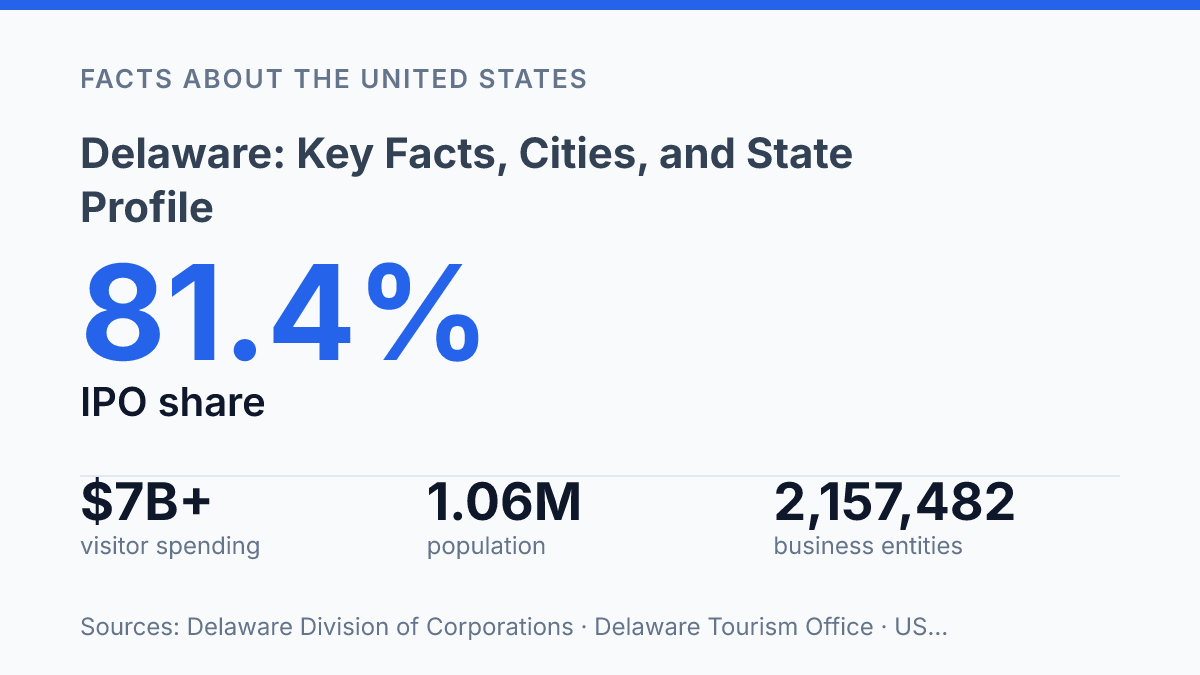
Delaware had 1,059,952 residents in 2025, yet its corporate registry counted more than 2.15 million business entities in 2024, a contrast that explains much of the state’s profile. Small population does not mean limited influence: New Castle County alone holds about 55.5% of residents, while Wilmington, Dover, and Newark form the main urban reference points for understanding settlement and services.
The state’s public identity also rests on unusually specific legal and fiscal choices, including no state or local sales tax and a corporate law system that drew 81.4% of U.S.-based IPOs in 2024. This profile looks at the state through population, cities, business rules, taxes, tourism, and historical markers, from the 1787 ratification vote in Dover to newer symbols such as the official state dinosaur.
Delaware at a Glance
Only Rhode Island covers less area than Delaware, yet the state sits between some of the country’s largest northeastern markets rather than on the geographic margins. The state is the second-smallest in the United States by area and is usually grouped with the Mid-Atlantic, a regional position that helps explain why its scale can be misleading. It borders Maryland to the south and west, Pennsylvania to the north, and New Jersey across the Delaware River, while its eastern side opens toward the Atlantic Ocean.
The state’s population reached 1,059,952 as of July 1, 2025, according to the U.S. Census Bureau, which also reported a 7.1% increase from the April 2020 estimates base and found that 21.8% of residents were age 65 or older. That places the state well above the threshold of a small-population state, even though its land area remains compact. The age profile also matters for interpreting later economic and community patterns, especially in coastal and retirement-oriented areas.
Water and borders shape the basic map as much as land size does. The Delaware River and nearby bay system connect the northern part of the state to the wider Philadelphia-area economy, while the Atlantic coast supports beach communities, tourism, and marine access. This combination of small territory, dense regional connections, and coastal exposure gives the state a profile that is more nationally significant than its physical footprint alone suggests.
Major Cities and Population Centers
More than half of the state’s residents live in a single northern county, which gives its urban map a distinctly uneven pattern. New Castle County had 588,026 residents in 2025, or 55.5% of the statewide population, according to U.S. Census Bureau QuickFacts. That concentration helps explain why the northern part of the state carries much of the demand for commuter infrastructure, higher-density housing, major employers, and higher education access.
Wilmington is the largest city, with 73,512 residents in the 2025 Census Bureau estimate, and it functions as the state’s main economic center. Its role extends beyond population size because major finance, legal, health care, and corporate services activity is concentrated there. The city anchors the northern employment market and connects closely with the broader Philadelphia metropolitan economy, which reinforces its importance relative to its modest municipal population.
Dover, with 40,592 residents in 2025, is smaller than Wilmington but carries the institutional weight of being the state capital. State government offices, legislative activity, courts, and administrative agencies give the city a role that is not measured by population alone. Its public-sector functions also support related employment in legal services, professional services, education, and local retail.
Newark had 30,359 residents in the same Census Bureau city estimates, and its identity is closely tied to the University of Delaware. The university makes Newark one of the state’s main education and research centers, with student housing, academic employment, and university-linked commercial activity shaping local development. This distinguishes Newark from both Wilmington’s business-centered profile and Dover’s government-centered profile.
The contrast between the urbanized north and more rural southern communities affects local priorities. Northern population centers face pressures associated with commuting corridors, redevelopment, and institutional growth, while southern areas tend to have different needs tied to agriculture, smaller towns, seasonal activity, and lower-density services.
Economy, Taxes, and Business Law
In 2024, 289,810 new business entities were formed through the state’s corporate registry, a scale that helps explain why corporate law is one of the state’s most visible exports. The state’s Division of Corporations reported 2,157,482 total business entities that year, surpassing the “more than 1.9 million” figure often cited in summaries of its corporate system. This does not mean those companies mainly employ workers or operate facilities inside the state; it means they have chosen it as their legal corporate home.
The core attraction is the Delaware General Corporation Law, a statute known for detailed corporate governance rules and frequent use by publicly traded companies. The state’s Court of Chancery is another major factor because it specializes in equity and corporate disputes, producing a large body of case law that business lawyers and boards can study when assessing risk. Companies such as Apple and Amazon, and Tesla for many years before shareholders approved a move to Texas that year, have favored Delaware incorporation because investors, directors, and attorneys are familiar with its rules, fiduciary-duty standards, and dispute-resolution structure.
Tax policy adds another layer, although it is not the whole explanation for the state’s incorporation appeal. Corporations doing business in the state face an 8.7% corporate income tax on allocated or apportioned federal taxable income, while the state and local sales tax rate is 0%, according to the Division of Revenue.
The corporate registry is also significant for public finances: the Division of Corporations generated $2.0065 billion in General Fund revenue in FY2024, including $1.8175 billion in net business entity taxes. The result is an economy shaped by legal domicile and fee revenue as well as by ordinary employment, production, retail activity, and services.
History, Symbols, and What Sets the State Apart
30 delegates, ten from each county, unanimously ratified the U.S. Constitution on December 7, 1787, giving the state the earliest place in the constitutional order, according to the state Public Archives. That act is the source of its best-known nickname, The First State, and it remains the clearest shorthand for why a small state holds an unusually prominent position in national memory.
Earlier colonial settlement gives that constitutional moment deeper context without requiring a long military chronology. Dutch settlers established Zwaanendael in 1631, and Swedish settlers founded Fort Christina in 1638 as part of New Sweden. Those early outposts placed the area within Atlantic colonial competition well before independence, and the three counties later belonged to the group that became the 13 original colonies and original states.
State symbols reinforce this identity by linking political precedence with local distinctiveness. The blue hen chicken, adopted as the official state bird in 1939, is associated with Revolutionary War-era militia lore and remains one of the most recognizable state emblems. More recently, Dryptosauridae was designated the official state dinosaur in 2022, showing how state symbolism can combine historical memory with natural-history identity.
The state’s distinctiveness is therefore layered rather than limited to a single fact. Its early constitutional role anchors its civic image, while its modern profile is also shaped by corporate identity and coastal visitation.
The latter is economically visible: visitor spending topped $7 billion in 2023, according to the state Tourism Office. Taken together, these elements explain why the state is known at once for constitutional firsts, compact historic identity, official symbols, and a shoreline economy that broadens its public image beyond law and government.
Why scale explains the state’s outsized role
Scale is the key to interpreting Delaware without underestimating it. A state with just over one million residents can still shape corporate governance, public revenue, tourism flows, and regional migration because its institutions are unusually concentrated and clearly defined.
The next question is not whether the state is small, but how that small scale will manage pressure from an older population, dependence on business-entity revenue, and continued growth in its northern county. Those forces make the state less a geographic footnote than a case study in how law, taxes, and location can give a compact jurisdiction national reach.
Frequently Asked Questions
Q: What is Delaware known for?
A: Delaware is known for being the first state to ratify the U.S. Constitution in 1787, which is why it is often called “The First State.” It is also widely associated with corporate registration because many U.S. companies are incorporated there. That combination gives the state a distinctive place in both American history and business law.
Q: What are the largest cities in Delaware?
A: The largest city in Delaware is Wilmington, followed by Dover and Newark. Wilmington is the main population and economic center, while Dover is the state capital. Newark is closely tied to higher education because it is home to the University of Delaware.
Q: Is Delaware a good place for businesses to incorporate?
A: Delaware is often chosen for incorporation because its corporate law is well established and the Court of Chancery specializes in business disputes. This legal framework provides predictability for many companies. The state’s small size and administrative system also make filings relatively straightforward.
Q: What is the capital of Delaware?
A: Dover is the capital of Delaware. It became the state capital in 1777 and remains the center of state government. While it is not the largest city, it plays the main administrative role in the state.
Q: How big is Delaware compared with other U.S. states?
A: Delaware is one of the smallest states in the United States by land area. Its compact size means that major cities, government institutions, and coastal areas are all within relatively short travel distances. That geography has shaped both settlement patterns and statewide connectivity.