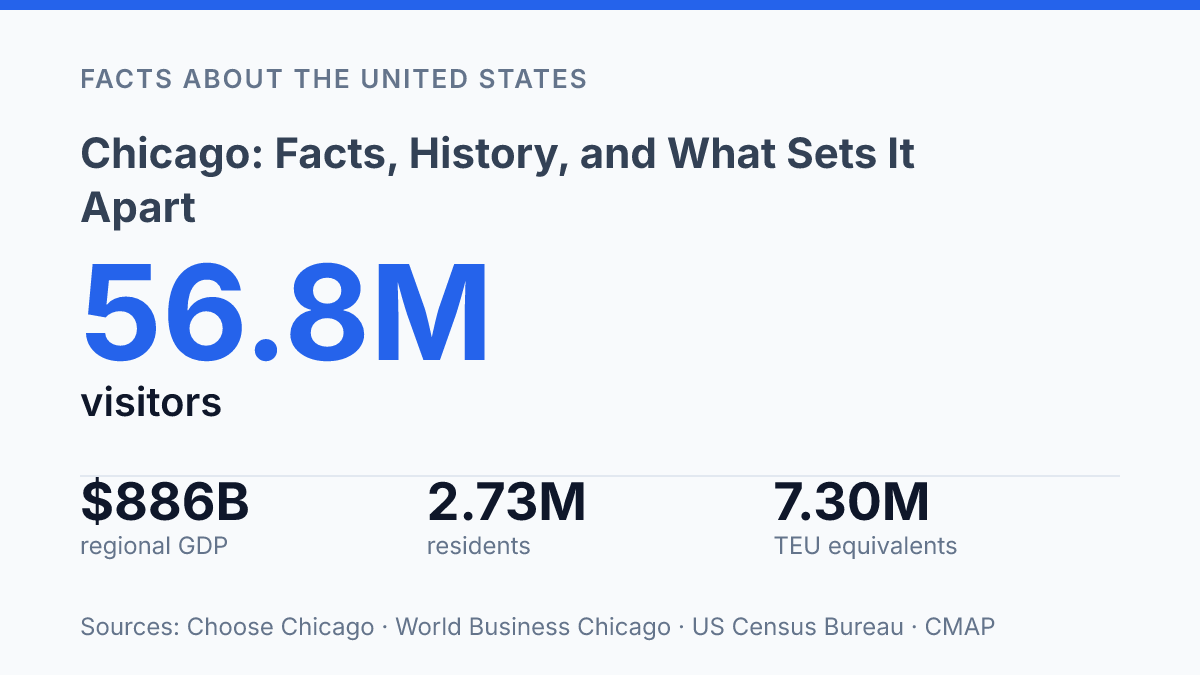
Chicago added more than 10,000 residents in a single year, reaching 2,731,585 people by July 1, 2025. The usual story still treats the city like a place stuck in old headlines.
That gap matters. This is a dense city on 227.73 square miles, with more than one in five residents born outside the U.S. It’s also a freight engine, a food capital. A sports town that can turn loyalty into civic identity. O’Hare alone handled $295 billion in trade in 2024.
The sharper question isn’t whether the city is big. It is. The question is why it keeps shaping the country after other places have claimed the spotlight. In my honest opinion, the lazy version of the city misses the point: its power sits in the mix of rail lines, neighborhoods, kitchens, teams, and money moving through the middle of America.
Chicago basics: location, size, and population
A city can feel walkable from the Loop and still sprawl far beyond what a first-time visitor expects. Chicago sits in northeastern Illinois on Lake Michigan, close enough to Milwaukee for a quick regional trip at about 90 miles, but far enough from St. Louis at about 280 miles to anchor its own corner of the Midwest.
Its 2020 census count was 2,693,976 residents. That made it the third-largest city in the United States, behind only New York and Los Angeles.
The ranking matters. The lived scale matters more: this is a dense city with a big-city population packed into a relatively tight grid.
The city covers about 234 square miles overall, with the Chicago River running through the downtown area and helping shape the Loop’s street-level geography. For a current yardstick, the city had 2,731,585 residents as of July 1, 2025, up from 2,721,308 in 2024, and 227.73 square miles of land area, according to U.S. Census Bureau QuickFacts. That gap between total area and land area is normal for a lakefront city, where water boundaries matter on the map.
The tricky part is perception. Downtown can feel compact, especially around the river, parks, offices, hotels, and transit stations. But the city limits stretch across a huge area of neighborhoods, industrial corridors, residential blocks, lakefront space, and inland streets. In my view, that contrast is one reason people underestimate it.
How the city grew into a national hub
A 96-mile canal made the city a shortcut between the Great Lakes and the Mississippi River system. When the Illinois and Michigan Canal opened in 1848, boats could move goods from eastern waters toward the Illinois River, then on to the Mississippi. That link pulled farm products, lumber, and people through the city instead of around it.
Then came the rails. They changed the scale. By the late 19th century, railroad companies used the city as the meeting point between western producers and eastern markets.
Grain moved in bulk. Meat moved through packinghouses. Manufactured goods moved out in every direction.
Meatpacking shows how practical the system became. The Union Stock Yard, opened in 1865, sat near rail connections and turned livestock shipment into a centralized business. The model was efficient, but harsh: the same network that fed national markets also concentrated dangerous, dirty work in industrial neighborhoods.
The Great Chicago Fire of 1871 should not be treated as a pause in this rise. It destroyed a large part of the built-up core. It also forced a reset at the exact moment money, labor, and rail access were already concentrating there. In my honest opinion, the rebuild matters more than the ruin.
Builders came back fast. Brick, stone, iron, and later steel replaced much of the older wood construction in the core. The same place that burned in 1871 emerged denser, better capitalized, and more disciplined about how business districts worked.
What people miss is the contrast. Disaster did not erase the hub.
It made investors rebuild the hub with stronger tools. Rail lines still converged there, so grain, meat, and manufactured goods kept moving through the city at national scale.
Food, sports, and the city’s public image
A hot dog with no ketchup has done more for the city’s image than most tourism campaigns.
Chicago-style hot dogs turn rules into identity: poppy-seed bun, yellow mustard, neon relish, onions, tomato, pickle spear, sport peppers, celery salt. The point isn’t just taste. It’s civic confidence in edible form.
Deep-dish pizza works differently. It sells excess, patience.
A little theatrical defiance, especially to visitors who expect a quick slice and get a fork-and-knife meal instead. Together, deep-dish and the dressed-up hot dog are less about novelty than branding.
Sports give that image a weekly rhythm. The Chicago Cubs at Wrigley Field represent memory, patience.
A ballpark that sells the city as much as the team. The Chicago Bulls at the United Center carry a sharper global charge, thanks to the Michael Jordan era and a red-and-black logo that still travels everywhere.
Downtown tourism adds the clean postcard version. Millennium Park and Cloud Gate pull crowds because they compress the city into one easy image: skyline, reflection, lakefront energy, and public art in a single stop. According to the city’s official tourism bureau, the city welcomed 56.8 million visitors in 2025, a number that shows the brand still has real force.
The postcard version of the city is all pizza, skyline views, and sports teams, but locals know the place is more complicated than its brand. In my humble opinion, that gap is exactly why it stays interesting. A slogan can’t hold the food scene, neighborhood loyalties, winter mood, and civic pride at once.
There’s also a serious dining reputation behind the comfort-food shorthand. The James Beard Awards were first hosted in the city in 2015 and are scheduled to remain through 2028, with more than 50 previous honorees based there, according to a James Beard Foundation announcement.
Deep-dish may get the jokes. The restaurant culture has national standing.
Why Chicago still matters to the U.S.
A shipment can leave a warehouse here and reach a quarter of Americans by truck in a day. That single fact explains why the city still matters more than its skyline suggests, according to the Facts Matter economic brief.
The region ties together six Class I railroads, 10 major interstates, two global airports. A freight network that still treats the Midwest as the country’s hinge.
O’Hare International Airport keeps that hinge moving at global scale. The airport handled 83.4 million passengers in 2023, placing it among the busiest airports in the world.
That isn’t just travel bragging rights. It means executives, cargo, conventions, students, and families move through the same hub that connects the interior of the country to the rest of the world.
Commerce here also runs through price, risk, and contracts. The Chicago Board of Trade anchors a long finance and commodities tradition built around grain, futures.
The practical needs of producers and buyers. In my view, that matters because the city didn’t become important by selling an image. It became important by solving hard problems of distance, storage, timing, and trust.
The surprise is that the old railroad logic never really disappeared. It changed form.
Containers replaced boxcars in many places, air cargo sped up the clock, and interstates stretched the same old map across asphalt. The region handled 7,304,898 TEU equivalents across area intermodal facilities in 2024, according to the regional planning agency, which shows how much freight still changes hands there before moving on.
Culture follows the same pattern: movement in, movement out. Comedy rooms, music clubs, universities, architecture firms, publishers, and neighborhood arts spaces keep feeding national conversations without needing to sit on either coast. The city is historic.
It doesn’t run like a museum. It runs like a transfer point for goods, money, people, and ideas.
What the city fixes next will matter far beyond Illinois
The next decade will test whether scale still pays when cities compete on speed, talent, and trust. The city has the bones for that fight: rail, airports, universities, food culture, lakefront land. A region that reaches 25% of Americans within a day’s drive.
But size won’t protect it from hard choices. Public safety, housing pressure, transit funding, and downtown recovery will decide how much of that advantage turns into daily life.
The James Beard Awards staying through 2028 says something larger than food. It says the country still comes here to measure taste, grit, and ambition. In my humble opinion, if you want to understand America’s next urban chapter, watch what this city fixes first.
Frequently Asked Questions
Q: Why is Chicago such a famous city?
A: Chicago stands out because it became a major hub for rail, shipping, finance, and architecture all at once. That mix gave it real influence far beyond the Midwest. In my view, what sets it apart is that it feels built to get things done, not just to be admired.
Q: What is Chicago best known for?
A: People know Chicago for its skyline, deep-dish pizza, blues, and strong neighborhood identity. But the city’s reputation is bigger than its landmarks… it’s also a place shaped by labor, migration, and reinvention. That combination gives it a sharper edge than many visitors expect.
Q: Is Chicago bigger than other major U.S. cities?
A: Chicago is one of the largest cities in the United States, but size isn’t the whole story. What matters more is how dense its transit, business, and cultural networks are. You feel that quickly when you move across the city.
Q: What should I know before visiting Chicago for the first time?
A: Plan for weather that can change fast, especially near the lake. The city can feel very different from one neighborhood to the next, and that’s part of the appeal. If you only stay downtown, you’ll miss the real range of the city.
Q: How did Chicago get its name?
A: The name comes from a Native word tied to wild onion or garlic plants that grew in the area. That detail matters because it points to a history that predates the modern city by a long stretch. The place had meaning long before it had towers. In my honest opinion, that history is one of the most overlooked parts of Chicago.