
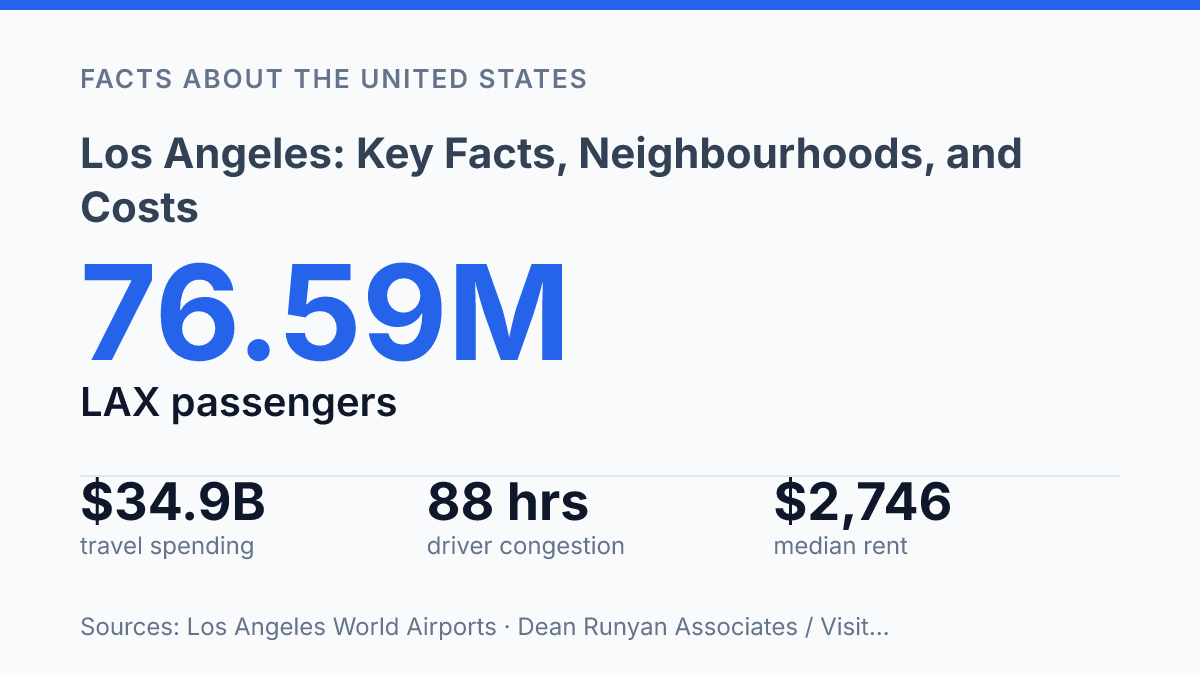
Los Angeles pulled in $34.9 billion in direct travel spending in 2024. The city most visitors meet first is a rental listing or a freeway delay.
That tension is the real story. LAX moved 76.59 million passengers in 2024. A person living in Venice may face a $5,500 median rent while someone in North Hollywood sees something closer to $2,997.
Same metro. Different math.
The pull is obvious: work, weather, beaches, film, food. A sense that a normal Tuesday can still feel loaded with possibility. In my honest opinion, the mistake is treating the city as one place.
This guide looks at the forces that shape daily life here: local identity, housing costs, heat, travel friction. The choices you need to make before a visit or a move.
Why Los Angeles pulls so many people in
A city of 3,878,704 residents can still feel like a supporting player next to the county it runs. According to the U.S. Census Bureau’s July 1, 2024 estimate, the city remains the second-largest municipality in the United States after New York City. It is also the county seat of Los Angeles County, a detail that matters more than it sounds when you look at courts, public agencies, transit decisions, and regional politics.
In my view, Los Angeles is famous for its image. The scale of its economy and logistics matters more than the postcards. Tourism alone shows the point: the area generated $34.9 billion in direct travel spending in 2024, up 3.0% from the year before, according to the Dean Runyan Associates / Visit California 2025 report.
That is not just hotel rooms and studio tours. It is restaurant payroll, convention work, ride-hail trips, museum admissions, and taxes that help fund public services.
The airport tells the same story with less glamour and more force. LAX handled 76.59 million passengers in 2024, according to the city airport agency’s 2025 Aviation Activity Analysis, and international traffic rose to 23.99 million. That makes the city more than a destination.
It is a transfer point, a business hub. A pressure valve for Southern California travel.
Still, size cuts both ways. The same scale that pulls workers, students, founders, artists, and visitors toward the city also makes basic decisions feel expensive and slow.
You can find opportunity here faster than in many places. You also meet the cost of that opportunity in rent, commute time, and competition for space.
Neighbourhoods that shape daily life
The same city can give you a rail ride to an office tower, a morning surf check, or a tourist crowd under a movie billboard before lunch. Downtown LA is the clearest example of the central-city version. It has office towers, courts, sports arenas, loft buildings, and some of the city’s best rail access packed into a small area.
Santa Monica works by a different clock. The ocean is the selling point.
The lifestyle feels easier on foot than much of LA. But that beach edge comes at a price: it can put you far from central jobs, eastside friends, or late-night plans that don’t line up with the E Line.
Hollywood sits between image and daily friction. Tourists see theatres, stars, and studio mythology. Residents deal with noise, older apartments, nightlife spillover.
A constant flow of visitors. The B Line gives it a direct rail link to Downtown, which helps. The famous name doesn’t make every errand simple.
Housing costs sharpen these differences fast. According to Redfin, the citywide median rent was $2,746 in August 2025, and nearby area medians swung much higher in places like Venice and Studio City. That gap matters more than a postcard view. In my honest opinion, the smartest way to judge an LA neighbourhood is not by its reputation, but by the weekly routes it forces on you.
Transit can make a neighbourhood feel smaller, but only along certain lines. The E Line links Santa Monica with the central city.
The B Line runs through Hollywood toward Downtown. Step outside those corridors, and daily life shifts back toward cars, ride-hailing, or long transfers.
That’s the core tradeoff. LA sells variety better than almost any city, but variety is not the same as convenience. The beach lifestyle and the central-city commute are two different versions of the place, and trying to have both every day can get expensive, slow, or both.
Weather, geography, and everyday tradeoffs
A dry 84°F afternoon can feel effortless until you remember the same air is drying out the hillsides around the basin. NOAA’s 1991–2020 Climate Normals for Los Angeles show average daily highs around 68°F in January and 84.4°F in August at the Downtown USC station.
That sounds mild on paper. On the ground, shade, tree cover, apartment insulation, and distance from the ocean decide how comfortable it feels.
The geography does a lot of quiet work. The Pacific cools coastal districts. The inland basin holds heat longer. The San Gabriel Mountains rise to the north and northeast, shaping wind, weather, and fire behavior.
A short drive can move you from marine air to dry foothills. That’s part of the appeal. It also means daily life changes block by block.
In my humble opinion, the weather is LA’s best sales pitch and its most misleading one. The same dry, sunny pattern that makes outdoor living easy also feeds water stress and fire danger. The LA County Climate Cost Study projects an average of 48.5 days above 90°F per year from 2024 through 2040.
That isn’t a beach-day statistic. It means more cooling costs, hotter bus stops, tougher workdays for outdoor crews, and more pressure on public infrastructure.
Fire risk isn’t theoretical here. On January 7, 2025, the Eaton and Palisades fires began during a destructive wind event; LA County later reported that the two fires burned 37,469 acres, destroyed 16,251 structures, and caused 31 confirmed deaths. The lesson is blunt: climate comfort and climate exposure come packaged together.
Sprawl adds another tradeoff. Longer distances make weather feel less like background and more like logistics. Heat changes when you run errands. Smoke can change school schedules.
A canyon road may be beautiful until wind, fire, or mud risk closes it. You don’t just live in the weather here. You plan around it.
What to know before you visit or move there
A free sunset at Griffith Observatory can sit inside a city where everyday expenses run 50% higher than the U.S. average, according to RentCafe’s cost-of-living index. Housing does most of the damage, but groceries, insurance, parking, and utilities add their own pressure.
A visitor can dodge some of that by staying fewer nights or choosing a cheaper base. A resident can’t negotiate with the same math every Monday.
Transportation looks simple on a map and feels different on a calendar. A ride on Metro costs $1.75. That fare includes two hours of free transfers when you use a TAP card.
That’s useful if your trip follows the rail network. But cross-town errands can still turn into a time tax. INRIX reported that local drivers lost 88 hours to congestion in 2024, equal to more than two full workweeks spent sitting in traffic.
Visiting and living here are two separate tests. If you’re staying near Griffith Observatory or Los Feliz, you can build a good trip around a few nearby meals, hikes, and rideshares. If you live there, the same location becomes a calculation about commute direction, street parking, rent increases, and how often you need to cross the basin.
In my view, Los Angeles rewards planning more than spontaneity, and that’s exactly why some people love it while others burn out fast. The city gives you more options than most places.
It rarely gives them to you all at once. The smart move is to choose a base around your real week, not your fantasy weekend.
Before you move, price the unglamorous stuff first: commute time, car insurance, parking, renter’s insurance, and cooling costs. Before you visit, group plans by area instead of chasing landmarks across the map. That one habit can save hours, money, and patience.
The test LA gives you before it lets you settle in
Treat LA less like a dream and more like a stress test with ocean views.
Before you book a lease or plan a packed week, run the ordinary numbers first. Test the commute at 5:30 p.m. Price the neighborhood, not the city. Check the heat exposure and fire history, especially after January 7, 2025, when the Eaton and Palisades fires turned risk into hard evidence.
The better move is not fear. It’s precision. 88 hours lost to traffic in a year is not trivia. It is time you never get back. In my humble opinion, LA rewards people who choose with discipline, not people who arrive with a mood board.
Frequently Asked Questions
Q: How expensive is it to live in Los Angeles?
A: Los Angeles is pricey, and housing takes the biggest bite out of your budget. Rent can swing hard by neighbourhood. The real shock is how quickly costs rise once you add parking, transport, and everyday basics. In my view, if you’re moving there, the rent number is only the start of the story.
Q: Which neighbourhoods in Los Angeles are best for first-time visitors?
A: Santa Monica, Downtown LA, and West Hollywood usually make the shortlist for first-time visitors. Each one gives you a very different trip, though… beach access, nightlife, or city energy. Pick based on what you want to do, not just the name on the map.
Q: Is Los Angeles walkable or do you need a car?
A: A car makes life much easier in Los Angeles. Some areas are walkable. The city is spread out and many trips take far longer than they look on a map. Transit exists. The tradeoff is time, transfers, and less flexibility.
Q: What is Los Angeles known for besides Hollywood?
A: Los Angeles is known for food, beaches, museums. A huge mix of communities. Hollywood gets the attention, but that’s only one part of the city’s identity. What people miss is how many neighbourhoods feel like separate cities.
Q: How many days do you need in Los Angeles?
A: Three to five days is enough for a solid first trip. That gives you time for a couple of neighbourhoods, one beach day. A few major sights without rushing. If you try to see everything, you’ll spend too much time in traffic and not enough time enjoying the city.