
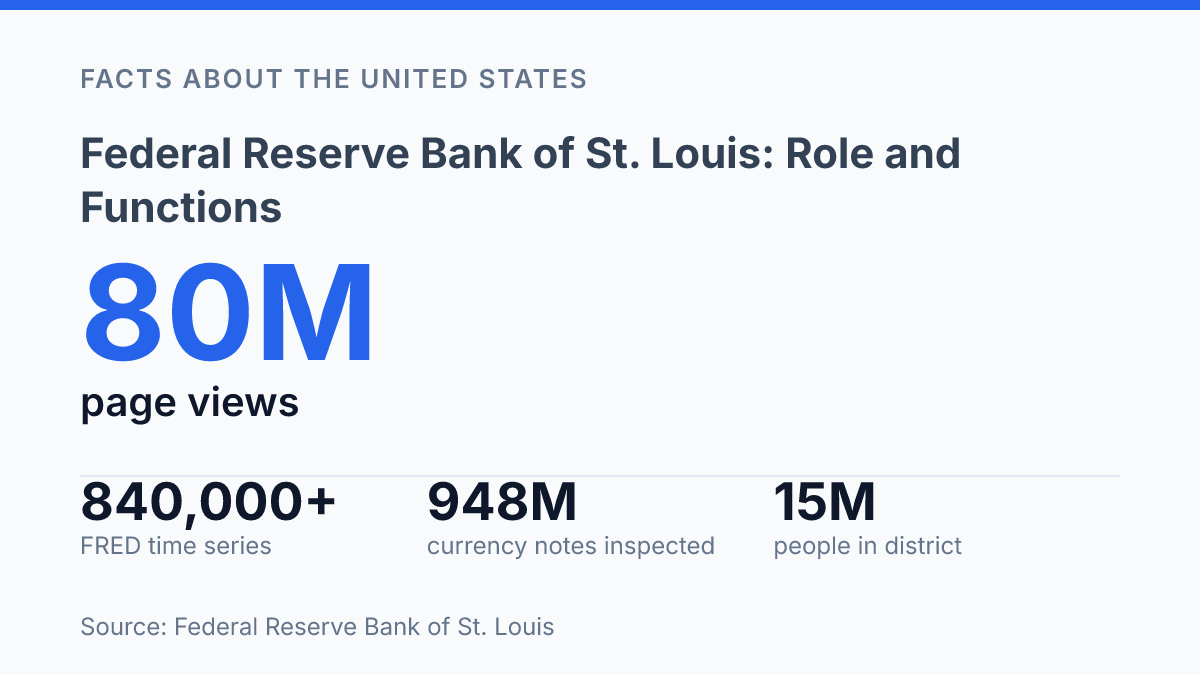
The Federal Reserve Bank of St. Louis operates at a scale that is easy to miss: its Eighth District covers about 15 million people across more than 180,000 square miles, yet its data tools reached users in 193 countries in 2025. That contrast explains why this regional Reserve Bank cannot be understood only as a local office of the central bank. It connects Arkansas, much of Missouri, and parts of five other states to the Federal Reserve System while also maintaining research and data services used worldwide.
Its work ranges from bank supervision and currency processing to public outreach, economic analysis, and Treasury operations. The result is an institution with two linked roles: gathering regional intelligence from Main Street and supplying evidence that helps shape wider understanding of the U.S. economy.
What the St. Louis Fed does inside the Federal Reserve System
One regional Reserve Bank can shape national policy discussions without having the power to set interest rates by itself. The Federal Reserve Bank of St. Louis is one of the 12 regional Reserve Banks in the Federal Reserve System, giving it a defined role in the nation’s central banking structure while keeping final interest-rate decisions at the system level rather than within any single district bank.
Its territory is the Eighth Federal Reserve District, which includes Arkansas and parts of Illinois, Indiana, Kentucky, Mississippi, Missouri, and Tennessee. According to the Federal Reserve Bank of St. Louis, 2025 Annual Report, the district covers about 15 million people and more than 180,000 square miles, spanning all of Arkansas, most of Missouri, and portions of Illinois, Indiana, Kentucky, Tennessee, and Mississippi, with branch locations in Little Rock, Louisville, and Memphis. That scale matters because the bank’s regional intelligence is drawn from economies that include metropolitan labor markets, agricultural areas, manufacturing centers, and community banking networks.
Within the Fed’s broader structure, the St. Louis Fed supports monetary policy by collecting regional information, producing economic analysis, and contributing to the policy process through its president and research staff. Its influence is analytical and institutional, not unilateral: decisions on the federal funds rate are made by the Federal Open Market Committee, whose voting structure combines the Board of Governors in Washington with Reserve Bank presidents on a rotating basis.
The bank also carries out core central-bank operations that are less visible than policy debates but central to the functioning of the financial system. These include supervising and examining certain banks and holding companies, supporting payment services, distributing and processing currency, and acting as a fiscal agent for the U.S. Treasury. In 2025, those responsibilities sat alongside public-facing research and regional outreach, linking national central-bank objectives with local economic conditions across the Eighth District.
How the Eighth District is organized and served
A single District label covers river ports, agricultural counties, auto-supply communities, college towns, and metropolitan labor markets that can move in different economic directions at the same time. The Eighth Federal Reserve District is administered from the main office in St. Louis and includes all of Arkansas, most of Missouri, and portions of Illinois, Indiana, Kentucky, Mississippi, and Tennessee. Its branch offices in Louisville, Memphis, and Little Rock give the Bank a local presence across major sections of that territory rather than concentrating regional contact in one city.
That structure matters because District boundaries are administrative, not economic equalizers. Conditions in western Kentucky manufacturing, eastern Arkansas agriculture, southern Indiana employment, and the St. Louis metropolitan service economy may differ sharply in the same reporting period. A district-wide indicator can therefore be useful for scale, but it can also conceal local stress or strength unless it is supplemented by business contacts, community outreach, and county-level information.
The St. Louis Fed’s regional intelligence system is designed to reduce that problem. According to its 2025 Annual Report, the Bank was guided by a nine-member independent board of directors and supported by six specialized advisory councils, giving it formal channels for private-sector, community, and financial-sector perspectives. Staff also reached more than 30,000 people through over 1,700 engagements and connected with stakeholders across 100 counties, which indicates that economic information is gathered through repeated local contact as well as published data.
This local information helps translate regional conditions into the Federal Reserve’s broader decision-making process. Reports from business leaders, bankers, workers, educators, and community organizations can highlight changes in prices, hiring, credit availability, housing, or investment before those shifts appear clearly in aggregate data. The District’s branch network and advisory structure therefore serve a practical function: they help ensure that national policy discussions are informed by conditions in smaller markets as well as major metropolitan centers.
Research, data, and economic publications from the bank
In 2025, the bank’s economic research content, including FRED and FRASER, drew 80 million page views from users in 193 countries, according to its annual report. That reach reflects a role that extends well beyond regional analysis: the research division produces public-facing data, interpretation, and scholarship used by economists, journalists, educators, market analysts, and policymakers seeking consistent economic evidence.
FRED, the Federal Reserve Economic Data database, is the bank’s best-known public data platform. The service brings together U.S. and international time series from public, private, national, and international sources, allowing users to track indicators across monetary policy, prices, employment, output, finance, trade, and related fields.
In 2025, the bank reported adding 15,000 data series, bringing the database to more than 840,000 time series from 118 sources. The scale matters because it reduces the friction involved in comparing data that would otherwise be scattered across many agencies and institutions.
The bank’s research agenda also covers core economic questions such as inflation, labor markets, household conditions, financial developments, and regional economic trends. These subjects are not abstract categories for the institution; they connect national indicators with the conditions observed across communities, industries, and credit markets. Research on inflation can clarify price pressures and expectations, while labor market analysis can distinguish between broad employment shifts and more localized changes in participation, wages, or hiring.
Publication formats help translate that research into different levels of detail. Charts and short economic summaries are often used to explain a timely indicator or trend in a concise format, while working papers give researchers space to test methods, present evidence, and circulate findings before formal publication.
This visibility should not be confused with direct policy authority. The bank’s publications can inform debate and improve public understanding, but they are explanatory and analytical products rather than individual policy votes.
Why this regional bank matters to the public
FRED turns a central-bank research function into a public resource: economic data that might otherwise sit across separate agencies, statistical releases, and archives can be compared in one place without a paywall. That access supports transparency because outside researchers, journalists, teachers, students, and market participants can inspect many of the same public data series used in economic analysis rather than relying only on summaries. Open data does not make interpretation automatic, but it makes claims about inflation, employment, output, and financial conditions easier to check against source material.
Public research from the bank serves a similar transparency function when it separates evidence from policy authority. Staff analysis can explain how economic indicators are moving, how regional conditions differ from national averages, or why a data series is difficult to read in real time.
Yet those publications are inputs to public understanding, not substitutes for Federal Reserve decisions. Monetary policy still depends on System-wide deliberation, incoming data, risk assessment, and judgment under uncertainty.
The bank’s public value also extends into economic education. Through official economic education resources such as Econ Lowdown, Page One Economics, and teacher-focused classroom materials, the St. Louis institution supports financial literacy and economics instruction beyond professional research audiences. These programs matter because central banking decisions are often discussed through technical language, while public understanding depends on more basic concepts such as interest, inflation, credit, saving, and opportunity cost.
Community-facing work connects regional evidence to the national policy context without making the regional bank independent of the broader System. Local contacts, outreach programs, and community development research can identify conditions that aggregate national figures may blur, such as differences in credit access, labor-market stress, or household financial resilience. In that sense, the regional role is not to speak for the entire economy on its own, but to add grounded information to a national framework.
Operational responsibilities also affect public trust in less visible ways. According to the bank’s 2025 Annual Report, it supervised institutions holding $377 billion in District banking assets and processed nearly 15 million U.S. government transactions as a fiscal agent for the Treasury. Those functions are not as publicly visible as research portals or education programs, but they support the financial infrastructure behind payments, banking oversight, and government accounting.
Where regional evidence meets national policy
The St. Louis Fed’s public value will likely depend less on visibility than on translation: turning county-level business conditions, bank exam findings, payment operations, and hundreds of thousands of data series into signals that can be trusted by policymakers, lenders, researchers, and households. That task is becoming harder as local economies diverge and federal data users expect faster, cleaner, more comparable information.
The practical consequence is that a regional Reserve Bank is not only a branch of a national system. It is also a measurement institution, and the quality of that measurement affects how clearly financial stress, labor shifts, inflation pressure, and credit conditions can be seen before they become national problems.
Frequently Asked Questions
Q: What does the Federal Reserve Bank of St. Louis do?
A: The Federal Reserve Bank of St. Louis is one of the 12 regional Reserve Banks in the U.S. Federal Reserve System. It helps carry out monetary policy, supervises some banks, and provides financial services to depository institutions and the U.S. government. It also supports economic research and public data access through its publications and databases.
Q: Which states are served by the St. Louis Fed?
A: The Federal Reserve Bank of St. Louis serves the Eighth Federal Reserve District. That district includes all of Arkansas and portions of Illinois, Indiana, Kentucky, Mississippi, Missouri, and Tennessee. Its regional structure helps the Federal Reserve gather information from different parts of the economy.
Q: How does the St. Louis Fed support economic research?
A: The bank is known for its research staff and its data resources, especially the FRED database. These tools help economists, policymakers, and the public track inflation, employment, interest rates, and other indicators. The research function matters because it informs policy discussions with regional and national evidence.
Q: Is the Federal Reserve Bank of St. Louis a government agency?
A: It is part of the Federal Reserve System, which is the central bank of the United States, but it is not a typical federal agency. Reserve Banks have a public mission and are overseen within a national system, while also operating with a degree of regional structure. This design helps balance national policy with local economic information.
Q: Why is the St. Louis Fed often cited in economic discussions?
A: The Federal Reserve Bank of St. Louis is frequently cited because its data tools are widely used and easy to access. FRED has become a common source for time series data on major U.S. and global indicators. That makes the bank a reference point for researchers, journalists, and analysts who need reliable economic data.