
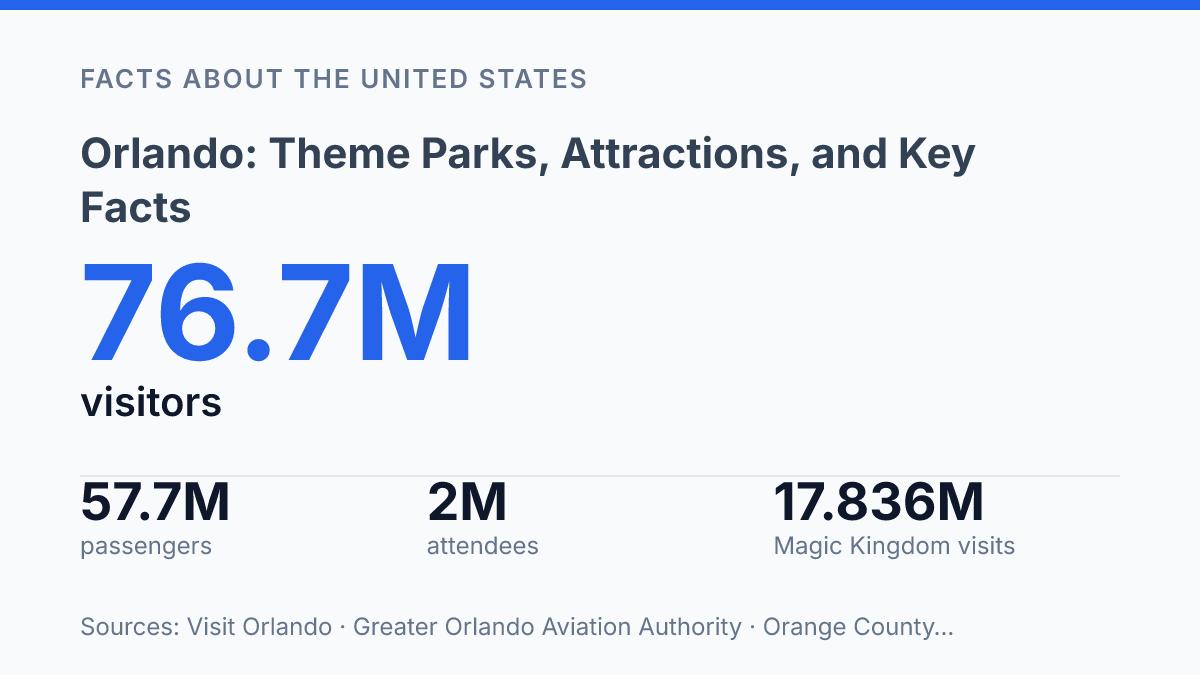
Orlando welcomed 76.7 million visitors in 2025, a record that makes its tourism scale closer to a national system than a single-city getaway. Visit Orlando reported that 70.3 million of those visitors were domestic and 6.34 million were international, while the airport handled 57.7 million passengers and rose to seventh among U.S. airports for traffic. Those figures help explain why the destination cannot be understood only through vacation imagery.
Walt Disney World remains a foundational anchor, with four theme parks and more than 25 resort hotels, but Universal’s Epic Universe opened in 2025 as the area’s first major new theme park in 25 years. The same market also supports convention travel, Michelin-recognized restaurants, and year-round leisure demand. The article traces how these parts connect, from headline parks to the wider visitor economy that keeps the region busy.
Why Orlando draws millions of visitors
Orlando welcomed 76.7 million visitors in 2025, up 1.8% from 2024, with 70.3 million domestic travelers and 6.34 million international travelers, according to the destination’s tourism association. The reported mix, 81% domestic leisure, 10% domestic business, and 8% international, shows that the city’s visitor economy is broad but still heavily weighted toward leisure travel within the United States.
The central Florida city is home to more than a dozen theme parks, giving it a concentration of ticketed entertainment that few destinations can match. That density matters because large-scale theme park travel does not operate as a single attraction visit; it supports multi-day itineraries, hotel demand, airport traffic, restaurant spending, retail activity, and transportation services across the wider metro area.
This concentration also explains why the city’s public image is so closely tied to tourism demand. A destination with many major parks can attract repeat visitors by combining familiar brands, seasonal events, new rides, and resort stays into return trips rather than one-time vacations. The same dependence creates a clear qualification: the city’s national reputation is unusually connected to the performance of leisure travel, so shifts in household spending, air access, international visitation, or convention-linked travel can have an outsized effect on how the destination is perceived.
Walt Disney World and its major parks
Walt Disney World Resort is not a single theme park but a multi-park destination whose scale is central to both its appeal and the complexity of planning a visit. Disney Experiences’ FY25 fact sheet identifies the resort, opened on October 1, 1971, as having 4 theme parks and more than 25 resort hotels. That combination makes it the leading attraction complex associated with the city, not merely because of its brand recognition but because it bundles parks, lodging, dining, transport, and recreation into one resort system.
Magic Kingdom remains the best-known park within the complex, organized around classic Disney lands and anchored by Cinderella Castle. EPCOT provides a different core experience, mixing international pavilions, seasonal festivals, and attractions built around technology, culture, and popular Disney properties. The two parks illustrate why the resort is hard to describe as one type of destination: one emphasizes fairy-tale iconography and family rides, while the other is more closely tied to exhibitions, food events, and large-scale themed environments.
Other major components broaden the resort beyond those two flagship parks. Disney’s Hollywood Studios and Disney’s Animal Kingdom add film-based attractions, live entertainment, wildlife exhibits, and immersive themed areas, while the water parks give the resort a recreation-focused format alongside the gated theme parks.
According to the TEA Global Experience Index 2024, Magic Kingdom recorded 17.836 million visits and EPCOT recorded 12.133 million, evidence that the resort’s core parks continue to operate at a scale few attractions can match. The same scale, however, requires choices about ticket types, travel time between areas, and whether a trip should prioritize rides, shows, dining, hotels, or water-park time.
Universal Orlando and the Wizarding World of Harry Potter
A single train ride is what turns Universal’s Harry Potter offering from two themed lands into a two-park itinerary. Universal Orlando Resort is the other major resort complex shaping the area’s theme-park identity, anchored by Universal Studios Florida and Universal Islands of Adventure. The two parks have distinct layouts and attraction mixes, but the Harry Potter areas are deliberately connected across that boundary rather than contained in one gate.
Universal Studios Florida includes Diagon Alley, while Islands of Adventure includes Hogsmeade. According to the resort’s 2026 materials, the Hogwarts Express links the first two Wizarding World lands for Park-to-Park guests, meaning the full experience depends on admission that allows movement between both parks. That structure makes the themed area more than a set of rides: it turns park access itself into part of the itinerary, especially for visitors who want to travel between King’s Cross Station and Hogsmeade Station as part of the story world.
The resort has continued to expand its role as a destination rather than a single-day add-on. Universal Epic Universe opened on May 22, 2025, and Universal described it as the first major theme park to open in the city in 25 years. Its arrival broadened the resort’s overall pull, while the established two-park Harry Potter layout remains central to how many visitors plan time at Universal Studios Florida and Islands of Adventure.
This split model is the key planning distinction within the resort’s best-known franchise area. The Wizarding World of Harry Potter does not function as one self-contained zone inside one park; it is divided between two major parks, with a themed transport link that rewards access to both. That arrangement gives Universal a strong second anchor in the destination’s theme-park market without requiring a ride-by-ride comparison to explain its importance.
What Orlando offers beyond the headline parks
A convention center drawing roughly 2 million attendees in a year shows that the area’s visitor economy is not built only around rides, shows, and castle skylines. The Orange County Convention Center reported 184 events in fiscal year 2024–2025, according to its annual report, making meetings and trade shows a significant part of the destination’s travel mix. That matters because convention travel supports hotel, restaurant, transport, and entertainment demand outside the peak rhythms of family vacation planning.
Even within themed entertainment, the inventory extends well beyond the two best-known resort complexes: the city has more than a dozen theme parks in total. Water parks, animal-focused attractions, dinner entertainment, indoor experiences, and smaller family venues help fill half-days, rest days, and repeat visits. These attractions usually function as supporting pieces rather than replacements for the largest resorts, but they broaden the itinerary options that make longer stays practical.
Dining has become another visible part of the area’s tourism identity. The 2025 MICHELIN Guide Florida added 11 new local restaurants, including the destination’s first Two-MICHELIN-Star restaurant, and listed 15 Bib Gourmand restaurants. For leisure travelers, that expands the trip beyond park reservations; for business and convention visitors, it gives the area more reasons to remain competitive as a meetings destination.
Air access also reinforces the broader market. Greater Orlando Aviation Authority data reported 57,669,226 passengers at Orlando International Airport in 2025, with the airport moving from ninth to seventh among U.S. airports for passenger traffic. High passenger volume does not create attractions by itself, but it makes the region easier to sell as a multi-purpose destination: large resorts, secondary attractions, conventions, dining, and short-break travel can all draw from a wide domestic and international catchment.
What the visitor numbers now imply
The next question is not whether the destination can attract crowds, but how its growth changes expectations. A place that combines a 57.7 million-passenger airport, record visitation, a major new Universal park, Disney’s mature resort base, and a convention center with about 2 million annual attendees is no longer operating on a single tourism cycle.
Leisure, meetings, dining, and international travel now reinforce one another, which makes planning more sensitive to season, event calendars, hotel location, and transport. The practical consequence is clear: the best experience depends less on seeing every headline attraction and more on matching the trip to the region’s scale.
Frequently Asked Questions
Q: What is Orlando best known for?
A: Orlando is best known for its large concentration of theme parks and family-oriented attractions. The city’s strongest association is with Walt Disney World, which anchors its tourism profile and includes multiple parks and water parks. This concentration makes the city a major destination for leisure travel in central Florida.
Q: How many theme parks are in Orlando?
A: The city is home to more than a dozen theme parks. That number reflects a broader mix of major resort parks and smaller attractions rather than a single compact district. It helps explain why Orlando functions as one of the most park-dense destinations in the United States.
Q: What parks are part of Walt Disney World in Orlando?
A: Walt Disney World includes major parks such as Magic Kingdom and Epcot, along with water parks. The resort is a multi-park complex rather than a single attraction, which is why many visitors plan several days around it. Its scale is one reason Orlando draws repeat visitation.
Q: What does Universal Orlando include?
A: Universal Orlando includes Universal Studios and Islands of Adventure. The resort is also home to the Wizarding World of Harry Potter, which is spread across both parks. That setup encourages visitors to move between parks to experience the full themed area.
Q: Is Orlando only about theme parks?
A: No. While theme parks are the city’s main draw, Orlando is a city in central Florida with a broader visitor economy and urban infrastructure. The park cluster is the most visible part of its identity, but the city’s role extends beyond that single sector.