
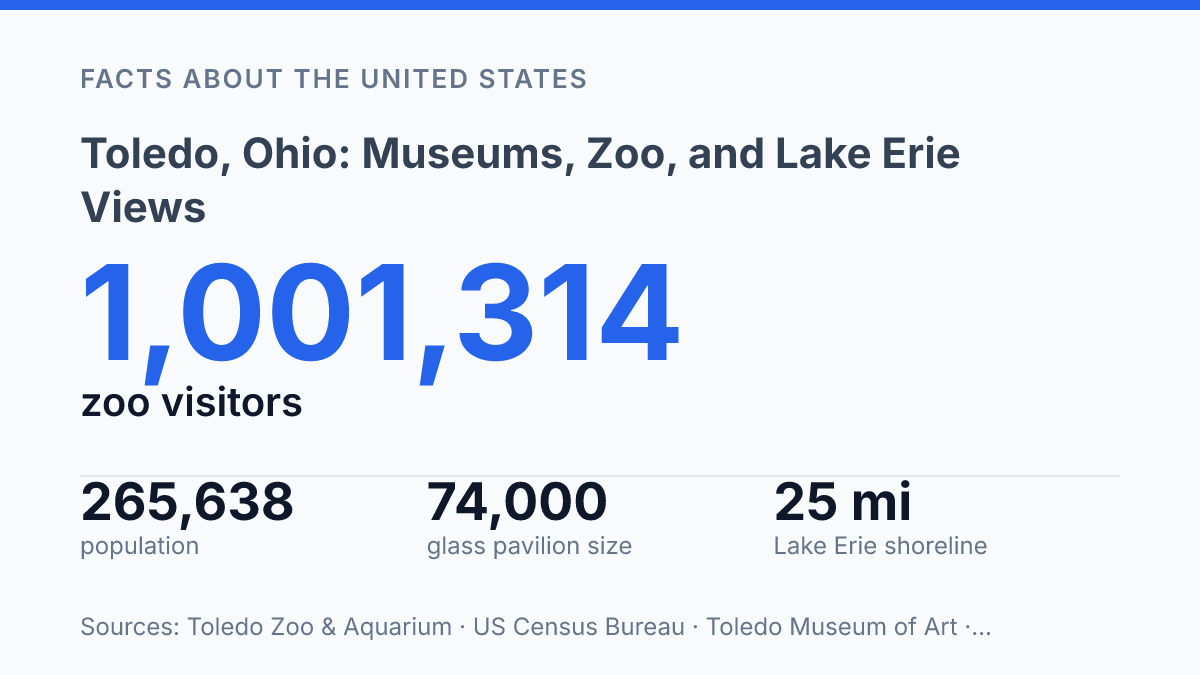
Toledo sits where an inland manufacturing city meets the western Lake Erie coast, a position that gives its museums, science center, and zoo a stronger regional role than population alone suggests. The Lucas County seat had an estimated 265,638 residents on July 1, 2024, yet its visitor infrastructure reaches far beyond city limits. Geography helps explain that pull: the city covers about 84 square miles in northwest Ohio, near Michigan, Wood County, and Maumee Bay, within Ohio’s westernmost coastal county.
The cultural map is just as concrete. The art museum’s 74,000-square-foot Glass Pavilion holds more than 5,000 glass works, Imagination Station drew more than 6,000 people for its 2024 eclipse event, and the zoo reported more than 1 million visitors in 2025. Those numbers frame the city as both a Lake Erie gateway and a compact cultural destination.
Where Toledo sits in northwest Ohio
At the western tip of Lake Erie, the Maumee River gives the city two orientations at once: outward to the Great Lakes and inland into northwest Ohio. That geography explains why its waterfront identity is not limited to lake views; the river corridor also connects the urban core with inland transport routes, agricultural areas, and industrial districts that developed away from the shoreline.
The city is the county seat of Lucas County in northwestern Ohio, about 75 miles east of the Ohio-Indiana border, covering 84 square miles and bordering Lake Erie to the east, Michigan to the north, and Wood County to the south, according to the City of Toledo. Those boundaries place it at a practical meeting point between Ohio, Michigan, and the western Lake Erie basin rather than on an isolated lakefront edge.
Regional significance also reflects political and economic history. The name Toledo Strip recalls the 1835–36 boundary dispute between Ohio and Michigan over a narrow band of territory that included the city’s future site, a conflict that underscored the value of access to the Maumee River mouth and western Lake Erie. Later industrial growth reinforced the same geographic logic: lake shipping, river access, rail connections, and nearby markets helped make the area a manufacturing and distribution center.
The result is a city whose setting can be read in two ways. Its Lake Erie position supports coastal recreation, port activity, and wetland-rich surroundings near Maumee Bay, while its inland-facing river and transportation network explain the heavier industrial and commercial character that shaped much of its urban form.
Toledo Museum of Art and the Glass Pavilion
A glass building on the museum campus turns the city’s industrial identity into part of the art experience. The Toledo Museum of Art is known for a broad collection that includes both Renaissance works and modern art, giving the institution a range that extends across centuries without relying on a single period or style. That breadth helps explain why the museum functions as one of the city’s principal cultural attractions rather than only a specialized gallery.
The Glass Pavilion gives that role a more local dimension. Opened in 2006, the 74,000-square-foot structure houses more than 5,000 glass works spanning ancient to contemporary art, according to the museum. The collection connects global glassmaking traditions with the city’s long association with glass production, so the pavilion is not simply an annex for decorative objects; it is a place where art history and local manufacturing history meet.
Architecture is part of the draw as well as the collection itself. The pavilion’s transparent design makes glass both the subject and the setting, creating a distinct visitor experience from the museum’s fine-art galleries. In that sense, the institution’s appeal rests on two linked strengths: major works of art inside the main museum and a purpose-built space where material, design, and civic identity are closely aligned.
Hands-on science at Imagination Station
A children’s science museum that drew more than 6,000 people to a solar-eclipse watch party shows how family learning can function as a civic attraction rather than a classroom add-on. According to Imagination Station, its “Totality Awesome” event on April 8, 2024 brought science enthusiasts from the local region as well as from other states and countries, making astronomy a public, participatory event rather than a distant subject.
Set on the Maumee River, Imagination Station is a children’s science museum built around hands-on exhibits and active learning. Its appeal is practical: visitors are encouraged to touch, test, build, observe, and repeat, which suits younger learners who often understand science most clearly through cause and effect. That format also makes the museum useful for school groups, because exhibits can reinforce classroom topics through direct interaction rather than passive viewing.
The museum’s programming extends that approach beyond its permanent exhibit floor. Live-style public events, interactive STEM activities, and themed science experiences give families and students a reason to return for specific topics, from physics demonstrations to space-related learning.
Its access policies also support a family audience: the museum lists standard adult admission at $22, free Saturday admission for local children, and Museums for All admission at $3 for up to seven people receiving SNAP or WIC benefits. In that sense, the institution adds a different cultural function to the city, emphasizing experimentation, affordability, and youth engagement over formal collection-based display.
What the Toledo Zoo adds to the city
More than 1,001,314 visits in 2025 make the Toledo Zoo & Aquarium a scale-setting attraction rather than a secondary stop on a city itinerary. The zoo’s annual report breaks that figure into 885,722 daytime visitors, 103,513 after-hours visitors, and 12,079 Wild Wellness Walkers, showing that the site functions as both a traditional animal park and a year-round recreation venue. Its visitor mix also explains its day-trip role: 61% of visitors came from Ohio, 32% from Michigan, and 1% from Indiana, according to the same report.
The zoo’s appeal rests partly on signature features that distinguish it from a generic family outing. Polar bears remain among its best-known animals, while rides and seasonal amusements give families reasons to build longer visits around more than exhibit viewing. The aquarium broadens that experience by adding aquatic habitats to the zoo’s land-animal collections, creating a wider range of environments in one destination.
That leisure function sits alongside a clear educational role. Animal habitats, keeper talks, and aquarium displays give visitors direct exposure to species behavior, adaptation, and conservation themes in a setting that is accessible to children and multigenerational groups. The zoo’s named Wild Toledo program extends that role beyond the grounds by focusing on native wildlife and habitat work, connecting public-facing exhibits with regional conservation practice.
This combination helps explain why the zoo is one of the city’s major family attractions and a common reason for short trips into the area. It offers the familiar strengths of a large zoo, including charismatic mammals, rides, and special events, but it also adds structured learning through animal care, aquatic exhibits, and conservation messaging. In the broader city profile, it supplies the outdoor, family-centered counterpart to the area’s indoor cultural and science institutions.
Why the visitor draw depends on more than the attractions
A smaller population base does not necessarily mean a smaller civic footprint. The city’s major attractions function as shared regional infrastructure, serving local families, school groups, day trippers, and visitors from nearby states in different ways. That mix matters because cultural value is not measured only by admission counts; it also shows up in access policies, education programs, seasonal events, and repeat local use.
The next useful question for the city is not whether these institutions attract attention, but how well transit, waterfront planning, and neighborhood connections can turn that attention into longer stays and broader economic benefit. The strongest signal is practical: the museums, science center, and zoo already draw people in, and the surrounding city determines how much of that visit becomes a fuller experience.
Frequently Asked Questions
Q: What is Toledo best known for visiting?
A: Toledo is known for its mix of cultural and family attractions, especially the Toledo Museum of Art, the Imagination Station, and the Toledo Zoo. Its setting at the western tip of Lake Erie also makes waterfront views part of the appeal. That combination gives the city a strong draw for short trips that combine museums and outdoor scenery.
Q: Is the Toledo Museum of Art worth seeing?
A: The Toledo Museum of Art is one of the city’s main attractions, with a large collection that includes modern and Renaissance work. Its Glass Pavilion is especially notable because it displays thousands of glass works, reflecting Toledo’s glassmaking history. The museum is a strong choice for visitors interested in art and local heritage.
Q: What can families do near the Maumee River in Toledo?
A: The Imagination Station is the main family-focused stop by the Maumee River. It is a children’s science museum with hands-on exhibits, which makes it suited to interactive learning rather than passive viewing. The location also places it close to other downtown attractions.
Q: What animals and attractions are at the Toledo Zoo?
A: The Toledo Zoo includes polar bears, an aquarium, and rides, which makes it broader than a standard animal exhibit. That mix gives it appeal for both younger visitors and adults interested in a full-day outing. Its variety is one reason it remains one of the city’s most visited attractions.
Q: Does Toledo offer views of Lake Erie?
A: Yes, Toledo sits at the western tip of Lake Erie, so lake access is part of the city’s geography and visitor experience. Those views add a scenic contrast to the museums and zoo that define many itineraries. The waterfront setting is a meaningful part of what shapes a visit to the city.