
Pittsburgh is defined by a measurable river fact: at the Point, the Allegheny River supplies 60% of the Ohio River’s flow and feeds a navigation system extending 70 miles through eight locks and dams. That geography helps explain why the city’s story is larger than its steel-era reputation. River transport, Gilded Age wealth, museum-building, professional sports, and trail-based recreation all meet along a compact urban corridor.
The same civic pattern appears in places as different as Phipps Conservatory, opened in 1893 from Henry W. Phipps’s $100,000 gift, and PNC Park, where right-center field runs 456 feet toward the Allegheny River. This article examines how location, industrial philanthropy, North Shore attractions, and riverfront investment combine to shape a city whose past remains unusually visible in its present use.
Where the city sits and why the rivers matter
At The Point, the Allegheny and Monongahela become the Ohio, giving Pittsburgh a location that functioned less like an edge of Pennsylvania than a gateway into the interior of the continent. The city sits in western Pennsylvania within Allegheny County, where steep hills, river valleys, and a narrow downtown triangle concentrate movement into a relatively small core. That geography explains why the river junction mattered for settlement: it offered access in three directions while also creating a defensible and commercially useful meeting place.
The confluence supported trade because river movement could connect local production with wider markets before rail and highway systems dominated inland transport. According to the U.S. Maritime Administration, the Allegheny River contributes 60% of the Ohio River’s flow at the city, drains an 11,747-square-mile watershed, and supports 70 miles of navigation from The Point through eight locks and dams. Those figures show that the rivers are not merely local scenery; they are part of an engineered and commercial water system with regional reach.
Industrial expansion followed the same logic of access. Heavy materials could move along river corridors, and flat land near the water became especially valuable for mills, warehouses, rail connections, and later road infrastructure.
The result was an urban form shaped by opportunity and constraint at the same time: riverfront access helped the city grow, but the surrounding slopes and converging waterways limited easy outward expansion from the core. This is why the central city feels compact despite its broad regional influence, with bridges, river crossings, and valley routes doing much of the work that a simple street grid might perform elsewhere.
Gilded Age sites tied to industrial growth
A city best known for heavy industry used part of that wealth to build institutions whose collections now rank among its most durable civic assets. The Carnegie Museum of Natural History, founded in 1895, reflects the Gilded Age belief that scientific knowledge could be gathered, classified, and displayed as a public good. It now cares for 22 million scientific specimens and objects, according to the Carnegie Museum of Natural History, a scale that links industrial-era ambition to an ongoing research and education mission.
The Carnegie Museum of Art expresses the same pattern through culture rather than science. Backed by the philanthropy of Andrew Carnegie, the museum grew from the idea that an industrial capital should also possess serious artistic institutions.
Its holdings now exceed 100,000 objects across paintings, sculpture, photographs, architectural material, design, and digital media, according to the Carnegie Museum of Art. That breadth matters because it shows how private industrial fortunes helped create public collections broad enough to outlast the social world that first funded them.
Phipps Conservatory and Botanical Gardens offers a more visibly Gilded Age form of civic display. Henry W. Phipps gave the city a $100,000 glasshouse with nine display rooms, completed in August 1893 and opened on December 7, 1893, according to the conservatory’s history. The building’s glass-and-garden setting presented refinement, science, and leisure as part of the same public project, making it more than an ornamental landmark.
These institutions are rooted in the fortunes generated when the city stood as an early-20th-century industrial capital, but their current role is not limited to commemorating elite donors. Museums, conservatories, and collections have become shared cultural infrastructure: places for education, research, preservation, tourism, and public gathering. Their significance lies in that transition from industrial patronage to civic access, where wealth created the buildings and collections, but public use continues to define their value.
North Shore attractions and modern identity
A museum expansion plan calling for a 40,000-square-foot performance and event venue makes the North Shore as much a current civic project as a sightseeing stop. The Andy Warhol Museum anchors that cultural role, linking the neighborhood to one of the city’s most internationally recognized artists while also supporting new public-facing development. According to the 2026 Tourism Development Plan progress page, the museum’s Pop District plan includes a six-square-block public art initiative and an institution supporting nearly 100 on-site jobs, which frames the area as an active cultural district rather than a static museum quarter.
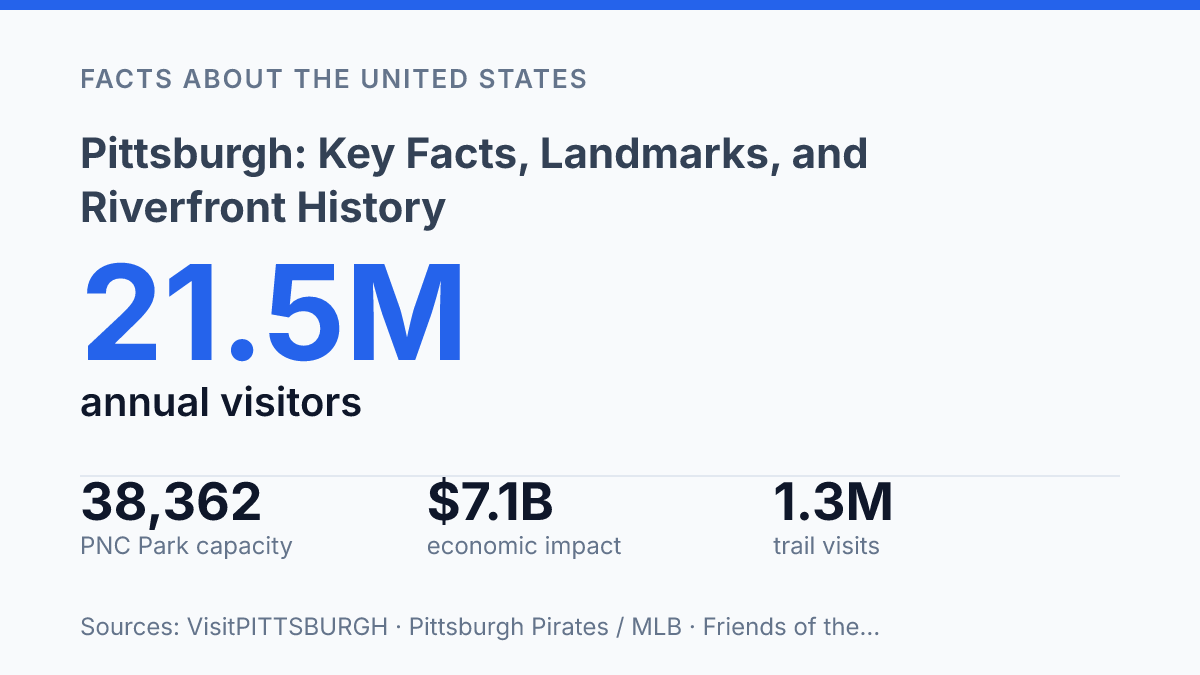
Sports give the same neighborhood a different kind of civic visibility. Heinz Field, now known as Acrisure Stadium, serves as the city’s football stadium, while PNC Park is its baseball stadium and one of the most place-specific venues on the waterfront. MLB’s PNC Park facts page lists a capacity of 38,362 and notes that the ballpark cost $262 million including land acquisition, details that show how professional sports facilities became major pieces of North Shore redevelopment rather than isolated entertainment buildings.
The area’s visitor appeal also depends on everyday movement through its public spaces. The 33-plus-mile Three Rivers Heritage Trail drew an estimated 1.3 million visits in 2023 and generated $26.5 million in total regional economic impact, according to Friends of the Riverfront. That figure helps explain why the North Shore functions as more than a stadium district: it connects art, events, walking and cycling, and game-day crowds into a shared urban corridor.
This mix gives the neighborhood a modern identity that differs from a preserved historic district. Civic memory is present through place names, public art, and long-standing sports loyalties, but the North Shore is shaped just as strongly by current programming, construction, tourism, and large gatherings. Its significance lies in that overlap, where cultural branding and public recreation meet the practical demands of a working visitor destination.
What these places reveal about the city’s character
The clearest through-line is that assets created or shaped by industry now help sell a post-industrial visitor economy. The older museums and conservatory reflect an era when manufacturing fortunes were converted into public culture, while the newer waterfront attractions show a later effort to make river edges work as places for events, sports, art, and recreation. The contrast is chronological rather than oppositional: both sets of places translate economic capacity into a public-facing identity.
That combination has measurable branding value. According to VisitPITTSBURGH, Allegheny County welcomed an estimated 21.5 million visitors in 2025 and generated an estimated $7.1 billion in economic impact; business events and sports teams booked 291 events tied to $433.5 million in anticipated direct visitor spending.
Cultural landmarks help give the destination depth beyond a single event, while stadiums create recurring reasons for regional and national attention. Together, they support tourism not by presenting one simplified story, but by linking heritage, entertainment, and riverfront visibility.
This is why the city’s image is often described through reinvention without fully leaving the industrial story behind. The inherited institutions keep philanthropy, collecting, science, and art connected to the era of industrial wealth, while the riverfront venues and public spaces present a more contemporary civic brand. The result is an identity built from adaptation: older capital and infrastructure remain visible, but they are increasingly interpreted through culture, sports, and visitor activity rather than production alone.
Why the riverfront keeps shaping the city
The city’s next chapter is likely to depend less on preserving individual landmarks in isolation than on keeping connections between them legible and accessible. Allegheny County’s estimated 21.5 million visitors in 2025 and $7.1 billion in economic impact show that history, sports, trails, and cultural institutions now function as a shared civic economy.
That creates a practical test for Pittsburgh: whether riverfront development can add new activity without weakening the public character that makes these places distinctive. The most revealing measure may not be a single museum attendance count or stadium figure, but whether the rivers remain a common route through the city’s industrial memory and current public life.
Frequently Asked Questions
Q: What rivers meet in Pittsburgh?
A: Pittsburgh sits at the junction of three rivers: the Allegheny, Monongahela, and Ohio. This meeting point helped shape the city’s growth as a transportation and industrial hub. The river confluence also remains a defining feature of the city’s geography and public riverfronts.
Q: Why is Pittsburgh historically important?
A: Pittsburgh became an early-20th-century industrial capital, and that period still shapes its built environment. The city’s Gilded Age institutions reflect the wealth and civic investment generated during industrial expansion. That history is visible in its museums, conservatories, and other preserved landmarks.
Q: What are the main historic landmarks in Pittsburgh?
A: The Carnegie Museum of Natural History, the Carnegie Museum of Art, and Phipps Conservatory and Botanical Gardens are among the city’s best-known Gilded Age sites. These institutions are closely tied to Pittsburgh’s industrial-era growth and philanthropic legacy. They are also major cultural attractions in the city today.
Q: What is there to see on Pittsburgh’s North Shore?
A: The North Shore combines cultural and sports attractions along the riverfront. It is home to the Andy Warhol Museum, Heinz Field, and PNC Park. That mix makes the area one of the city’s most visited districts for both arts and stadium events.
Q: Is Pittsburgh a good city for riverfront attractions?
A: Yes. Pittsburgh’s riverfront setting gives it a strong concentration of parks, museums, and stadiums along the waterways. The city’s three-river junction makes the waterfront central to both its history and its modern visitor experience.