
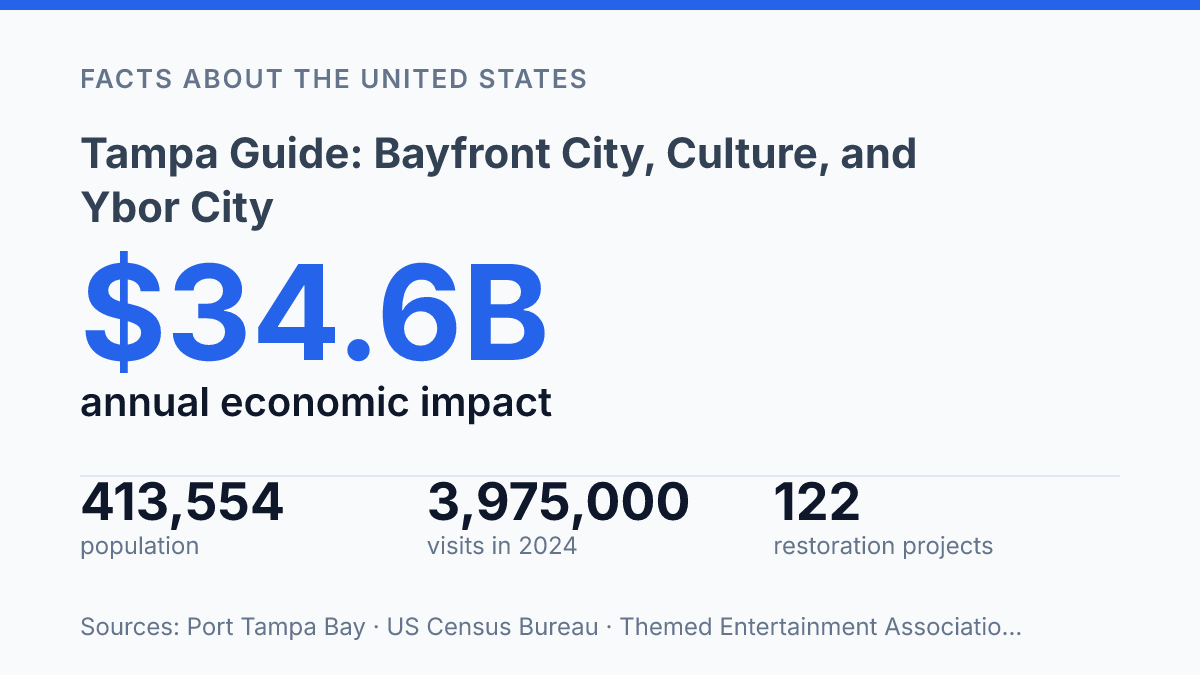
Tampa counted 413,554 residents on July 1, 2025, a 7.3% increase from the 2020 estimates base, which gives the bayfront city a measurable growth story rather than a vague reputation. Its setting on Florida’s largest open-water estuary helps explain both its appeal and its constraints: restoration partners completed 122 habitat projects and 113 water-quality projects between 1989 and 2025, linking urban expansion to bay management. The city’s profile also rests on economic scale.
Hillsborough County’s GDP reached $115.8 billion, while the regional port reports $34.6 billion in annual statewide economic contribution. Against that backdrop, the museums, downtown amenities, family attractions, and Ybor City’s cigar-worker district are not isolated visitor stops. They show how commerce, waterfront geography, and immigrant industrial history have shaped one of Florida’s most layered urban centers.
Where Tampa sits on Florida’s Gulf Coast
Florida’s largest open-water estuary sits at the city’s front door, so the waterfront functions as infrastructure, habitat, and public space at the same time. Tampa is located on Tampa Bay along Florida’s Gulf Coast, with a setting that ties its neighborhoods to the wider metro area bearing the bay’s name. According to the Southwest Florida Water Management District, restoration partners completed 122 restoration projects and 113 water-quality projects from 1989 through 2025, evidence that the bay is not only a geographic marker but also a managed environmental asset.
That coastal position helps explain why the city is linked so closely to a waterfront economy. The bay supports shipping channels, marine terminals, cruise activity, and related logistics, while also giving visitors and residents access to boating, fishing, paddling, waterfront dining, and shoreline parks. The local port authority reported that port activity contributes $34.6 billion annually to Florida’s economy, a figure that shows how the city’s shoreline connects local commerce to statewide trade.
Tourism also draws strength from the bayfront setting, even when visitors come for reasons beyond the water itself. A coastal city can package warm-weather recreation, walkable waterfront districts, and harbor views as part of the same trip, which broadens its appeal across leisure and convention travel. Tourism Economics reported that Hillsborough County generated $6 billion in direct visitor spending in 2025, showing that the visitor economy is large enough to shape transportation, hospitality, and public-space planning.
The same location that supports commerce and recreation requires attention to coastal risk. Low-lying waterfront areas must be planned with storm exposure, heavy rain, tidal conditions, and evacuation routes in mind. The bayfront identity is therefore both an economic advantage and a planning responsibility, shaping how the city grows as much as how it is marketed.
Why the city is a major business center
A surrounding county economy estimated at $115.8 billion makes Tampa more than a visitor destination; it is one of Florida’s major business centers. According to the Tampa Bay Economic Development Council, that economy ranks fourth among county economies in the state, a scale that reflects a broad employment base rather than a single dominant sector. Finance, healthcare, professional services, logistics, and corporate administrative offices all contribute to the city’s role as a regional workplace for Florida’s Gulf Coast.
Population growth reinforces that economic position by expanding both the labor pool and the market for services. The city had 413,554 residents as of July 1, 2025, up 7.3% from the April 2020 estimates base, according to U.S. Census Bureau QuickFacts. That increase helps explain why office demand, medical services, housing development, and transportation planning are treated as linked issues in the urban economy rather than separate local concerns.
The city’s business base is also supported by infrastructure that serves the wider metropolitan area. Harbor logistics and cargo-related services connect local companies to regional and international trade, while hospitals, insurers, banks, and back-office operations anchor year-round employment. This diversification can reduce dependence on seasonal tourism, but it also increases pressure on commuting corridors, housing supply, and downtown redevelopment as more firms and residents compete for well-connected space.
Museums, arts, and family attractions
A single theme park drew nearly four million visits in one year, giving the city a leisure profile that many business centers do not have. Busch Gardens Tampa Bay recorded 3,975,000 visits in 2024, according to the Themed Entertainment Association, ECA, and TPDB, and ranked 13th among North American amusement and theme parks. Its African-themed setting combines roller coasters and other thrill attractions with animal-viewing areas, which helps it appeal to both ride-focused visitors and families seeking a full-day attraction rather than a short museum stop.
Cultural institutions give the destination a different kind of draw, especially in and around the downtown core. The Tampa Downtown Partnership counted 11 museums and art galleries downtown in 2025, a concentration that supports walkable cultural itineraries rather than isolated stops. The Tampa Museum of Art, Glazer Children’s Museum, Henry B. Plant Museum, Florida Museum of Photographic Arts, and Tampa Theatre each serve a different audience, from visual arts and children’s learning to architectural history, photography, and historic cinema programming.
Family-oriented attractions also extend beyond conventional gallery visits. The Florida Aquarium anchors a marine-life experience near the central waterfront, while performing-arts venues such as the Straz Center for the Performing Arts add concerts, touring theater, dance, and education programs to the city’s visitor mix. Taken together, these institutions make cultural tourism less dependent on a single season or a single type of traveler.
Large attractions broaden the city’s visitor base beyond the bayfront by pulling regional day-trippers, families, school groups, and theme-park travelers into the same market as convention visitors and arts audiences. The tradeoff is attention: high-profile entertainment venues can dominate trip planning, while museums and neighborhood-based cultural sites often require more deliberate discovery. That contrast helps explain the city’s tourism pattern, where major attractions create scale and cultural institutions add depth.
Ybor City’s cigar-worker heritage and nightlife
A cigar district that once employed more than 4,000 workers now carries much of its public identity through restaurants, bars, music venues, and restored streetscapes. The shift is visible because Ybor City was never just a leisure quarter; it began as a production community built around cigar factories, worker housing, social clubs, bakeries, and immigrant institutions.
The neighborhood was developed by Cuban and Spanish cigar-factory workers at the turn of the 20th century, after industrial cigar-making took root there in the late 19th century. Vicente Martinez Ybor came to the area in 1885, and Florida State Parks notes that the Ybor cigar factory became the largest in the world. That scale shaped the district’s streets and social life, making cigar work not simply an occupation but the organizing force behind housing patterns, labor culture, and ethnic community networks.
As cigar manufacturing declined, the district’s original industrial purpose weakened, leaving buildings and commercial corridors that could have disappeared through neglect or demolition. Instead, preservation, tourism, and adaptive reuse turned many historic structures into places for dining, drinking, retail, and live entertainment. The result is one of the city’s best-known nightlife areas, but its appeal depends heavily on the older urban fabric: brick buildings, former factories, and narrow streets give the entertainment economy a setting that newer commercial districts cannot easily reproduce.
Ybor City’s historic function remains visible through museums, markers, preserved architecture, and stories of immigrant labor. Florida State Parks also records that the Ferlita bakery once produced more than 5,000 loaves of bread per day, a detail that helps show how the district supported everyday working-class life beyond the cigar floor. That broader memory matters because it frames Ybor City as a place of migration, work, mutual support, and labor identity, not merely as a place to go out at night.
Commercial success has helped keep many buildings occupied and has made preservation financially practical in ways that abandonment rarely does. At the same time, heavy entertainment use can sit uneasily with local authenticity when historic blocks are treated mainly as a backdrop for nightlife. The neighborhood’s long-term character depends on keeping both stories in view: the immigrant industrial district that made Ybor City distinctive, and the contemporary dining and entertainment scene that keeps it widely visible.
Why the bayfront economy keeps shaping what comes next
The practical consequence is that planning cannot treat the city as only a visitor destination or only a business hub. Population growth, a high-value port, and a tourism sector tied to nearly 62,000 jobs all depend on the same limited coastal space, transportation network, and public services. The bay adds another constraint: water quality and habitat gains require maintenance even as demand rises around the waterfront.
Ybor City points to a useful standard for future development. Places with durable economic value tend to preserve the evidence of how they were built, from cigar factories to workers’ streets, rather than replacing memory with anonymous growth.
Frequently Asked Questions
Q: What is Tampa known for?
A: Tampa is known as a major business center on Tampa Bay along Florida’s Gulf Coast. It also draws visitors for its museums, cultural institutions, and waterfront setting. The city combines commercial activity with a strong arts and entertainment profile.
Q: Is Tampa on the Gulf Coast?
A: Yes. Tampa sits on Tampa Bay, which is part of Florida’s Gulf Coast. That location gives the city a coastal setting while also supporting its role as a regional economic center.
Q: What can visitors do in Tampa besides the beach?
A: Tampa offers several attractions beyond the coast, including museums and other cultural venues. Busch Gardens is a major draw, with thrill rides and animal-viewing areas. Ybor City also adds dining and nightlife options with a historic backdrop.
Q: Why is Ybor City historically significant?
A: Ybor City was developed by Cuban and Spanish cigar-factory workers at the turn of the 20th century. That heritage shaped the neighborhood’s identity and contributed to its preserved historic character. Today, it is best known as a dining and nightlife destination.
Q: What kind of park is Busch Gardens in Tampa?
A: Busch Gardens is an African-themed amusement park. It combines thrill rides with animal-viewing areas, which makes it different from a standard rides-only theme park. The mix of attractions is part of its appeal for families and general visitors.