
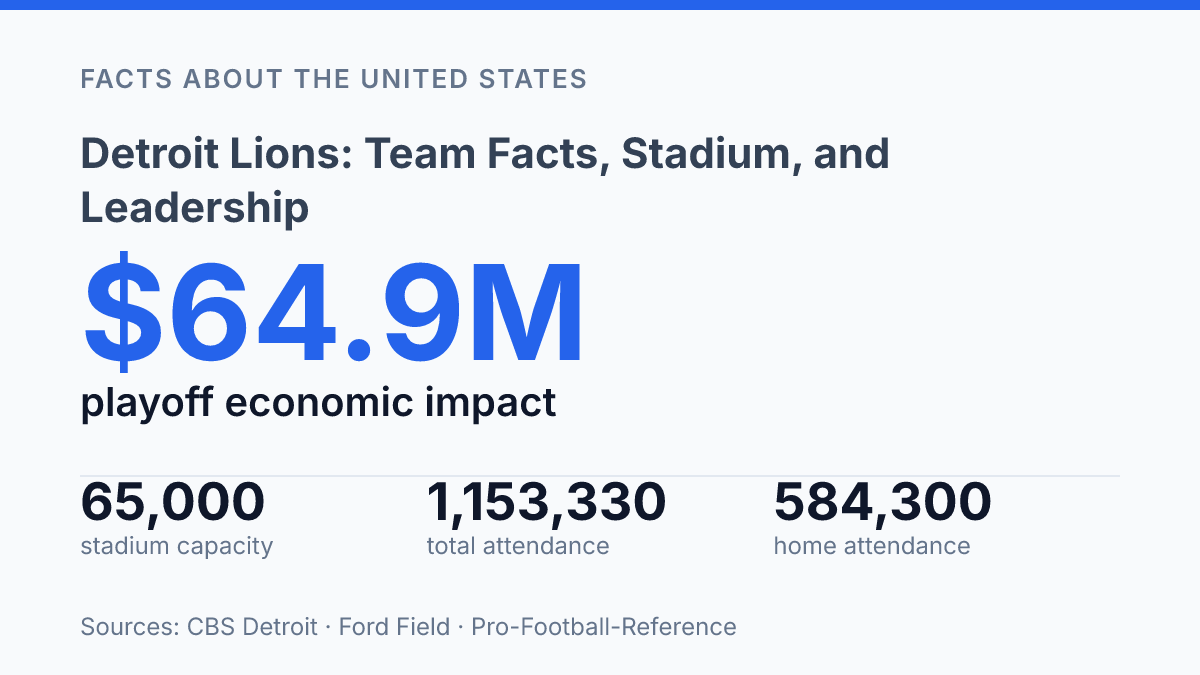
The Detroit Lions entered November 2, 2026 at 5–2–0 and second in the NFC North, placing a franchise founded in 1930 in a sharply different position from much of its recent history. That current snapshot is only part of the team’s profile. Ford Field gives the organization a 65,000-seat home that opened in 2002 after a $500 million build, while recent attendance and playoff economic-impact estimates show how home games extend beyond the field.
Leadership is also central to the picture: Sheila Ford Hamp’s ownership tenure has coincided with four straight winning seasons, and Richard Haddad’s 2026 appointment as president and CEO adds a new front-office marker. Even the mascot program, led by Roary, helps explain how the club presents itself to fans and the wider Detroit community.
Team overview and NFL division
A 5–2–0 record and second-place divisional position as of November 2, 2026, give the club a current competitive marker, but its basic league identity is simpler and more durable: the Detroit Lions are Detroit’s professional American football franchise. The team is based in Detroit, Michigan, United States, and represents the city within the National Football League’s broader national structure. According to NFL.com, the franchise dates to 1930, placing it among the league’s long-running organizations without making history the only way to understand it.
Within the NFL, the Lions compete in the National Football Conference North division, commonly shortened to the NFC North. That placement matters because divisional alignment shapes the team’s regular competitive frame, including repeated matchups against the same regional conference opponents. For a quick understanding of the franchise, the essential coordinates are therefore its city, its professional status, and its NFC North membership rather than a full review of past seasons or honors.
Ford Field and home-game setting
Ford Field places every regular home date in Downtown Detroit rather than on the metropolitan fringe. The Lions play home games at Ford Field, a central-city venue that makes the stadium part of the city’s core geography, not a detached suburban destination. That location reinforces the club’s local identity because game days bring team traffic, media attention, and visiting fans into the same downtown area associated with Detroit’s civic and commercial life.
Venue scale helps explain why the home setting has significance beyond the field itself. Ford Field lists capacity at 65,000, along with 129 suites and 7,251 club seats, according to Ford Field’s venue information. Those figures show that home games are large civic events as well as sporting events, with tens of thousands of spectators concentrated in a dense urban district rather than spread across a remote campus.
The downtown setting also shapes the economic context of major games. CBS Detroit reported that Anderson Economic Group estimated a Lions NFC Divisional Playoff game against Washington at Ford Field would generate $64,875,576 in combined economic impact, including direct and indirect effects. That estimate is specific to a high-profile postseason event, so it should not be treated as the value of every home game, but it illustrates how a central venue can link football attendance with nearby spending, hospitality activity, and city visibility.
Ford Field has served as the club’s home venue since its first scheduled game on August 24, 2002, according to Ford Field. The practical result is a home-game setting closely tied to Detroit itself: fans attend games in an urban stadium embedded in the city center, rather than traveling to a suburban sports complex separated from the city’s daily geography.
Current leadership and ownership
The club’s NFL.com profile lists Dan Campbell as head coach and Sheila Ford Hamp as owner, but those adjacent labels describe separate layers of authority rather than a single chain of football command. Campbell’s role is centered on the team’s on-field operation: setting the coaching approach, preparing players and staff for games, managing in-game decisions, and helping establish the standards used inside the football program.
Sheila Ford Hamp holds the ownership role, a position with broader institutional responsibility. She became Principal Owner and Chair on June 23, 2020, placing her at the top of the organization’s ownership structure. That role is not the same as calling plays or directing weekly game plans; ownership is more closely tied to governance, executive accountability, major organizational direction, and the resources that support football and business operations.
The distinction matters because coaching and ownership influence the club through different mechanisms. A head coach can shape preparation, culture, and player performance within the season-to-season football environment, while an owner can shape continuity, leadership expectations, investment priorities, and the conditions in which football decisions are made.
When those priorities are aligned, the organization has a clearer path for translating broad direction into daily standards. When they are not aligned, responsibility can become harder to interpret from the outside because authority is distributed across different levels of the franchise.
Mascot and team identity
A lion mascot gives the franchise one of the NFL’s most literal brand translations: the animal in the team name becomes a sideline and community-facing character. The team identifies Roary as the Lions’ official mascot, making him part of the club’s public image rather than a separate entertainment feature. The name, costume, and character all reinforce the same visual idea carried by the franchise name: strength, aggression, and recognisable football branding built around a lion identity.
That symbolism matters most because it is easy to understand across different audiences. Longtime supporters may focus primarily on results, roster quality, and coaching, while casual fans and younger audiences often encounter a team through logos, colours, mascots, merchandise, and game-day presentation. Roary fits into that broader recognition system by turning the team’s identity into a character that can appear in fan events, youth outreach, social media, and broadcast cutaways without requiring detailed knowledge of the roster.
The club’s 2026 mascot information also lists Junior Roary, Reizinho, and Leo Löwe as mascot companions, which shows how the lion theme can be adapted for different audiences and settings. Booking guidelines say appearance requests are handled no more than 2 months before an event, a practical detail that places the mascot within the team’s community and promotional operations. Mascots do not define competitive success, but they help make a franchise visually consistent and immediately identifiable beyond the field.
What the current structure signals for the franchise
The next useful test for the organization is whether structure and performance continue to reinforce each other. A 65,000-seat venue, a recent four-year winning run, and a new CEO appointment create conditions for stability, but they do not guarantee it. NFL teams are shaped by injuries, roster cycles, division strength, stadium demand, and management decisions that only become clear over multiple seasons.
For Detroit, the practical measure will be whether attendance strength, playoff-event value, and leadership continuity remain aligned when results fluctuate. If they do, the club’s recent rise will look less like a short run of wins and more like an institutional shift.
Frequently Asked Questions
Q: Where do the Detroit Lions play home games?
A: The Detroit Lions play their home games at Ford Field in Downtown Detroit. The venue is the club’s fixed home stadium and is central to its identity as a Detroit-based NFL franchise.
Q: Who owns the Detroit Lions?
A: The team is owned by Sheila Ford Hamp. Her role places her at the top of the club’s ownership structure and helps set long-term direction for the franchise.
Q: Who is the head coach of the Detroit Lions?
A: The current head coach is Dan Campbell. He leads the team’s football operations on the field and is responsible for coaching strategy and roster performance.
Q: What division do the Detroit Lions play in?
A: The Detroit Lions compete in the NFC North, which is one of the NFL’s four divisions in the National Football Conference. Division membership determines much of the team’s regular-season schedule and its path to the playoffs.
Q: What is the Detroit Lions mascot called?
A: The team’s mascot is Roary. Mascots are part of a club’s public identity and are commonly used at home games and team events.