
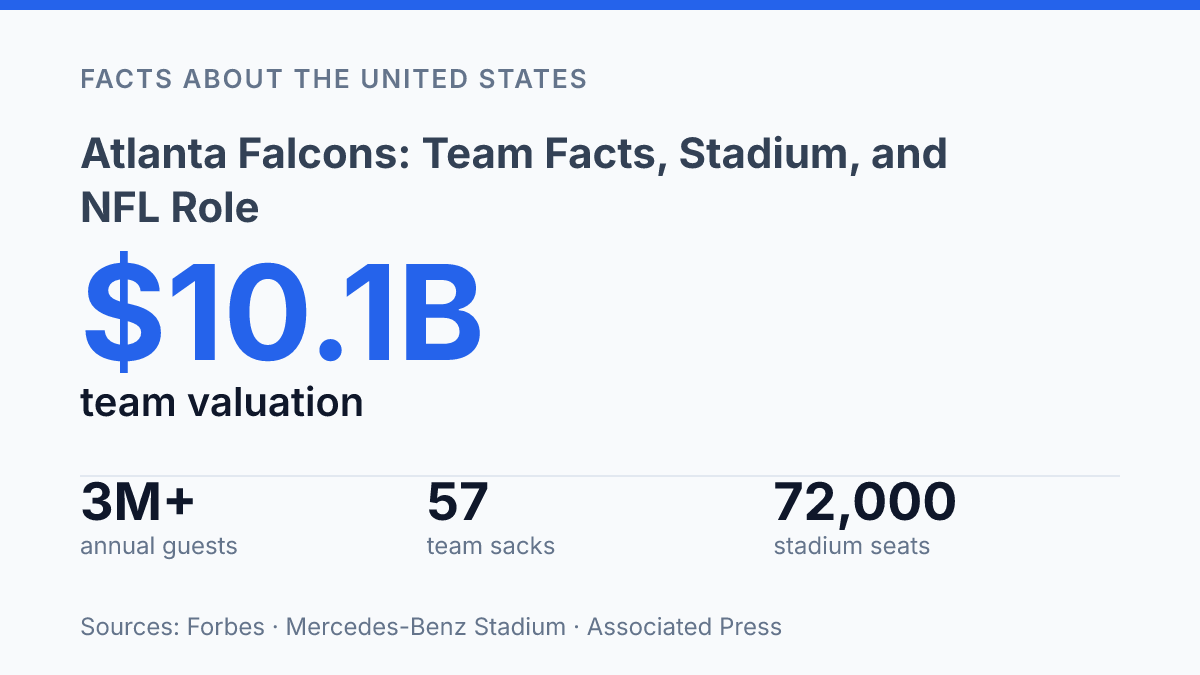
The Atlanta Falcons enter 2026 valued by Forbes at $10.1 billion, nearly 19 times the $545 million Arthur Blank paid in 2002, while also resetting football leadership after an 8–9 season. That combination makes the franchise more than a roster snapshot: it is a case study in how NFL teams are measured through ownership, operations, venue economics, and public identity at the same time. Matt Ryan’s move into football oversight, Kevin Stefanski’s arrival as the 20th head coach, and Greg Beadles’ promotion to president and CEO place former playing legacy, coaching credentials, and business continuity in the same frame.
Mercedes-Benz Stadium adds another layer, drawing more than 3 million guests a year and giving the team a home that functions as both an NFL venue and a civic events platform. The facts behind the club show how competitive ambition, brand value, and local presence intersect.
Franchise overview and NFL placement
In its 2026 NFL valuations, Forbes ranked the Atlanta Falcons No. 10 in the league at $10.1 billion, with $805 million in revenue and $240 million in operating income, while noting that Arthur Blank bought the franchise in 2002 for $545 million.
The franchise is a professional American football team based in Atlanta, Georgia, United States. Its core sporting identity is tied to the National Football League, where it competes in the National Football Conference’s South division, commonly referred to as the NFC South.
That divisional placement gives the team’s identity a competitive frame beyond geography. NFL clubs are not discussed only by city or conference; division membership shapes recurring schedules, standings comparisons, playoff pathways, and rivalry context. For Atlanta, the NFC South label places the franchise in a smaller competitive group within the wider NFC, making divisional performance central to how its seasons are evaluated.
The result is a dual identity: locally, the team represents Atlanta and the state of Georgia in the country’s highest-profile professional football league; competitively, it is measured through the structure of the NFC South and the broader NFL hierarchy. This distinction matters because a franchise’s market value, league status, and divisional position all help define how it is understood within professional football.
Ownership, coaching, and team leadership
Kevin Stefanski’s hiring on Jan. 17, 2026, made him the Falcons’ 20th head coach, placing a two-time AP NFL Coach of the Year within Arthur Blank’s ownership structure, according to the team’s announcement. The head coach is responsible for on-field management: preparing the team, setting football priorities for games and practices, and directing competitive decisions during the season. That role is operational and immediate, because it is tied to weekly preparation and performance rather than broader business oversight.
Blank’s authority is different in scope. As franchise owner, he sits above the football and business structure, appointing senior leadership and setting the organization’s overall direction. Ownership does not mean calling plays or managing game-day substitutions; it means holding ultimate responsibility for the club’s leadership framework, resources, and institutional priorities.
The distinction matters because the same franchise can be shaped by separate lines of authority at once. Business leadership, including the club’s president and CEO role, supports the organization as an enterprise, while football leadership handles the systems that affect competition.
In 2026, the Falcons also added a president of football, Matt Ryan, with the team stating that he reports directly to Blank and oversees football operations. That arrangement reinforces the separation between ownership authority, executive football oversight, and the head coach’s direct control of the team on the field.
Mercedes-Benz Stadium and the home-field setting
More than 3 million guests pass through Mercedes-Benz Stadium in a year, according to the venue’s 2026 information, which makes the Falcons’ home ground a civic event site as well as a football address. The stadium is located in Atlanta, Georgia, and serves as the team’s primary home venue for NFL games, anchoring the club’s public presence in the city on regular-season home dates and other football events staged there.
For the franchise, the stadium functions as the most visible point of contact between the team and its market. Game days bring together ticketing, broadcasts, sponsor displays, concessions, merchandise, and in-stadium presentation in one controlled setting, so the venue helps shape how the club is experienced beyond the roster itself. That public-facing role matters because a home stadium is not only where games are played; it is where team branding, local identity, and fan rituals are repeatedly reinforced.
The fan experience at the venue is also shaped by operational choices rather than architecture alone. Ahead of the 2026 Falcons season, DowntownATL reported that Mercedes-Benz Stadium kept several fan-friendly concession prices in place, including $2 hot dogs, pretzels, popcorn, bottled water, and refillable fountain drinks, along with $5 12-ounce domestic beers. Pricing policies of that kind can affect how accessible the event feels for families and repeat attendees, even though they do not determine the outcome on the field.
A modern venue can strengthen the club’s presentation and broaden its year-round footprint, but competitive results still depend on football decisions, player performance, health, and coaching execution. Mercedes-Benz Stadium therefore matters most as the Falcons’ central home setting: the place where the team’s NFL schedule becomes a live public event in Atlanta and where the organization’s identity is displayed at its largest scale.
Mascot and public identity
The franchise gives its official mascot a roster-style profile: Freddie Falcon is listed by the team at 6 feet 2 inches and 190 pounds, according to the team’s 2026 mascot information. That presentation makes the character feel like part of the football operation without confusing the mascot’s role with competitive decision-making. Freddie is a public-facing symbol, not a strategic asset in the way a coach, executive, or player is, but the character helps translate the club’s identity into a form that is easy to recognize at events and during games.
Mascots function as living brand marks within sports presentation. They appear in entertainment breaks, interact with fans, support youth-oriented programming, and give the team a recognizable figure that can operate outside the pace and seriousness of the game itself.
The franchise’s published appearance guidelines also show how formal that role can be: requests must be made two weeks before an event, and appearances beyond a 60-mile radius of metro Atlanta include a mileage charge of 65 cents per mile. Those details place Freddie within the organization’s community and event operations rather than treating the mascot as a casual sideline feature.
The character’s identity is directly tied to the team name. A falcon suggests speed, aerial movement, and predatory focus, qualities that fit naturally with a football brand built around motion and competition.
Freddie Falcon turns that abstract naming idea into a visible personality, which matters most for audiences that may not track standings, personnel changes, or league structure closely. For casual fans and younger audiences, a mascot can become one of the simplest points of recognition: a symbol that carries the team’s name, colors, and tone in a more accessible form than a logo alone.
What the 2026 reset will test
Franchise facts become more useful when they are read as indicators rather than trivia. The 2026 changes create a clear test of alignment: whether ownership, football operations, coaching, stadium strategy, and public identity can point in the same direction over more than one season. A $10.1 billion valuation signals market strength, but it does not guarantee cleaner roster decisions, better late-season results, or deeper fan attachment.
Mercedes-Benz Stadium can keep expanding the club’s civic reach, while Freddie Falcon and fan-friendly pricing help make the brand visible at street level. The practical measure will be narrower and more demanding: whether a reorganized front office can convert institutional scale into sustained NFC South relevance.
Frequently Asked Questions
Q: What division do the Atlanta Falcons play in?
A: The Atlanta Falcons compete in the National Football Conference South division, commonly called the NFC South. That places them alongside other NFC South teams in the league’s regular divisional schedule. Divisional standing is a key part of their path to the postseason.
Q: Where do the Atlanta Falcons play their home games?
A: Their home venue is Mercedes-Benz Stadium in Atlanta, Georgia. The stadium serves as the team’s base for home games and other club events. Its location in Atlanta gives the franchise a central presence in the city it represents.
Q: Who owns the Atlanta Falcons?
A: The team is owned by Arthur Blank. He is the principal figure behind the franchise’s ownership structure. Ownership matters because it shapes long-term team leadership, facilities, and organizational direction.
Q: Who is the current head coach of the Falcons?
A: The Falcons’ head coach is Kevin Stefanski. The head coach directs game planning, staff coordination, and weekly preparation. That role has a direct effect on offensive and defensive identity over the course of a season.
Q: What is the Falcons’ mascot?
A: The team mascot is Freddie Falcon. Mascots are part of a club’s public identity and fan-facing events. Freddie Falcon is used to represent the team in stadium settings and community appearances.