
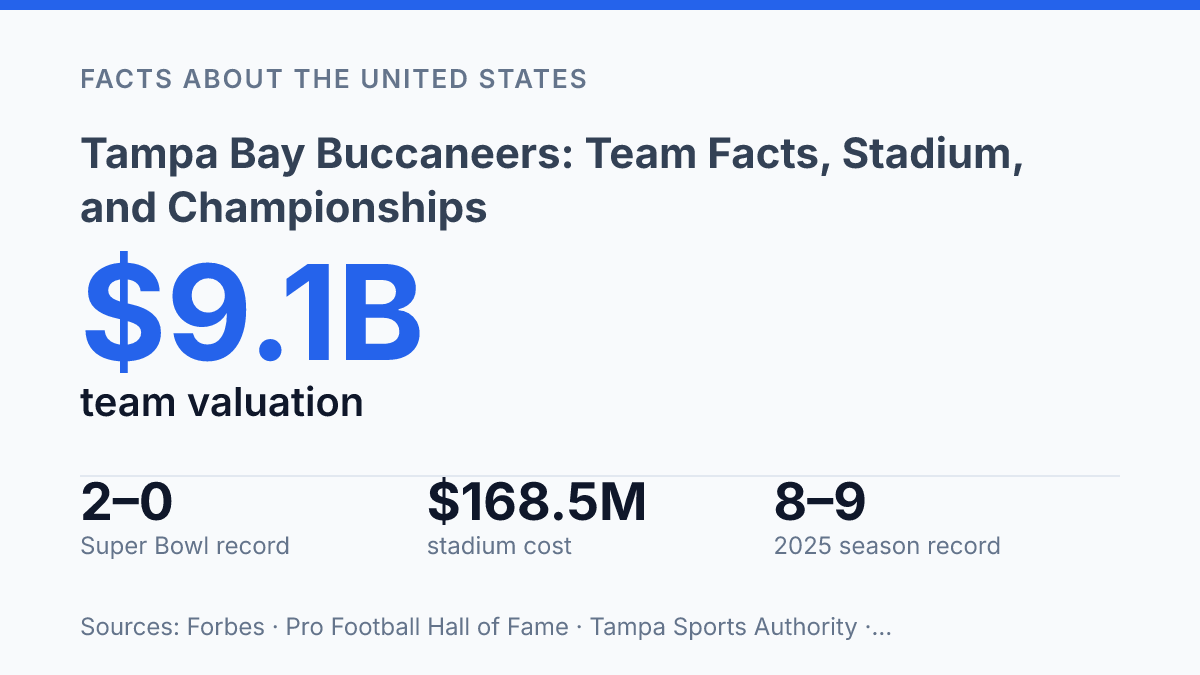
The Tampa Bay Buccaneers were valued by Forbes at $9.1 billion in 2026, nearly 47 times Malcolm Glazer’s then-record $192 million purchase price in 1995. That financial rise gives the franchise a different frame than its recent 8–9 season alone would suggest. On the field, the picture is less linear: Tampa Bay placed second in the NFC South in 2025, while Todd Bowles entered 2026 with one of the strongest early coaching records in team history and a defense that ranked first in the NFL from 2019–25 in both rushing yards allowed per game and quarterback pressures.
Raymond James Stadium adds another defining layer, from its 1998 opening to the 103-foot pirate ship in Buccaneer Cove. The franchise’s two Super Bowl wins, including the first home-stadium title in NFL history, make its facts more than a simple list of dates and records.
Team overview and league place
Forbes placed the Tampa Bay Buccaneers in the middle of the NFL’s franchise-value table while still valuing the club at $9.1 billion in 2026, a figure that shows how financially large even a mid-ranked NFL team has become. The franchise is based in Tampa, Florida, United States, and represents the city within the National Football League rather than a separate regional or state league structure.
Within the NFL, the club competes in the National Football Conference as a member of the NFC South division. That divisional placement is the most precise way to describe its league position: it determines the team’s regular divisional opponents, standings comparison group, and route through the conference structure. Location and division membership establish where the franchise sits institutionally, while season-by-season performance is a separate measure.
The team is coached by Todd Bowles, whose role places him in charge of football operations on the field, including game planning, staff leadership, and weekly competitive preparation. His tenure gives the current team a defined coaching identity without needing to treat recent results as a full assessment here.
The franchise is owned by the Glazer family, placing it among the NFL clubs controlled by long-term private ownership groups. Taken together, its Tampa base, NFC South membership, current head coach, and ownership structure provide the core reference points for understanding the team before turning to venue identity or championship history.
Home field and matchday identity
A 103-foot pirate ship inside Buccaneer Cove gives the club’s home games a signature visual cue that is unusual even by NFL standards. According to the Tampa Bay Buccaneers Media Guide, Buccaneer Cove covers 20,000 square feet, and the ship includes eight cannons with a 30-plus person crew responsible for effects and fan interaction. That staging reinforces the pirate identity already present in the team name, uniforms, and mascot rather than functioning as a purely decorative feature.
Raymond James Stadium is the team’s home venue and the central setting for that matchday identity. The Tampa Sports Authority Strategic Plan states that the stadium opened on September 20, 1998, and that its initial agreement runs through January 31, 2028, with four five-year extension options. Those dates matter because they place the venue within a long-term civic and franchise arrangement, not just a season-by-season home field.
The Glazer family’s ownership provides the institutional continuity behind the club’s public presentation, while the game-day branding supplies the more visible layer seen by fans. Captain Fear, the team mascot, turns the pirate theme into a recognizable sideline and community-facing character, helping connect the franchise’s name, stadium rituals, and merchandise identity. These elements can strengthen recognition and fan attachment, but they should be separated from competitive evaluation: ownership structure, mascots, and stadium atmosphere shape how the team is experienced, not whether a particular roster wins games.
Championship seasons and title record
Tampa Bay’s 2021 championship made it the first NFL team to win a Super Bowl in its own home stadium. The title came in Super Bowl LV, when the club defeated Kansas City 31–9, a result that stood out not only for the margin but also for the setting. That championship was won under head coach Bruce Arians, not Todd Bowles, which matters when separating the franchise’s recent title history from its later coaching era.
The earlier championship came in 2003, when the team beat Oakland 48–21 in Super Bowl XXXVII. That result established the franchise’s first NFL title and remains the foundation of its championship record. According to the Pro Football Hall of Fame, the Buccaneers are 2–0 in Super Bowls, a compact but perfect title-game record that gives the franchise a clearer championship profile than teams with longer but less successful Super Bowl histories.
The gap between the 2003 and 2021 titles is central to understanding the club’s competitive arc. Two championships in different eras show that the franchise’s peaks were not confined to a single roster cycle or coaching period.
At the same time, the nearly two-decade separation points to long stretches of rebuilding and uneven contention between those high points. The title record is therefore both efficient and selective: few Super Bowl appearances, no losses on that stage, and two championships that anchor the team’s historical standing without suggesting constant dominance across every intervening season.
What to know about the franchise today
Tampa Bay’s current profile is unusual for a mid-market NFL franchise: a 2026 valuation above $9 billion sits alongside a recent losing record and a coaching tenure defined by defense. In financial terms, Forbes valued the club at $9.1 billion in 2026, ranking it No. 16 among NFL teams, with estimated 2025-season revenue of $657 million, operating income of $95 million, and a 38% one-year value increase. Those figures place the organization firmly among the league’s high-value properties, even though annual competitive results remain subject to normal NFL variation.
On the football side, the franchise remains in the NFL’s NFC South, with Todd Bowles listed as head coach for the current era. Team-published data entering 2026 described Bowles as a fifth-year Tampa Bay head coach with 35 regular-season wins through four seasons, fourth in franchise history, and credited his tenure with three straight playoff appearances and division titles from 2022 through 2024. The same organizational data points to a sustained defensive identity from 2019 to 2025, when Tampa Bay ranked first in the NFL in fewest rushing yards allowed per game at 94.5 and first in quarterback pressures with 1,487.
The club continues to play in Tampa, Florida, at Raymond James Stadium, keeping its competitive, commercial, and local identity tied to the same home market. A current reference snapshot is useful for orientation because it identifies the division, venue, leadership, valuation, and recent performance markers at one point in time. It should not be treated as a forecast, since coaching decisions, roster availability, injuries, and schedule strength can alter an NFL team’s outlook quickly from one season to the next.
What Tampa Bay’s next franchise cycle will test
Tampa Bay’s next phase will be judged by two measures that do not always move together: franchise strength and competitive separation. A $9.1 billion valuation signals a club with major commercial power, but the 2025 standings showed how narrow the NFC South margin can be when three teams finish with the same record.
The stadium agreement, which runs through January 31, 2028, also gives the organization a practical timeline for decisions about venue control, fan experience, and long-term market position. If Bowles’ defensive base remains intact, the clearest question is not whether the franchise has identity, but whether that identity can keep producing division advantages when financial growth alone cannot decide games.
Frequently Asked Questions
Q: What city are the Tampa Bay Buccaneers based in?
A: The Tampa Bay Buccaneers are based in Tampa, Florida, United States. They compete in the NFL as part of the NFC South division. Their home games are played at Raymond James Stadium.
Q: Who owns the Tampa Bay Buccaneers?
A: The team is owned by the Glazer family. The ownership group has overseen the franchise during both of its Super Bowl-winning seasons. That continuity has made the family a central part of the club’s modern identity.
Q: Who is the current head coach of the Buccaneers?
A: The current head coach is Todd Bowles. He leads the team on the field and is responsible for game planning, roster management, and day-to-day football operations. His role is especially important in a division as competitive as the NFC South.
Q: How many championships have the Buccaneers won?
A: The Tampa Bay Buccaneers have won 2 NFL championships, in 2003 and 2021. Those titles came in separate eras, which shows the franchise has been able to reach the top more than once. Both championships remain the defining achievements in team history.
Q: What is the Buccaneers’ home stadium?
A: The Buccaneers play at Raymond James Stadium in Tampa, Florida. The venue has been the team’s home field for years and is closely associated with the franchise’s identity. It also provides the setting for the team’s home division games and playoff runs.