
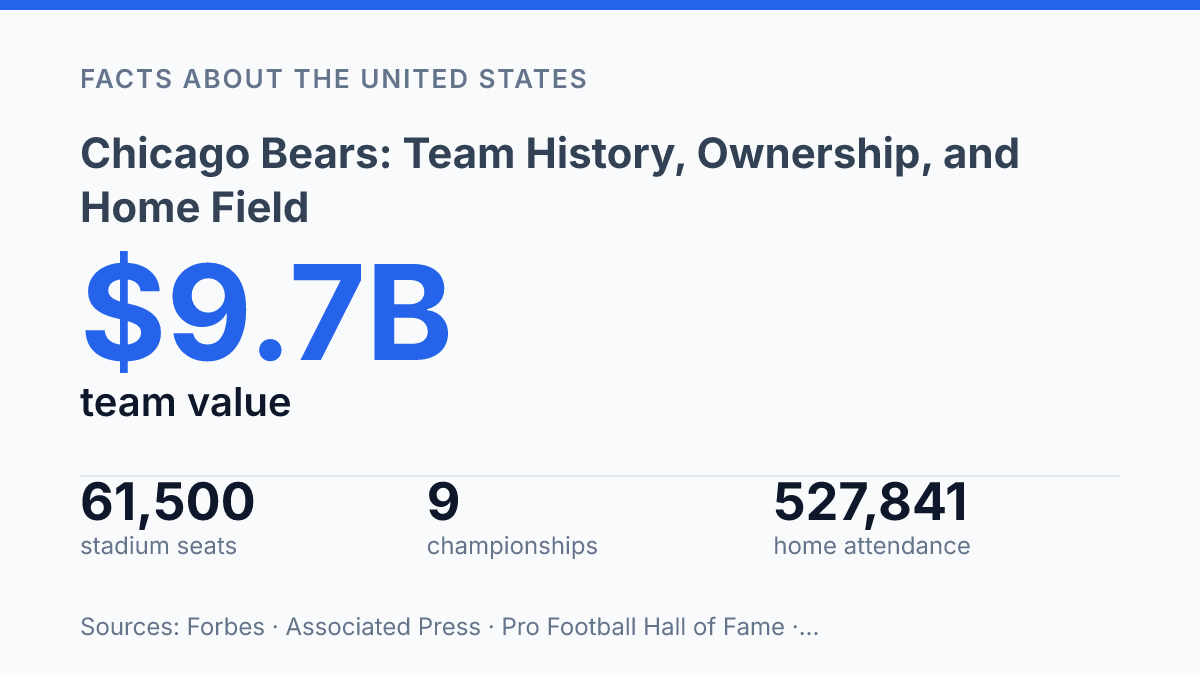
The Chicago Bears entered 2026 valued by Forbes at $9.7 billion, yet their origin story still runs through a franchise purchased for $100 in 1920. That contrast explains why the team is both a sports business case study and one of the NFL’s central historical reference points. The franchise began as the Decatur Staleys, became tied to Chicago, and has accumulated nine championships, including the 46-10 Super Bowl XX win over New England on January 26, 1986.
Its present is shaped by a different set of questions: ownership under the McCaskey family, a leadership structure led by President and CEO Kevin Warren, new football direction under head coach Ben Johnson, and unresolved stadium choices involving Soldier Field and Arlington Heights. The result is a franchise whose identity is measured through records, real estate, family control, and public memory at the same time.
Franchise basics and NFL standing
1920 connects the franchise to the NFL’s origin story, but its modern profile is also measured in billions rather than only in age. According to Forbes, the club was valued at $9.7 billion in 2026, ranking No. 12 among NFL franchises, with estimated revenue of $656 million and operating income of $73 million. Those figures place the team within the league’s upper business tier even before accounting for its historical status.
The Chicago Bears are a professional American football team based in Chicago, Illinois, United States. They compete in the National Football League as a member of the National Football Conference North division, commonly shortened to the NFC North. That divisional placement groups the team within the NFC’s Midwest-centered structure and frames its regular-season competitive schedule against long-established regional opponents.
Few NFL clubs carry the same continuity from the league’s earliest period. The Bears are one of only two remaining franchises from the NFL’s founding year, alongside the Arizona Cardinals, which gives the organization a direct link to professional football’s formative era. That longevity adds historical weight to the franchise, but it should not be read as a guarantee of present performance; league standing is renewed each season through roster quality, coaching, injuries, and results rather than inherited legacy alone.
Ownership, coaching, and team leadership
The franchise’s most consequential decisions flow through a family ownership structure rather than a public-company model. Owner George McCaskey serves as the controlling figure for the organization, with the McCaskey family retaining ownership authority over major business, stadium, executive, and football-operations direction. That control does not mean ownership calls plays or manages the week-to-week football program; it means the owner sets the senior structure in which those decisions are made.
Ben Johnson’s arrival clarified the current football chain of command. The team announced Johnson as head coach on January 21, 2025, making him the 18th full-time head coach in franchise history, according to the club’s official website.
In practical terms, that role places him at the center of game planning, staff management, player development, and in-season competitive preparation. A head coach is evaluated through far shorter feedback cycles than ownership, because wins, losses, personnel usage, and game management become visible every week.
Team leadership also includes the executive layer between ownership and the coaching staff. Kevin Warren, named President and CEO in 2023, gives the organization a senior business and administrative executive responsible for broad operations that extend beyond the sideline. His position helps separate corporate leadership from coaching responsibility, even though both areas shape the franchise’s overall direction.
The distinction matters because professional football organizations divide authority across different time horizons. Ownership and senior executives tend to shape long-range priorities, including facilities, financial strategy, executive hires, and organizational standards.
The head coach works inside that framework but is responsible for the immediate football product: preparation, tactical decisions, locker-room direction, and staff execution. That separation explains why leadership continuity at the top can coexist with frequent scrutiny of coaching performance during a season.
Soldier Field and the Chicago home base
Few NFL venues make team geography as visible as Soldier Field, where lakefront weather, skyline proximity, and limited capacity all become part of Bears home games. The stadium is the franchise’s home field in Chicago, Illinois, giving the club a matchday setting tied to the central city rather than to a remote training campus or a neutral event complex. That distinction matters because the venue places the team inside a widely recognized civic space, making home games part of the city’s public calendar as well as the NFL schedule.
SoldierField.com says the stadium opened on October 9, 1924, and that the Bears moved there in 1971; the renovated venue hosted its first Bears game on September 29, 2003. Those dates give the current home field a layered identity: it is neither a purpose-built suburban football park nor simply a modern entertainment facility. Its status as a municipal landmark helps connect the franchise to Chicago’s lakefront image, even when the football operation itself extends far beyond game day.
Capacity is central to the current stadium discussion. SoldierField.com lists 63,500 capacity, while a 2026 Associated Press explainer described Soldier Field as having 61,500 seats, the smallest total in the NFL. Pro-Football-Reference’s 2024 attendance data showed 527,841 home attendance and an average of 59,403 per home game, which indicates that demand sits close to practical capacity even before broader venue questions are considered.
The same urban setting that strengthens local identity can also sharpen stadium debates. Open-air football near Lake Michigan exposes late-season games to wind, cold, and variable field conditions, elements often treated as part of the Bears’ home character. At the same time, the Associated Press reported that the franchise bought a 326-acre Arlington Heights site for about $200 million and examined a $5 billion domed-stadium development, showing how capacity, revenue, weather control, and civic attachment all remain part of the home-field conversation.
Championships, mascot, and team identity
A single scoreline still anchors the Bears’ modern title identity: 46-10, the margin of their Super Bowl XX victory over the New England Patriots. According to the Pro Football Hall of Fame, that championship was won on January 26, 1986, giving the franchise a clear modern benchmark within a broader record of nine total league championships. The result remains central to how the club’s history is presented because it compresses competitive achievement into an easily recognized reference point: one title game, one dominant result, and one era-defining standard.
That championship history works differently from ordinary season-by-season performance. A past title does not predict current results, but it does shape expectations by giving supporters, media, and the organization a shared measure of what franchise success has looked like at its highest level. In public identity terms, the 1986 NFL championship moment functions as both archive and brand memory, allowing the team to connect present-day narratives to a concrete achievement without needing to recount every historic roster or individual milestone.
Mascot branding serves a separate purpose. Staley Da Bear, the official mascot, is part of the club’s visible identity and appears at more than 300 events each year, according to the team’s official website. That kind of presence matters less as a statement about wins and losses than as a tool of recognition: the mascot makes the franchise legible at games, community appearances, youth events, and promotional settings where emotional association is as important as competitive history.
Together, the title record and mascot identity create two complementary forms of public recognition. Championships supply permanence and credibility, especially when one victory remains so clearly fixed in national football memory. Mascot-driven branding, by contrast, supports continuity in everyday fan culture, giving the organization a recognizable character through which younger supporters and casual audiences can engage with the franchise beyond standings and schedules.
What the stadium decision will reveal
The next major clue about the franchise may come less from a win-loss column than from where it chooses to build its future. Soldier Field connects the team to the lakefront and civic history, but its reported 61,500-seat capacity also limits the economics of a modern NFL venue.
Arlington Heights, with 326 acres already purchased for about $200 million, represents a different model: more land, more commercial control, and a larger question about public value. The decision will not erase the franchise’s past, but it will define how that past is monetized, shared, and physically experienced by the next generation of fans.
Frequently Asked Questions
Q: When were the Chicago Bears founded?
A: The Chicago Bears are one of the NFL’s original franchises, dating to the league’s founding in 1920. They remain one of only two teams from that first season still in operation, alongside the Arizona Cardinals.
Q: Who owns the Chicago Bears now?
A: The team is owned by George McCaskey. Ownership has remained with the McCaskey family for decades, which gives the franchise one of the more stable ownership structures in the NFL.
Q: What stadium do the Chicago Bears play in?
A: The Bears play home games at Soldier Field in Chicago, Illinois. The stadium has been their home field and is closely associated with the team’s identity and fan base.
Q: What division do the Chicago Bears play in?
A: The Chicago Bears compete in the NFL’s NFC North division. That places them in a division with some of the league’s most familiar regional rivals.
Q: How many NFL championships have the Chicago Bears won?
A: The Bears have won 1986 NFL championships in the official team record provided here. That figure reflects the franchise’s long history and its place among the NFL’s most established teams.