
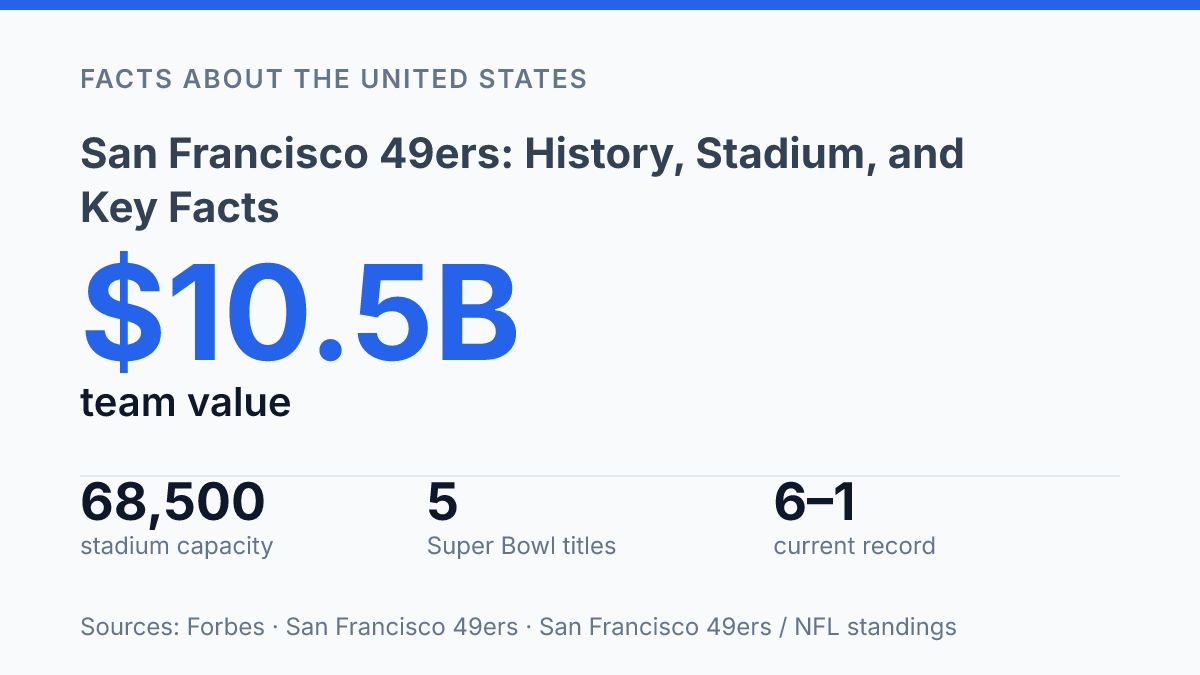
The San Francisco 49ers enter 2026 with one of the NFL’s clearest combinations of on-field strength and commercial scale: a 6–1 NFC West lead, a .857 winning percentage, and a Forbes valuation of $10.5 billion. That pairing places the franchise in a different frame from a simple current-standings story.
Its modern profile is tied to a stadium scheduled to host both Super Bowl LX and FIFA World Cup matches in 2026, a postseason record that still carries the weight of five Super Bowl wins, and identity markers that range from Kyle Shanahan’s coaching era to Sourdough Sam. The useful question is how these pieces fit together: whether the club is being defined mainly by a fresh division race, by a dynasty standard set in the 1980s and 1990s, or by the business and venue platform now surrounding the team in Santa Clara.
Team profile and NFC West place
The club’s name points to San Francisco, but its football address is Santa Clara. The San Francisco 49ers are a professional American football team based in the San Francisco Bay Area, California, with operations tied to Santa Clara, California, United States. That distinction matters because the brand remains linked to San Francisco, while the team’s stadium, training environment, and regular home-game setting are associated with Santa Clara.
Within the NFL structure, the 49ers compete in the National Football League as a member of the National Football Conference West division. In the 2026 San Francisco 49ers / NFL standings, the club leads the NFC West at 6–1 with a .857 winning percentage, 197 points scored, 139 points allowed, and a 3–0 division record; Seattle is second at 4–3. Those figures identify not just divisional placement, but also the team’s current advantage in both record and head-to-head divisional positioning.
Leadership and ownership help complete the basic profile. Jed York is identified with current ownership, providing continuity in the franchise’s executive identity while the team operates as one of the NFL’s most prominent West Coast clubs. The result is a profile with two geographic layers: a San Francisco name and regional fan identity, supported by a Santa Clara operating base inside the NFC West.
Championships and era of success
Five titles in a 14-season span turned the 49ers from a successful franchise into one of the NFL’s nationally recognized dynasty brands. Their championship sequence is commonly identified by the Super Bowl calendar years: 1982, 1985, 1989, 1990, and 1995. The team’s official 2025 media guide lists those results as five Super Bowl championships, tied to the 1981, 1984, 1988, 1989, and 1994 seasons, which explains why title years may appear in either season-year or game-year form depending on the source.
Levi’s Stadium and game-day setting
A home game carrying the San Francisco name is staged about 40 miles southeast of the city at Levi’s Stadium in Santa Clara, California, United States. That geography is central to understanding the franchise’s modern game-day setting: the venue is not in San Francisco proper, but it sits within the wider Bay Area, where sports, media, business, and fan communities often operate across city and county lines. The result is a home identity that connects the South Bay stadium site with a regional brand that still uses San Francisco as its public-facing name.
Levi’s Stadium functions as the team’s regular home venue and as a major event site for the region. The 49ers’ 2025 media guide lists its standard capacity at 68,500, with expansion to more than 75,000 for special events.
That scale matters because NFL game days draw beyond Santa Clara itself, pulling spectators from San Francisco, Silicon Valley, the Peninsula, the East Bay, and other parts of Northern California. The stadium’s location near major South Bay employment and transit corridors also reflects a broader shift in Bay Area sports infrastructure toward regional access rather than a single-city footprint.
The venue’s profile extends beyond league scheduling. According to the San Francisco 49ers 2025 Media Guide, in 2026 Levi’s Stadium is set to become the first venue in global history to host both a Super Bowl and FIFA World Cup matches in the same calendar year, with projected regional impacts of at least $370 million from Super Bowl LX and at least $480 million from World Cup events. Those figures show why the Santa Clara site is more than a local home field: it is a Bay Area event platform attached to one of the NFL’s most recognizable names.
Coach, mascot, and team identity markers
Sourdough Sam’s official profile gives the mascot a deliberately specific stat line: a 4/9 birthday, a listed 249-pound weight, and a height of 6-foot-6 without his hat. Those details, published by the team’s official site, are more playful than competitive, but they help translate the franchise’s Gold Rush theme into a visible character for younger fans, community appearances, and in-stadium entertainment. The mascot functions as a fan-facing symbol rather than a measure of football performance, which is precisely why the character is useful in settings where the club is presenting itself beyond the scoreboard.
What the next benchmark will measure
The next meaningful read on the franchise will not come from one metric alone. A division lead can disappear quickly in the NFL, while franchise value and stadium status move on longer cycles tied to revenue, media demand, and event hosting. Levi’s Stadium’s 2026 calendar gives the club a rare global platform, but the standard inside the organization remains narrower: postseason conversion.
For a team with a 38–24 playoff record and five Lombardi Trophy seasons, regular-season control matters most when it creates home-field advantage and a cleaner route through January. The practical consequence is clear: the 49ers’ profile is measured in both standings and stages, from NFC West games to world-scale events in Santa Clara.
Frequently Asked Questions
Q: Where do the San Francisco 49ers play their home games?
A: The 49ers play home games at Levi’s Stadium in Santa Clara, California, United States. The venue is located in the San Francisco Bay Area, which places the team within the wider regional identity associated with San Francisco.
Q: Who owns the San Francisco 49ers?
A: The team is owned by Jed York. Ownership matters because it shapes the franchise’s long-term direction, including leadership decisions and major organizational priorities.
Q: Who is the current head coach of the 49ers?
A: The current head coach is Kyle Shanahan. His role covers on-field strategy, roster usage, and the overall identity of the team on game days.
Q: How many NFL championships have the 49ers won?
A: The 49ers have won 5 NFL championships, with titles in 1982, 1985, 1989, 1990, and 1995. That run reflects one of the strongest championship stretches in league history.
Q: What division do the San Francisco 49ers compete in?
A: The 49ers compete in the National Football League as part of the NFC West. Division membership determines many of the team’s regular-season matchups and its path to the playoffs.