
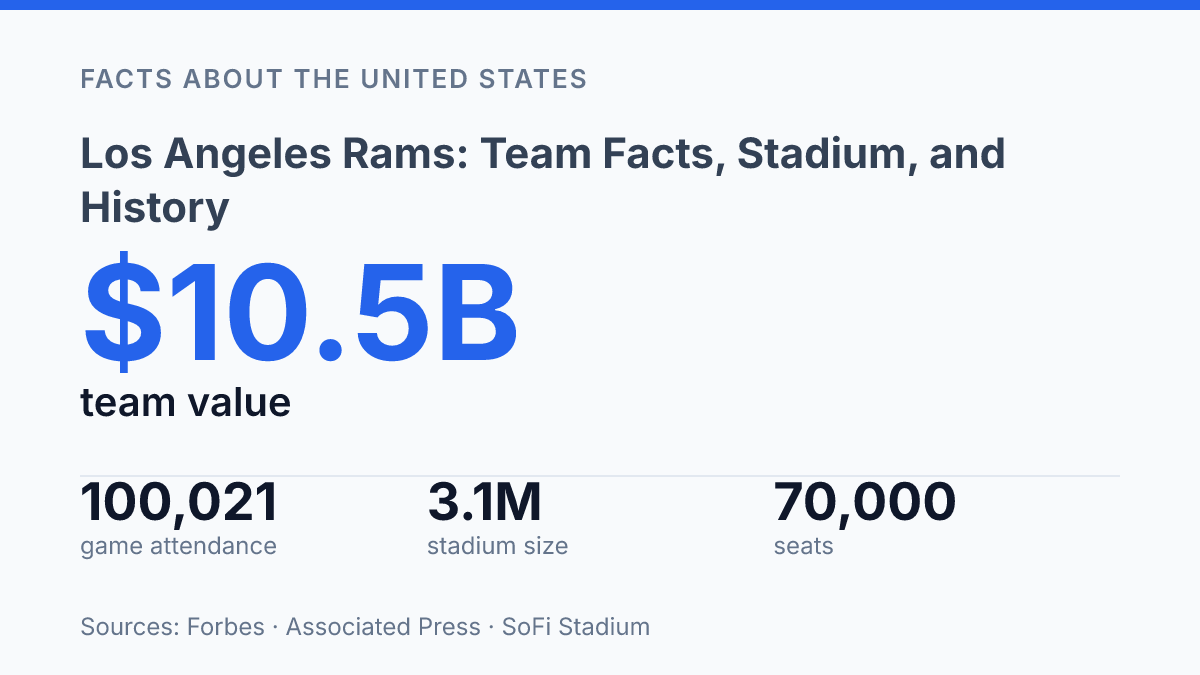
The Los Angeles Rams were valued by Forbes at $10.5 billion in 2025, a 38% one-year increase that placed the franchise third among all sports teams worldwide. That figure reflects more than wins, merchandise, or the size of the Los Angeles market. The club is also reshaping its physical base, moving football operations to a temporary Woodland Hills headquarters in August 2024 while planning Rams Village at Warner Center on land tied to nearly 100 acres acquired by Stan Kroenke.
Its public profile is anchored at SoFi Stadium, a 3.1 million-square-foot venue built for NFL Sundays and international events alike. The team’s recent identity is also tied to Sean McVay’s coaching record, Super Bowl LVI, and a widening reach that now includes Australia. Together, those details explain why the Rams function as both a football team and a major Los Angeles sports institution.
Team profile and home base
The Rams’ Los Angeles identity is broader than a city-center address, with the franchise tied to the market while its operations extend across the wider metropolitan area. The Los Angeles Rams said the team began practicing at its new Woodland Hills football headquarters on August 26, 2024, on land described as part of nearly 100 acres acquired by owner and chairman Stan Kroenke; the temporary setup includes two full-size natural-grass fields and modular football operations space.
As a franchise profile, the team is based in the Greater Los Angeles area and is headquartered in Agoura Hills, California, United States. Its current home market is Los Angeles, California, United States, which is the market name used for the club’s NFL identity even as day-to-day facilities sit in surrounding communities. That split is typical of major professional teams in large metro areas, where brand identity, training operations, administrative offices, and venue locations may not all occupy the same municipality.
Within league structure, the Rams compete in the National Football League as a member of the National Football Conference West division. This places the club in the NFC side of the NFL’s two-conference format and gives it a fixed divisional framework for scheduling, standings, and postseason qualification. The result is a team profile defined by Los Angeles as the public market, Southern California as the operating footprint, and the NFC West as the competitive home inside the league.
SoFi Stadium and the game-day setting
A stadium that spans 3.1 million square feet makes the Rams’ home field less a neighborhood venue than a regional event platform. SoFi Stadium in Inglewood, California, United States, is the team’s stadium, and SoFi Stadium reports a standard capacity of about 70,000 that can expand to 100,000, with more than 260 luxury suites and more than 13,000 premium seats. Those figures matter because the building supports both ordinary NFL Sundays and the kind of corporate, premium, and broadcast-oriented presentation associated with the league’s largest modern venues.
Championships, coaching, and ownership
The Rams’ modern football identity is closely tied to Sean McVay, whose official team bio credits him with a 92–57 regular-season record, a 10–5 playoff record, seven playoff berths, two Super Bowl appearances, and a Super Bowl LVI win. The same bio notes that he became the youngest head coach to win a Super Bowl at age 36, a distinction that helps explain why his tenure is treated as the central reference point for the franchise’s current era rather than simply one chapter in a longer coaching history.
The franchise’s listed NFL championships include 2022 and 2000, a pairing that places the Rams’ success across different periods of league history. The earlier title remains part of the organization’s historical résumé, but the more recent championship is the clearer marker of the team’s present identity because it connects directly to the current leadership structure, public profile, and competitive reputation. This distinction matters because championships are not only records of past results; they also shape how a franchise is evaluated by fans, media, sponsors, and future opponents.
Ownership gives that football profile a broader business frame. Stan Kroenke controls the franchise, and Forbes ranked the Rams as the world’s No. 3 most valuable sports team in 2025, estimating the club at $10.5 billion, up 38% year over year.
That valuation reflects more than wins and losses, but it reinforces the scale at which the organization now operates. In practical terms, the Rams’ recent championship record, McVay’s coaching stature, and Kroenke’s ownership all point to a franchise defined by competitive credibility and high-value institutional backing.
What the Rams represent in NFL California
California is one of only two states with three NFL franchises, and the Rams occupy the league’s largest West Coast media platform in Los Angeles. That combination makes the team one of the NFL’s major California organizations rather than simply a local club with regional appeal. Its market position connects the franchise to national television attention, entertainment-industry visibility, corporate sponsorship opportunities, and a fan base that extends well beyond Southern California.
Within California football, the Rams sit between local identity and national brand power. The state’s NFL presence is split across Northern and Southern California, with the Rams, Chargers, and 49ers each drawing from different histories and fan communities. That setting gives the Rams unusually high visibility, but it also means attention is not automatic; winning seasons, recognizable players, and meaningful late-season games remain central to sustaining relevance.
The NFC West also reinforces the franchise’s western orientation in practical scheduling terms. Division games against Seattle, San Francisco, and Arizona keep the Rams tied to a travel pattern built around Pacific Coast and Mountain-region routes rather than an East Coast-centered rhythm. Those recurring matchups shape kickoff windows, broadcast placement, and rivalry familiarity, helping the division function as one of the NFL’s main western clusters.
Large-market status can amplify the Rams’ national profile, but it does not replace on-field results. A Los Angeles address raises the ceiling for exposure, yet durable league prominence still depends on performance, roster strength, and competitive stakes. In that sense, the team represents both the opportunity and the pressure of NFL football in California: a major-market platform where visibility is abundant, but lasting attention has to be earned.
What permanence would change in Woodland Hills
The next measure is whether the Rams’ off-field growth produces permanence rather than scale alone. A 70,000-seat stadium that can expand to 100,000, a planned mixed-use district in Woodland Hills, and a regular-season game before 100,021 fans in Melbourne all point to a franchise built for audiences beyond Southern California.
Yet the more durable shift may be local: if Rams Village develops as proposed, the organization’s identity will be tied not only to game days in Inglewood but also to year-round activity in the San Fernando Valley. That would make the club’s footprint easier to see in daily city life, not just in television ratings, franchise valuations, or championship records.
Frequently Asked Questions
Q: Where do the Los Angeles Rams play home games?
A: The team plays home games at SoFi Stadium in Inglewood, California. The venue is located in the Greater Los Angeles area and serves as the Rams’ current home field.
Q: Who is the current head coach of the Rams?
A: The Rams are coached by Sean McVay. He has been the team’s head coach since 2017 and is one of the most established figures on the current roster side of the organization.
Q: What division do the Rams compete in?
A: The Rams play in the NFC West, which is one of the four divisions in the National Football Conference. That places them alongside other West Coast and western U.S. NFL teams in regular-season competition.
Q: Who owns the Los Angeles Rams?
A: The franchise is owned by Stan Kroenke. He also oversees the broader sports and real-estate holdings connected to the organization’s presence in Los Angeles.
Q: How many NFL championships have the Rams won?
A: The Rams have won 2 NFL championships, listed in the reference data as 2000 and 2022. Those titles mark the high points of the franchise’s modern history and are central to its identity in Los Angeles.