
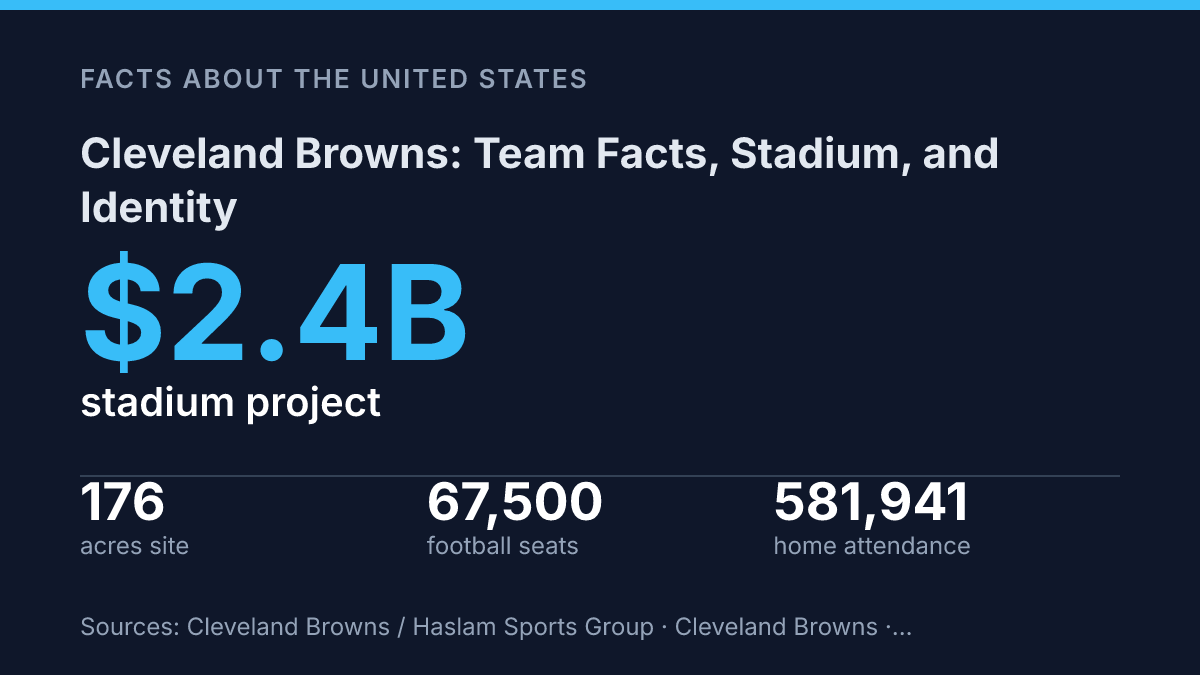
The Cleveland Browns entered 2026 tied to an approximately $2.4 billion stadium plan, a $100 million city settlement, and a coaching change that reframed a franchise whose record book begins in 1946. Few NFL teams combine such an old football identity with such active civic negotiation: eight league titles and 17 Pro Football Hall of Famers sit beside a proposed Brook Park venue, new funding commitments, and the recent Huntington Bank Field naming-rights deal. That contrast makes the team more than a standings-page entry in the AFC North.
Its current profile is shaped by where it plays, who leads it, how fans identify with it, and how symbols such as Brownie, Chomps, and the orange helmet carry institutional memory. The article traces those elements through verifiable team facts, stadium context, leadership changes, and the markers that keep the franchise visible beyond weekly results.
Team overview and NFL placement
Unlike many NFL clubs named for animals, colors, or local landmarks, the Cleveland Browns take their identity from a person: original coach and co-founder Paul Brown. That naming origin gives the franchise a more biographical identity than a standard geographic nickname, linking the team’s public profile directly to its founding leadership rather than only to its city or region.
The team is based in Cleveland, Ohio, United States, and competes at the top level of professional American football. Within the National Football League, it is aligned with the American Football Conference North division, commonly shortened to the AFC North. That placement groups the club within one of the NFL’s conference-and-division structures, which determines regular-season scheduling patterns, standings, and divisional competition.
A franchise profile from the Cleveland Browns identifies the team as an AFC North club established in 1945, with its first season in 1946, entry into the NFL in 1950, and official credits including 8 league titles, 13 division championships, and 17 Pro Football Hall of Famers. Those figures place the club’s current league identity in a longer competitive record, while the AFC North designation explains its present organizational position inside the NFL.
Home field and game-day setting
A stadium name change in September 3, 2024 means current schedules and older box scores may identify the same Browns home under different labels. The team plays at Huntington Bank Field, the name adopted through a 20-year naming-rights partnership with Huntington National Bank, according to a Browns press release announcing the agreement. That naming context matters because archival coverage may refer to the venue by earlier names, including FirstEnergy Stadium or Cleveland Browns Stadium, even when describing games at the same lakefront site.
The stadium is in Cleveland, Ohio, on the Lake Erie waterfront, placing home games in a highly visible downtown setting rather than in an outlying sports complex. Its lakefront position is part of the practical identity of Browns home dates: television broadcasts often show the water, the downtown skyline, and weather conditions shaped by proximity to the lake. For fans, that location also means game-day movement is tied to central-city parking, public event traffic, and waterfront access patterns rather than a campus-style stadium district.
Attendance data gives a useful measure of the venue’s game-day scale. Pro-Football-Reference’s 2025 NFL attendance data lists the Browns with 581,941 home attendance at Huntington Bank Field, a figure that reflects the large weekly crowds associated with regular-season NFL home schedules. The number is best read as a season total rather than a single-game measure, but it still clarifies why the stadium’s location, access, and current name are frequent reference points in team information searches.
Coaching, mascot, and team symbols
The Browns’ public identity currently combines a newly listed head coach with mascots that have carried meaning across multiple eras of team branding. Todd Monken is identified as the current head coach, and a 2026 team announcement said he was named the franchise’s 19th full-time head coach on January 28, 2026. That type of role shapes the team’s public profile through leadership, play-calling philosophy, media presence, and week-to-week accountability, but it is also one of the more changeable parts of an NFL organization’s identity.
Mascots work differently because they function as durable symbols rather than operational leaders. Brownie the Elf, Chomps, and Swagger each represent a different strand of the franchise’s public-facing character: Brownie connects to older visual tradition, Chomps serves as a costumed dog mascot, and Swagger is remembered as the team’s first live mascot. The team’s current official mascot page lists Chomps and Brownie, while a 2020 team report noted that Swagger, a 145-pound bullmastiff, served from 2014 into 2019 and died at age 6.
This distinction matters because coaching leadership and mascot branding communicate identity on different timelines. A head coach reflects the present football operation and can change as competitive priorities change.
Mascots, logos, and sideline characters tend to carry continuity, giving fans and media recognizable shorthand even when personnel shifts. Together, Monken and the mascot group show how the organization presents both current leadership and longer-running symbols without relying on the team name alone.
Why the Browns remain a notable franchise
Few NFL brands are as closely tied to a single civic label as the Cleveland Browns, whose public identity is difficult to separate from the city’s broader sports culture. That connection gives the franchise recognition beyond roster cycles or individual eras. In practical terms, the team functions as one of the most visible sporting identifiers for Cleveland and Northeast Ohio, with its home market, colors, name, and symbols reinforcing a local association that is unusually direct for a major professional team.
Within the AFC North, that identity sits inside a competitive setting defined by repeated divisional matchups and shared standings consequences. The division context matters because it places the Browns in a regular comparison group rather than treating the club as an isolated brand. Rivalries, schedule structure, and playoff positioning all help shape how the franchise is discussed nationally, even when the focus is not on a specific season.
The Browns remain notable because their visibility comes from two related but distinct sources: heritage and current NFL presence. Historic roots explain why the team carries an established place in professional football memory, while present-day branding keeps the club recognizable to contemporary audiences through its venue references, visual identity, mascots, and organizational messaging.
Those factors do not guarantee on-field success, and they should not be treated as a prediction of future performance. They do explain why the franchise continues to stand out as a recognizable NFL institution with a strong civic anchor and a clearly defined divisional context.
What the Brook Park Move May Redefine
The next phase is likely to test how much of a football identity can move without losing continuity. Brook Park promises a larger development canvas than the lakefront site, with a 176-acre plan built for NFL games, concerts, and year-round events. The practical question is not only whether the project is built on schedule, but how public financing, community-benefit spending, access, and demolition obligations are judged after the first seasons in the new venue.
For a franchise with unusually strong symbolic continuity, the helmet, mascots, colors, and fan base may provide stability while the address changes. The clearest measure will be whether the move expands the club’s regional role without making its Cleveland identity feel administrative rather than lived.
Frequently Asked Questions
Q: What city are the Cleveland Browns based in?
A: The Cleveland Browns are based in Cleveland, Ohio, United States. They are a professional American football team in the National Football League. Their home games are played at Huntington Bank Field.
Q: Which NFL division do the Browns play in?
A: The Browns compete in the AFC North division. That places them alongside several long-standing regional rivals, which makes division games especially significant in the regular season. Division standing can strongly affect playoff access.
Q: Who is the Browns’ head coach?
A: The Browns’ head coach is Todd Monken. The head coach is responsible for leading the team’s overall strategy, preparation, and game management. That role shapes both offensive and defensive coordination at the team level.
Q: Why are the Cleveland Browns called the Browns?
A: The team is named after Paul Brown, its original coach and co-founder. His influence was central to the franchise’s early identity and structure. The name has remained part of the team’s identity ever since.
Q: What are the Browns’ mascots?
A: The Browns have three mascots: Brownie the Elf, Chomps, and Swagger. These figures appear in team branding and game-day presentation. They help reinforce the franchise’s visual identity and fan-facing tradition.