
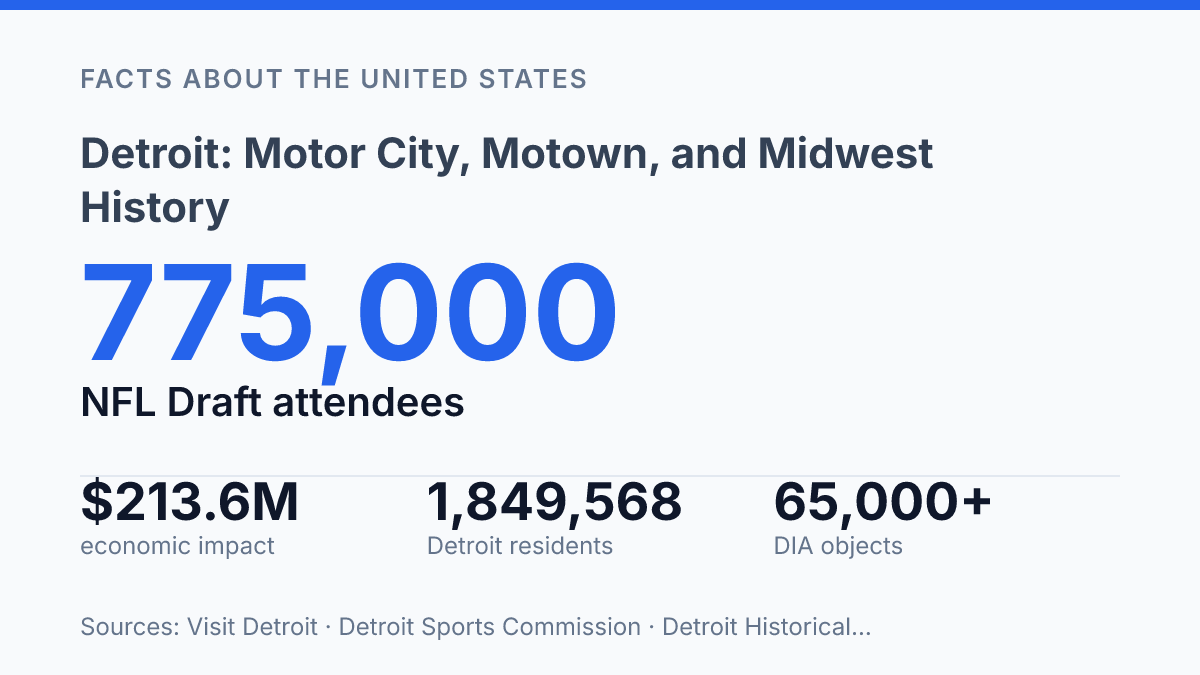
Detroit remains Michigan’s population giant: the 2025 Census estimate puts the city at 649,095 residents, more than 3.2 times the size of Grand Rapids at 201,183. That scale is not a historical accident. Between 1900 and 1950, the city moved from 285,704 residents and 13th place among U.S. cities to nearly 1.85 million residents and 5th place, a surge tied closely to manufacturing, migration, and the rise of the automobile economy.
Yet the city’s influence is not explained by industry alone. Its major museum preserves both civic wealth and industrial memory, Motown turned a house on West Grand Boulevard into a national music engine, and the Motor City label still has measurable force in Michigan’s auto sector and visitor economy. The pattern is one of reinvention rather than replacement.
Why Detroit became Michigan’s largest city
Between 1900 and 1950, the city grew from the nation’s 13th-largest urban place to its fifth, a climb that tracks the rise of mass automobile production. The change was not only demographic. It made Michigan’s dominant city a national industrial center whose influence extended far beyond state politics and commerce.
It remains the largest city in Michigan: the U.S. Census Bureau’s 2025 QuickFacts estimate listed 649,095 residents, compared with 201,183 in Grand Rapids, making it more than 3.2 times larger. That contemporary lead is much smaller than the city’s mid-century peak, but it still shows why the state’s public image, corporate history, and urban debates so often center on this one place.
Geography gave the city an early advantage before the automobile era intensified it. Its position in southeastern Michigan along the Detroit River, near the Canadian border, placed it at a strategic crossing between the Great Lakes region and Ontario. That location supported trade, manufacturing, and cross-border movement, creating the conditions in which large factories and related suppliers could cluster.
The automobile industry turned those advantages into rapid urban growth. Ford, General Motors, and Chrysler anchored a manufacturing ecosystem that drew workers, capital, parts makers, engineers, and service businesses into the metropolitan area. By 1900, the city had 285,704 residents, according to the Detroit Historical Society; by the 1950 Census, it had 1,849,568 residents, according to the U.S. Census Bureau. That growth helps explain why the city became Michigan’s economic reference point rather than simply its largest municipality.
The same concentration that powered expansion also narrowed the city’s exposure. Heavy dependence on auto manufacturing linked local prosperity to production cycles, corporate restructuring, suburban industrial shifts, and later competition in the global car market. The result was a civic identity built on industrial scale and innovation, but also one unusually sensitive to the fortunes of a single sector.
What the Detroit Institute of Arts reveals
A room of 27 fresco panels gives the museum’s art collection one of the clearest visual records of machine-age labor in the United States. The Detroit Institute of Arts, near Downtown, is widely recognized as one of the city’s best-known cultural institutions, not only because of the scale of its collection but because its most famous interior links fine art directly to the industrial systems that shaped the city around it.
According to the Detroit Institute of Arts Fact Sheet, accessed, the museum’s collection contains more than 65,000 objects, and its collection, building, and grounds were owned by the City of Detroit from 1919 to 2014. That long civic ownership matters for interpretation: the museum was not simply a repository of European and American art, but a public institution embedded in the city’s identity, finances, and debates over cultural value.
The clearest example is Diego Rivera’s Detroit Industry Murals, painted in 1932–1933 after the Mexican artist studied local factories and production processes. The murals draw on automobile manufacturing for their subject matter, showing workers, presses, assembly lines, raw materials, and scientific imagery as parts of one vast industrial organism. Rivera’s composition does not reduce the city’s auto connection to a slogan; it records how labor, technology, capital, and urban modernity appeared at the height of industrial production.
Their lasting power comes from that dual function. The cycle celebrates industrial capacity through monumental scale and rhythmic machinery, yet it also preserves details of repetitive work, physical strain, and coordinated human skill. As a result, the museum reveals how the Motor City’s economic identity entered public art, transforming factory processes into a civic artwork that can be read as both tribute and historical document.
How Motown changed American popular music
Over 180 number-one hits came from a label that began in a converted house on West Grand Boulevard. According to the Motown Museum Giving Guide, Motown Records produced that total across its catalogue, a figure that helps explain why the company is treated not merely as a local success story but as a major force in American popular music.
Founded in Detroit in 1959 by Berry Gordy Jr., Motown built a sound designed to travel well beyond its home city. Its original headquarters, Hitsville U.S.A. on West Grand Boulevard, combined business offices and recording space in a way that made the label’s creative process unusually concentrated. Songwriters, producers, session musicians, vocal groups, and arrangers worked in close proximity, which helped create a recognizable style: tight rhythm sections, clear lead vocals, polished harmonies, and pop structures that could reach broad radio audiences.
The label’s artist roster turned that studio model into chart dominance. The Supremes became one of the most commercially successful vocal groups of the 1960s, Marvin Gaye expanded the label’s range from romantic pop-soul into socially conscious work, and Stevie Wonder developed from a young hitmaker into one of the era’s most influential singer-songwriters. Their success showed that Black popular music could command the center of the national charts without abandoning its musical roots.
Motown’s polish can sometimes make the music sound detached from its origins, but the label’s identity remained tied to local networks and neighborhood discipline. Hitsville U.S.A. was not an abstract corporate brand; it was a working studio embedded in the city’s west-side music culture. That combination of national ambition and local production is why Motown remains one of the city’s most recognizable cultural exports.
Why the city’s nickname still fits
The nickname survives because automobile work is still measurable in the region, not merely remembered in museums or slogans. Michigan produced 172,007 motor vehicles in June 2026, and automotive manufacturing employment stood at 155,100 jobs, according to MichAuto and the regional chamber. Those figures do not make the city identical to the industry, but they show why an auto-derived label can remain credible rather than purely nostalgic.
The phrase Motor City came from the city’s central place in automobile production, but its meaning has always extended beyond assembly alone. Manufacturing required engineering, logistics, toolmaking, advertising, architecture, and industrial design, so the car business became a complete civic language rather than a single line of work. The result was a city identity built around making, styling, moving, and selling modern machines at large scale.
That identity still shapes how the city is understood, even when the most visible evidence is cultural rather than industrial. Cars gave the city a public shorthand, but art and music gave that shorthand emotional range: machinery became a subject for civic art, and disciplined studio production helped translate local creativity into national popular culture. The shared thread is not only production, but the organization of talent, labor, rhythm, and design into forms that travel far beyond the city itself.
The nickname therefore fits best when it is read as a historical foundation rather than a complete description. It points to the manufacturing past that made the city internationally recognizable, while leaving room for the cultural legacy that now stands beside cars in its public image. In that sense, the name remains meaningful because it identifies both an industrial origin and a broader habit of turning technical skill and creative work into national influence.
Where the Motor City label points next
The city’s most durable identity is not a single nickname, industry, or era. It is the way economic power, public culture, and national memory keep reinforcing one another. A 27-panel Rivera mural cycle, more than 180 Motown number-one hits, and a 2024 NFL Draft that drew 775,000 attendees point to the same practical reality: inherited symbols still produce present-day activity when institutions protect them and audiences continue to respond.
The next measure will be whether cultural investment, including the Motown Museum’s planned 40,000-square-foot expansion, turns heritage into broader civic benefit. In that sense, the Motor City label remains less a slogan than a test of how well history can keep generating work, tourism, and public meaning.
Frequently Asked Questions
Q: Why is Detroit called Motor City?
A: The nickname comes from the city’s historic role in the auto industry. Detroit became closely associated with automobile manufacturing, and that industrial identity shaped how the city is known nationally.
Q: Where is the Detroit Industry Murals display located?
A: The Detroit Industry Murals are inside the Detroit Institute of Arts near Downtown. The museum is known for these Diego Rivera paintings, which reflect the city’s connection to automobile production.
Q: What is Hitsville U.S.A. in Detroit?
A: Hitsville U.S.A. is the original headquarters of Motown Records. It preserves the label’s chart-topping history and shows how Detroit became central to American popular music.
Q: Is Detroit the biggest city in Michigan?
A: Yes. Detroit is the largest city in Michigan, the Midwestern state where it is located. That status has made it the state’s best-known urban center for industry, culture, and history.
Q: What are the main things Detroit is known for?
A: Detroit is known for its auto industry heritage, its Motown music legacy, and major cultural sites such as the Detroit Institute of Arts. These themes explain why the city appears so often in discussions of American industrial and cultural history.