
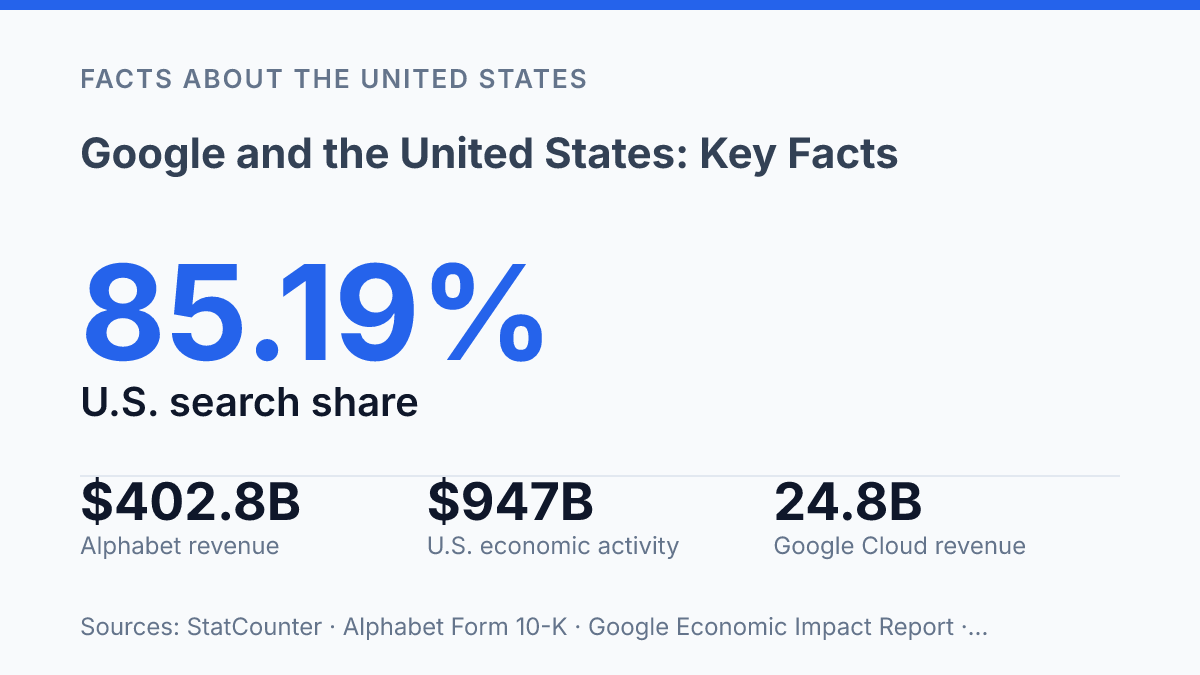
Google began with a $100,000 check in August 1998, but its prototype was already indexing at least 24 million pages before the company moved into Susan Wojcicki’s Menlo Park garage. That contrast helps explain why the company’s U.S. story is not only a startup origin tale, but also a study in scale. By 2025, Alphabet reported $402.8 billion in total revenue, with advertising still providing the largest share and cloud computing becoming a major growth line.
At the same time, StatCounter placed its U.S. search share at 85.19% in September 2026, while federal antitrust scrutiny focused on even higher benchmarks for general and mobile search. The key facts behind the company’s rise show how a research project became a dominant American technology business, why its revenue model attracts regulatory attention, and why its services remain deeply embedded in U.S. commerce.
Google’s founding and early growth
Before it had a permanent office, the prototype search engine already held a full-text and hyperlink database of at least 24 million pages, according to the 1998 Google Research / Computer Networks paper. That scale helps explain why the project was more than a classroom exercise when Larry Page and Sergey Brin, Stanford University doctoral students, turned their research into a company that year.
The original search project was built around a ranking method called PageRank, which treated links between web pages as signals of relevance and authority. Earlier search tools often leaned heavily on matching words on a page, but PageRank used the structure of the web itself to sort results. This gave the young search engine a practical advantage: it could return pages that were not only textually related to a query, but also more likely to be useful because other pages linked to them.
The company was incorporated as Google Inc. in Menlo Park, California, after Sun Microsystems co-founder Andy Bechtolsheim wrote a $100,000 check in August 1998; early operations then took shape in Susan Wojcicki’s garage. The check mattered less as a large sum than as a signal that experienced technology investors saw commercial potential in the research prototype.
Early growth came from the combination of better search quality and favorable timing. The web was expanding quickly, which made finding information harder and increased demand for reliable search. Stronger ranking methods, a growing pool of pages to index, and early investor support together helped move the company from a Stanford research project into one of the most closely watched young technology firms in the United States.
How the company became a U.S. tech giant
By the late 2000s, four services had pushed the company beyond web search: Gmail, Google Maps, YouTube, and Android. Gmail, introduced in 2004, turned the company’s data-center capacity and search expertise into a mass consumer communications service, while Maps, introduced in 2005, made geographic information a daily online utility. YouTube, launched independently in 2005 and acquired the following year, gave the company a central position in online video, while Android moved it into mobile operating systems and app distribution as smartphones became the main gateway to the web.
The corporate structure changed in 2015, when Alphabet Inc. was created as the parent company for the main internet businesses and a set of other ventures. Within Alphabet, Google is the core operating company for search, advertising, Android, YouTube, Maps, and related consumer services, while other subsidiaries cover areas such as life sciences, research projects, and investment activity. Alphabet’s headquarters in Mountain View, California, place the company inside Silicon Valley’s dense network of engineers, venture capital, suppliers, universities, and competing technology firms.
Scale in the U.S. economy came from combining consumer products with advertising infrastructure. The company’s 2025 U.S. Economic Impact Report said its search, app-store, cloud, video, and advertising tools helped provide $947 billion in economic activity for U.S. businesses, a company-reported figure that shows how it frames its reach beyond direct revenue. The same expansion that made the company more useful to advertisers, creators, developers, and local businesses also widened the areas under scrutiny, with policy attention extending across digital advertising, privacy practices, app distribution, and competition in online services.
Business model, revenue, and market power
Advertising supplied nearly three quarters of Alphabet’s 2025 revenue, making the company’s commercial center much narrower than its range of services might suggest. According to Alphabet’s 2026 Form 10-K, total revenue was $402.8 billion in 2025, including $294.7 billion from advertising.
That category includes search ads, which appear alongside query results, and display ads, which are sold across owned properties and partner inventory. The model works because ads can be matched to user intent, audience signals, and measurable outcomes, allowing free services to be funded largely by advertisers rather than direct user fees.
Market power in search gives that model unusual scale. StatCounter reported an 85.19% U.S. search-engine market share for Google in September 2026, compared with 9.89% for Bing and 1.75% for DuckDuckGo.
For advertisers, that concentration means search campaigns often have to include the dominant platform to reach broad demand. For publishers and merchants, visibility in search results can influence referral traffic, ad revenue, and customer acquisition, even when they are not buying ads directly.
The same distribution strength also carries significant costs and regulatory risk. Alphabet reported $59.9 billion in traffic acquisition costs in 2025, equal to a 20.3% TAC rate, reflecting payments to partners and revenue-sharing arrangements that help secure traffic. Those payments are commercially rational because default placement and distribution can preserve query volume, but they are also central to competition concerns.
U.S. antitrust scrutiny has focused on whether that power is maintained through exclusionary arrangements rather than ordinary competition. The Department of Justice brought a search monopolization case filed in 2020, and a federal ruling in 2024 cited shares of 89.2% in general search and 94.9% on mobile devices, according to Pew Research Center’s summary of the decision.
The DOJ has also pursued a separate advertising-technology case concerning tools used to buy, sell, and serve digital ads. These cases do not negate the efficiency of the ad-funded model, but they show why the combination of search dominance, ad infrastructure, and default distribution has become a central competition issue in the United States.
Why Google matters in the United States today
A search result, an Android notification, and a workplace Gemini prompt can all pass through related account, identity, and data systems, which is why the company’s U.S. role is as much infrastructural as consumer-facing. Alphabet reported 183,323 employees at the end of 2024 in its annual filing, a global figure rather than a domestic headcount. Even with that qualification, the company’s American footprint is substantial: its U.S. office listings include major sites in New York, San Francisco, Seattle, Kirkland, Austin, Atlanta, Chicago, Boulder, Cambridge, Pittsburgh, Los Angeles, and Washington, D.C., among others.
The company’s services shape how Americans encounter information because search ranking, autocomplete, local results, snippets, and account-linked personalization influence what appears first and what appears credible. That influence extends beyond the search page. Android phones connect users to app distribution, identity services, location tools, notifications, and cloud-synced settings, while widely used online services for email, documents, browsing, video, storage, and business software make the company part of everyday consumer and workplace routines.
AI has widened this role from organizing information to generating and summarizing it. In Alphabet’s Q2 2026 earnings release, Sundar Pichai said nearly 90% of the Fortune 100 were using Gemini Enterprise, indicating that the company’s AI products are being adopted inside large organizations as well as in consumer tools. That adoption gives product design choices greater consequence, including how outputs are labeled, how errors are handled, and how enterprise data is separated from model training or product improvement systems.
Public debate in the United States therefore centers not only on convenience but on governance. Privacy advocates, lawmakers, regulators, businesses, and civil-society groups scrutinize how data is collected, retained, combined across services, and used for advertising, personalization, security, and AI development. The central tension is clear: the same scale that makes the company’s services useful across phones, workplaces, and the open web also raises the standard for transparency around data practices, ranking systems, and AI deployment.
Why the next phase will be measured by control, not recognition
Google’s U.S. significance now depends less on whether people recognize the brand and more on how its position shapes access, pricing, competition, and business visibility. Search defaults, advertising auctions, cloud contracts, AI tools, and app ecosystems all affect firms that may never have direct negotiating power with the company. That makes the next phase harder to measure than revenue alone suggests.
Antitrust remedies, AI adoption, and shifts in distribution could change where value is created, but they are unlikely to make the company peripheral. A practical consequence follows: any serious assessment of the U.S. technology economy has to treat search, ads, cloud, and AI as connected systems rather than separate markets.
Frequently Asked Questions
Q: How does Google operate in the United States?
A: Google runs most of its core consumer products, advertising systems, and cloud services from the United States, where the company is headquartered. Its U.S. presence also includes major offices and technical hubs that support product development, sales, and policy work.
Q: Where is Google headquartered?
A: Google is headquartered in Mountain View, California, at the company’s main campus in Silicon Valley. That location places it near a large concentration of technology firms, research institutions, and venture capital activity.
Q: What role does Google play in the U.S. economy?
A: Google contributes to the U.S. economy through employment, advertising spending, cloud infrastructure, and payments to contractors and partners. Its services also support many other businesses by helping them reach customers, process data, and distribute digital content.
Q: Why is Google often mentioned in U.S. antitrust cases?
A: Google’s size and market share in search and online advertising have drawn scrutiny from U.S. regulators. Antitrust cases usually focus on whether its dominance limits competition, shapes default settings, or affects how rival services can reach users.
Q: Which Google products are most widely used in the United States?
A: Search, Gmail, YouTube, Google Maps, Chrome, and Android are among the best-known Google products in the U.S. Their broad use reflects how deeply the company’s services are integrated into daily communication, navigation, media consumption, and device use.