
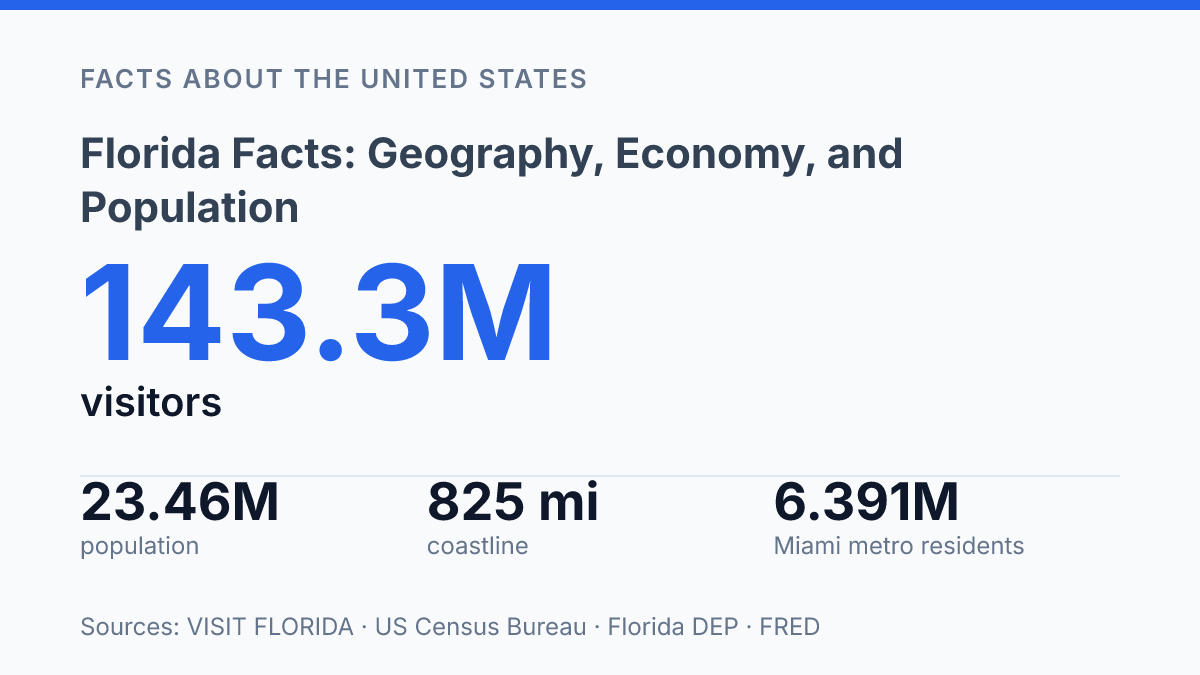
Florida combines 825 miles of sandy coastline with a 2025 population of 23,462,518, making its physical exposure and human growth difficult to separate. Its position between the Atlantic Ocean, Gulf of America, and Straits of Florida helps explain the state’s wet-summer climate, including a statewide annual average precipitation of 53.7 inches from 1895 to 2020. The same geography also supports rare nearshore coral reefs, heavy visitor traffic, and major ports that connect tourism, logistics, and coastal development.
Population gains in Miami, Tampa Bay, and Orlando add another layer: the state is not only a vacation destination but one of the country’s largest and fastest-growing places to live and work. The facts that follow connect geography, climate, population, industry, and civic identity to show how the state’s size and setting shape its public profile.
Where Florida sits and what shapes its climate
Few U.S. states are shaped by water as completely as Florida: the peninsula projects between the Atlantic Ocean and the Gulf of Mexico, leaving much of the state close to open water on at least one side. Its only land connections are to Alabama in the northwest and Georgia in the north, which makes the state’s borders unusually simple compared with those of many inland states. That position also helps explain why coastal conditions influence weather, settlement patterns, and environmental risk across large parts of the state.
The coastline is not just long; it is ecologically distinct. State coastal managers identify 825 miles of sandy coastline facing the Atlantic Ocean, the Gulf of America, and the Straits of Florida, along with a coral reef tract extending about 350 linear miles from the Dry Tortugas to St. Lucie Inlet, according to the state environmental agency’s 2025/2026 pages. That reef system is unusual in the continental United States and adds to the state’s exposure to marine heat, storms, erosion, and coastal water-quality pressures.
Climate varies noticeably from north to south. Northern and central areas generally fall within a humid subtropical climate, with hot summers, mild winters, and seasonal rainfall.
Farther south, especially around the lower peninsula and Keys, conditions become tropical, with warmer winter temperatures and a stronger maritime influence. NOAA’s 2022 State Climate Summary reports statewide annual average precipitation of 53.7 inches for 1895–2020, with the wetter part of the year concentrated from June through September.
The same warm, water-influenced climate that allows outdoor activity through much of the year also raises hazard exposure. Hurricanes can approach from the Atlantic, the Gulf, or the Caribbean, and low-lying coastal areas face storm surge, heavy-rain flooding, saltwater intrusion, and erosion. Those risks help explain why weather and geography are closely tied to building standards, flood planning, and property-insurance costs in the state.
Population growth and major metro areas
Only two states had more residents on July 1, 2025, when the U.S. Census Bureau estimated the state’s population at 23,462,518. The same QuickFacts update put the increase at 8.9% from the April 1, 2020 estimates base, a pace that helps explain why population growth is central to the state’s budget, labor market, and housing debates.
At the metro scale, the largest concentration remains the Miami–Fort Lauderdale–West Palm Beach area, which had 6.391 million residents in 2025, according to FRED data based on Census Bureau figures. Other large anchors spread population and employment across the peninsula: Tampa–St. Petersburg–Clearwater had 3,403,788 residents in 2025, while Orlando–Kissimmee–Sanford had 2,961,947 and grew 10.8% from 2020 to 2025, according to UF BEBR estimates. Jacksonville also functions as a major demographic center for the northeast part of the state, with a regional role that differs from the larger central and south metro corridors.
Domestic migration is one of the clearest growth factors, including both retiree relocation and moves by working-age households seeking jobs or lower-tax residency. That growth has encouraged urban expansion in central and south Florida through new housing, commercial districts, health-care facilities, and transportation-related development. The tradeoff is practical rather than abstract: more residents can deepen the labor pool and support construction, but they also add pressure to roads, schools, utilities, and the supply of affordable housing.
The industries that drive the state economy
Tourism alone brought 143.3 million visitors to the state in 2025, a volume large enough to connect hospitality, transportation, entertainment, retail, and convention activity within one economic engine. According to VISIT FLORIDA, that total was slightly above the prior year, while the agency’s economic-impact study for 2024 estimated $133.6 billion in tourism-related impact and 1.8 million supported jobs. Orlando remains central because of its theme parks, resorts, and meetings business, while Miami combines leisure travel, cruise activity, international visitors, and finance-linked business travel.
Agriculture gives the economy a different base, especially in rural and interior counties where land, water management, packing, processing, and distribution remain tied to crop cycles. Citrus is the best-known agricultural product, but sugarcane and winter vegetables also form part of the state’s farm profile, supplying markets when colder regions produce less. The sector faces clear pressures: USDA NASS reported 2024–2025 all-citrus production of 14.6 million boxes, down 28% from the prior season, with orange production falling 32% to 12.2 million boxes, reflecting the strain from crop disease, storm damage, and other production challenges.
Beyond tourism and farming, the income base extends into aerospace, defense, logistics, financial services, and international trade. Aerospace and defense activity is tied to launch operations, simulation, avionics, military contracting, and nearby federal installations, while logistics benefits from highway, rail, airport, and seaport connections.
The state commerce department’s 2025 Target Industry Report credited logistics with $169.2 billion in GDP and 731,724 jobs, and ports in Miami and Jacksonville support trade in containers, vehicles, cruise operations, and goods moving between the United States, Latin America, the Caribbean, and other global markets. This mix reduces dependence on any single sector, although tourism and agriculture remain more exposed than many service industries to storms, labor shortages, and crop disease pressure.
State history, symbols, and civic identity
Admission to the Union on March 3, 1845 made the peninsula the 27th state, placing it among the wave of states added before the nation’s mid-19th-century territorial expansion accelerated westward. That date remains the central civic marker in the state’s official chronology, more useful for a concise profile than a long account of earlier colonial rule or later wartime politics.
The state’s official symbols combine common Southern imagery with species tied closely to its own ecology. The northern mockingbird serves as the state bird, while the sabal palmetto, also called the sabal palm, is the state tree and appears in civic imagery because of its long association with the peninsula’s natural environment. The Florida panther, designated as the state animal, carries a different kind of significance: it is not only symbolic, but also a reminder of habitat conservation and the pressure placed on native wildlife by development.
Other identity markers are embedded in formal state emblems. According to the state Department of State, the current flag design dates to 1900, while the state seal’s basic elements were set in 1868 and revised in 1985. The official motto, “In God We Trust,” was adopted in 2006, aligning the state motto with the national motto rather than creating a separate phrase unique to the state.
Tallahassee anchors this civic structure as the capital, but it differs from the state’s largest and best-known urban centers. Its identity is closely tied to government, higher education, and public administration rather than the coastal tourism, finance, entertainment, or port activity that shape much of the state’s public image. That contrast helps explain why the seat of government is not always the place most associated with the state in national perception: official authority is inland, while popular identity is often projected through larger coastal and fast-growing metropolitan areas.
Why the scale of the peninsula changes the stakes
The next version of the state’s story will be shaped less by a single headline statistic than by how several pressures move at once. A larger population raises demand for housing, water, roads, insurance, and coastal protection, while visitor volume keeps service jobs and public infrastructure under constant strain. The coral reef system, citrus groves, ports, and metro labor markets each point to a different policy problem, but they share one feature: small percentage changes can affect millions of residents, workers, and visitors.
For anyone comparing states, the practical consequence is clear. The peninsula’s facts should be read as connected indicators, not isolated trivia.
Frequently Asked Questions
Q: What is Florida known for geographically?
A: Florida is a southeastern U.S. state shaped by low-lying peninsulas, long coastlines, and a humid subtropical to tropical climate in the south. Its geography includes major wetlands, barrier islands, and extensive access to both the Atlantic Ocean and the Gulf of Mexico.
Q: How large is Florida compared with other states?
A: Florida covers about 65,758 square miles, making it one of the larger U.S. states by area. Much of that land is flat or only slightly elevated, which affects drainage, development, and flood risk.
Q: What drives Florida’s economy?
A: Tourism is a major part of the state’s economy, supported by beaches, theme parks, and warm-weather travel. Agriculture, real estate, transportation, and aerospace also contribute significantly to economic activity.
Q: How many people live in Florida?
A: Florida is one of the most populous states in the United States, with more than 22 million residents. Population growth has been driven by migration, retirement communities, and job opportunities in large metro areas.
Q: Why does Florida have such a diverse population?
A: Florida’s population reflects long-term migration from other U.S. states, Latin America, the Caribbean, and other parts of the world. Its climate, economic opportunities, and coastal cities have made it a major destination for both permanent residents and seasonal newcomers.