
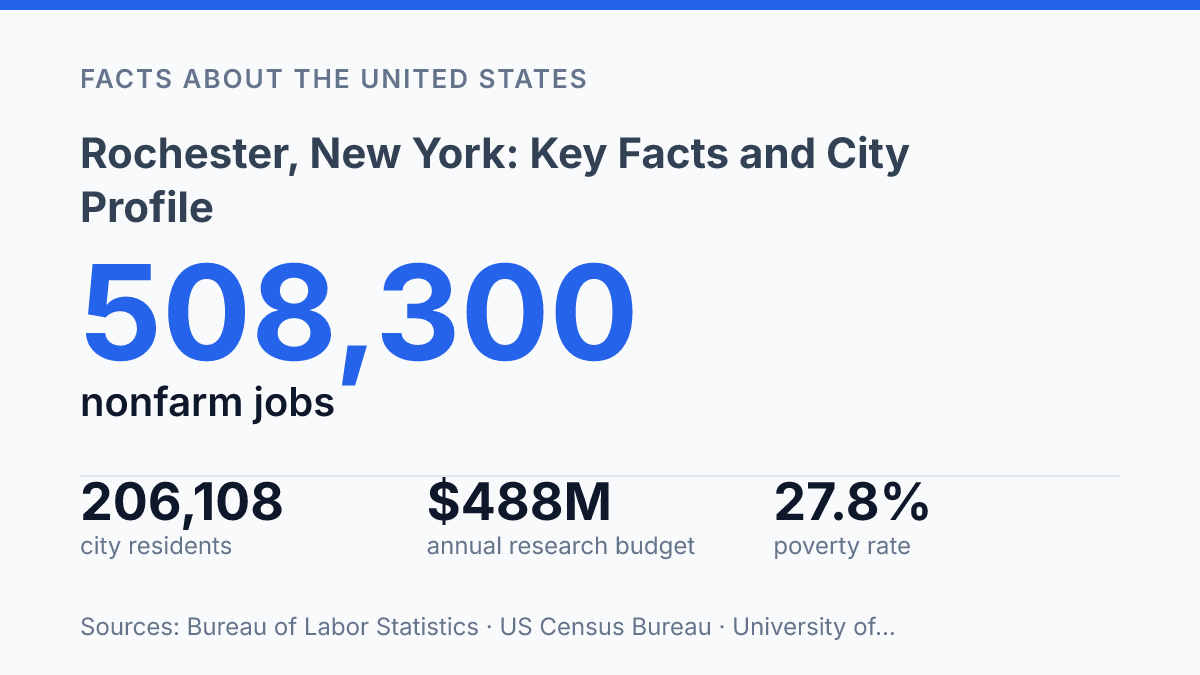
Rochester combines New York’s fourth-largest city population with a proposed $680 million municipal budget and a 27.8% poverty rate, a profile that makes simple labels such as affordable, midsize, or struggling incomplete. The city sits in Monroe County in western New York’s Finger Lakes region, where the Genesee River reaches the south shore of Lake Ontario, and its regional position places it within 400 miles of New York City, Toronto, Boston, and Washington, D.C. Recent Census estimates put the city at 206,108 residents as of July 1, 2025, slightly below its 2020 base.
That scale helps explain why its county seat role, civic institutions, and economy carry weight beyond the municipal boundary. The profile below connects location, population rank, government function, and the forces now shaping the city’s identity.
Where Rochester sits in New York
Rochester’s map position is unusually easy to triangulate: west of Syracuse, east of Buffalo, and on the Genesee River’s route toward Lake Ontario. Rochester is in Monroe County, New York, and serves as the county seat, giving the city a central administrative role within the county as well as a recognizable place in western New York geography.
The broader setting places the city in the Finger Lakes region, close to the south shore of Lake Ontario and tied physically to the river corridor that runs through it. According to the Monroe County, 2026 Adopted Budget, Monroe County is in western New York where the Genesee River meets the south shore of Lake Ontario, and the area is within 400 miles of New York City, Toronto, Boston, and Washington, D.C. That regional reach helps explain why the city is often described not only by its county function, but also by its position between Great Lakes, Finger Lakes, and cross-border travel corridors.
Buffalo and Syracuse provide the simplest in-state reference points for orientation. Buffalo lies to the west near Lake Erie, while Syracuse lies to the east along the central New York corridor, placing the city between two other major upstate urban centers. Its county-seat status matters for government and records, but its wider identity is shaped just as strongly by the Genesee River’s northward course and the city’s proximity to Lake Ontario.
Population size and state ranking
Only 6,495 residents separate Rochester from Yonkers in New York’s city population ranking, which places the two cities close together despite their different regional roles. According to U.S. Census Bureau QuickFacts, the city had 206,108 residents in the 2025 Census estimate. That figure makes Rochester the fourth-most populous city in New York, according to Plain Cities’ 2026 ranking of New York municipalities by population.
The scale difference within the state is substantial. New York City, listed at 8,584,629 residents, is in a category of its own, with a population more than 40 times larger than Rochester’s.
Buffalo ranks second at 274,613, giving it a clear but not overwhelming lead among upstate cities, while Yonkers ranks third at 212,603, only narrowly ahead of Rochester. These comparisons show that the city is large by New York standards, but its size is best understood relative to the state’s highly uneven urban hierarchy.
A fourth-place ranking matters because it signals a municipality with significant administrative capacity, service demands, political visibility, and economic weight. At the same time, city population alone does not measure regional influence. Employment patterns, institutions, commuters, and suburbs all extend the city’s practical reach beyond municipal boundaries, so the population figure is a starting point rather than a complete measure of its role in New York.
Government, county seat role, and civic functions
Monroe County’s own emblem places the city at the center: the 2025 Monroe County Legislature Directory says its central symbol represents the county seat, while 19 towns are shown as spokes around it. That design is more than decorative. It reflects the way county government is organized around a central administrative and legal core, with the county seat serving as the place where many official functions are filed, heard, managed, or coordinated.
County-seat functions commonly include the work of the county legislature, county executive offices, the county clerk, records administration, finance and purchasing, elections administration, public health leadership, social services management, probation, and court-related operations. In practical terms, this means residents, attorneys, businesses, nonprofit agencies, and municipal officials often interact with county government through offices and proceedings concentrated in the city. Deed filings, court appearances, legislative meetings, benefit administration, licensing functions, and public records access are examples of services that give the county seat a daily civic purpose beyond its symbolic status.
This concentration is especially visible in the cluster of courthouses, administrative buildings, and public-service offices that support county-level governance. The Monroe County Legislature Directory helps frame that arrangement as a countywide system rather than a city-only function: the central seat supports legal and administrative activity for surrounding towns as well as urban neighborhoods.
That distinction matters because institutional authority is centered in the city, while demand for services, commuting patterns, business relationships, and public-agency responsibilities extend across the broader metropolitan area. County-seat status therefore gives the city formal civic weight, but the effects of that role are regional in practice.
What defines the city today
Education and health services now outweigh the city’s older factory image in the regional job mix: the U.S. Bureau of Labor Statistics reported 127,700 metropolitan jobs in that sector in August 2026, compared with 48,700 in manufacturing. That balance helps explain the city’s present identity as an institutional and research center as much as a former industrial powerhouse. Manufacturing remains visible, but it is no longer the only lens through which the local economy is understood.
The shift is clearest in anchors such as the University of Rochester and Rochester Institute of Technology. A 2025 University of Rochester News Center report said the combined institution had more than 39,000 employees and an annual research budget of $488 million, with about 96% of that research funding coming from outside the city and state. RIT adds a technology-focused higher-education presence, reinforcing links among computing, engineering, design, and applied research.
The city’s industrial identity has not disappeared; it has been reframed through a longer innovation history. Eastman Kodak’s legacy keeps photography and imaging central to local memory, while optics and precision technologies remain part of the area’s technical reputation. This continuity matters because current research, advanced manufacturing, and technical education draw credibility from an older base of image science, materials knowledge, and production expertise.
Cultural institutions also shape the city’s contemporary profile. The Strong National Museum of Play gives the city a nationally distinctive marker outside the usual categories of government, higher education, and industry. Taken together, these anchors define a city still associated with manufacturing history, but increasingly characterized by research institutions, education, health services, technology, and specialized cultural assets.
Why the city resists a single label
The most useful reading of the city’s profile is not a fixed category but a set of measurements that must be watched together. Low home values can ease entry into the housing market, but lower household incomes and a high poverty rate change what affordability means in practice.
Large institutions can stabilize employment and research activity, while older public systems still require long-term investment. The next version of the city’s profile will be shaped less by rank alone than by whether civic capacity, institutional strength, and household conditions begin to move in the same direction.
Frequently Asked Questions
Q: Where is Rochester, New York located?
A: Rochester is a city in Monroe County in western New York State. It also serves as the county seat, which makes it an administrative center for the county.
Q: How many people live in Rochester, NY?
A: According to the 2025 Census estimate, Rochester has a population of 206,108. That figure places it among New York’s larger cities, though it remains smaller than New York City, Buffalo, and Yonkers.
Q: Is Rochester the county seat of Monroe County?
A: Yes. Rochester is the county seat of Monroe County, so county government functions are centered there. This status makes the city important for regional administration and public services.
Q: What is Rochester’s rank by population in New York State?
A: Rochester is the fourth-most populous city in New York. That ranking reflects its size relative to other cities in the state, even though the city proper is much smaller than the New York metropolitan area as a whole.
Q: Is Rochester a city or a county?
A: Rochester is a city, not a county. It is located within Monroe County and serves as that county’s seat, so it has a city government and a separate county government.