
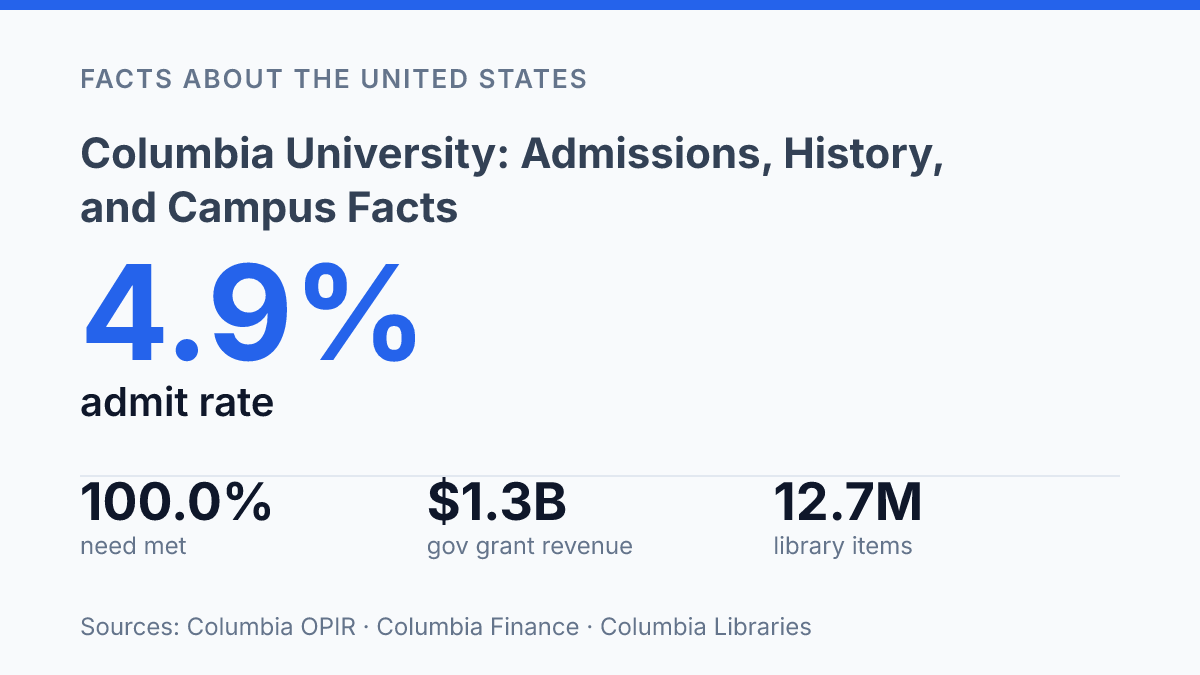
Columbia University admitted 2,946 of 59,611 first-year applicants for Fall 2025, a rate of about 4.9%, while enrolling a class shaped by test-optional reporting and unusually large aid awards. That selectivity is only one part of the institution’s profile.
A university founded as King’s College in 1754 now combines an Ivy League admissions market, a residential undergraduate experience in New York City, and research systems large enough to include more than 12.6 million physical library items. The result is a school often discussed through rankings and prestige, but better understood through its operating details: who gets admitted, how aid changes access, what campus life looks like in Manhattan, and how faculty, alumni, libraries, and research funding connect the university to public life beyond Morningside Heights.
What Columbia University is known for
Columbia University is one of the few U.S. institutions whose identity rests simultaneously on an 18th-century origin, Ivy League membership, and a dense Manhattan research setting. Founded in 1754 as King’s College in New York City, the institution was later renamed Columbia College and then took its current university name as its academic structure expanded. That progression matters less as a full chronology than as a marker of institutional identity: Columbia is both an old colonial-era college and a modern research university with multiple professional and graduate schools.
Its Ivy League status places Columbia within the group of eight private Northeastern universities most associated with long-standing academic prestige in the United States. The New York City location distinguishes it within that group. Rather than occupying a rural or small-town campus, Columbia is anchored in Morningside Heights, Manhattan, which connects its public image to media, finance, publishing, medicine, law, international affairs, and the arts as much as to undergraduate education.
The university is often discussed through several highly visible academic units. Columbia College represents the traditional undergraduate liberal arts core, while Columbia Engineering is associated with applied science, computing, and technical fields within a broad research environment. The Columbia Journalism School gives the institution a particularly strong association with media education and public affairs, reinforced by New York’s role as a global center for journalism and publishing.
Prestige is a central part of Columbia’s reputation, but it can also flatten how the institution is understood. A college applicant, a journalism student, an engineering researcher, and a professional-school candidate may encounter very different versions of Columbia. Its public identity is therefore not only that of an elite Ivy League university, but of a large, specialized, urban institution whose reputation varies by school, discipline, and professional network.
How admissions and selectivity work
The clearest measure of selectivity is that fewer than one in twenty first-year applicants were admitted for Fall 2025. Columbia received 59,611 first-year applications, admitted 2,946 students, and enrolled 1,797, producing an admit rate of about 4.9%, according to the Columbia Office of Planning and Institutional Research, 2025–26 Common Data Set. That rate places admission among the most competitive in the United States, but it is a summary outcome rather than a full explanation of how decisions are made.
Undergraduate applicants are reviewed through a file-based process built around the Common Application or other accepted application platforms, the school record, counselor and teacher recommendations, required writing, and Columbia-specific supplemental questions. The academic transcript carries central weight because it shows course selection, grades, and preparation in the context of what the applicant’s school offers. Recommendations and essays add evidence about intellectual habits, character, interests, and possible contribution to the class, but they are evaluated alongside the academic record rather than as a substitute for it.
Standardized testing is currently optional for first-year applicants to Columbia College and Columbia Engineering, which means applicants may choose whether to submit SAT or ACT results. The Fall 2025 class profile shows how that policy functions in practice: 50% of first-years submitted SAT scores and 17% submitted ACT scores, while the reported SAT middle range was 1510–1560. The same profile reported that 74.9% of students with reported GPAs had a 4.0, underscoring that test-optional review has not reduced the academic strength of the enrolled class.
Early Decision is a separate admission plan and remains materially different from regular review because it is binding for admitted students. For Fall 2025, Columbia recorded 5,868 Early Decision applications and admitted 819 students, an admit rate of roughly 14.0%; the university did not offer an Early Action plan.
The higher Early Decision rate should not be read as a simple advantage detached from applicant context, since the pool can differ in preparation, institutional fit, and commitment level. Taken together, the numbers show intense competition, while the review process still considers preparation, context, and personal evidence beyond the admit rate itself.
Campus, libraries, and student life
A New York residential pattern stands out in the campus data: according to Columbia’s 2025–26 Common Data Set, 99% of first-year students and 90% of undergraduates in Columbia College and Engineering lived in college-owned, operated, or affiliated housing. That figure matters because the university’s setting is urban, but undergraduate life is still anchored by residence halls, dining spaces, advising, and student organizations clustered around the main Morningside Heights campus rather than dispersed entirely across the city.
The campus is centered on a compact set of academic and student-service buildings, with College Walk, Low Memorial Library, and surrounding quads giving the area a recognizable university core. Butler Library is one of the main academic landmarks, especially for humanities and social sciences study, while Dodge Fitness Center provides athletic and recreation space close to classrooms and residence halls. The physical environment is therefore denser than a suburban campus, but it still gives students repeated daily contact with the same libraries, lawns, lecture halls, and student facilities.
Library scale is one of the clearest measures of the academic environment beyond the classroom. Columbia University Libraries reported 12,694,743 physical collection items, 3,990,813 digital or electronic collection items, and $69,312,546 in total library expenditures in FY2024, according to university library statistics. Those resources support not only coursework but also undergraduate research, archival work, language study, and access to specialized collections across disciplines.
Student life combines structured intellectual requirements with the opportunities of a large city. The Core Curriculum gives many undergraduates a shared set of texts, themes, and seminar-style courses, creating common academic reference points across different majors.
Outside class, students can join cultural organizations, publications, performing arts groups, political and service groups, pre-professional societies, and research-related activities. The surrounding city expands those options through museums, media organizations, laboratories, nonprofits, courts, hospitals, and internship sites, although the same urban setting means the campus does not feel as enclosed or self-contained as some peer institutions with larger contiguous grounds.
Notable alumni, research, and public impact
A former U.S. president, a Supreme Court justice, and the first U.S. Treasury secretary all help illustrate the institution’s reach beyond classrooms and laboratories. Barack Obama, a Columbia College graduate, became the 44th president of the United States, giving the university a direct connection to modern presidential politics and constitutional governance. Ruth Bader Ginsburg, who graduated from Columbia Law School after earlier study at Harvard Law, became a U.S. Supreme Court justice whose opinions and dissents shaped equal-protection and gender-discrimination law. Alexander Hamilton, who studied at the institution’s predecessor, later designed core features of the early American financial system, including federal debt management and the national bank model.
Alumni prominence, however, is only one measure of public impact. The university’s research enterprise links scholarship to medicine, economics, climate science, public policy, and the arts through professional schools, laboratories, and affiliated centers.
Columbia’s Irving Medical Center anchors major work in biomedical research and clinical education, while the Lamont-Doherty Earth Observatory has long contributed to earth science, oceanography, and climate research. In fiscal terms, that research scale is substantial: Columbia Finance reported $1.3 billion in government grant revenue in FY2025, alongside a turbulent federal funding environment that included grant terminations and later reinstatements tied to a resolution agreement.
Economics is a particularly visible area of scholarly distinction. In October 2026, the Columbia Department of Economics said Professor Michael Woodford’s Nobel Prize made him the ninth Nobel laureate then serving on the faculty and the sixteenth Columbia faculty member or alumnus to receive the Nobel in Economic Sciences. That figure matters because Nobel recognition usually reflects decades of influence across academic research, policy debates, and graduate training rather than a single institutional achievement.
Journalism gives the university another form of national influence. Columbia administers the Pulitzer Prizes, among the most recognized awards in American journalism, letters, drama, and music.
This role does not simply add prestige; it places the institution within the infrastructure that evaluates and honors public-interest reporting, historical writing, criticism, and cultural work. Taken together, alumni outcomes, research funding, Nobel-linked scholarship, medical science, and journalism awards show an institution whose reputation rests on both famous individuals and durable systems of knowledge production.
The pressure points behind Columbia’s scale
Columbia’s scale makes the institution difficult to judge through one measure, whether that measure is admit rate, Nobel recognition, library holdings, or research revenue. The more useful question is how those measures interact. A 4.9% admit rate signals scarcity, but need-based aid and near-universal first-year housing show how the university structures access after admission.
Large research funding creates public reach, yet the 2025 grant disruptions show that prominence can also expose a university to policy shifts beyond campus control. For students, families, and researchers comparing elite institutions, the practical takeaway is to read Columbia through both opportunity and exposure: its resources are unusually deep, and its position in national academic life makes those resources highly visible.
Frequently Asked Questions
Q: How hard is it to get into Columbia University?
A: Admission is highly selective, and Columbia University typically accepts a small fraction of applicants each year. Strong grades, rigorous coursework, high test scores where submitted, and a clear academic fit all matter, but no single factor guarantees admission. The process is holistic, so extracurricular depth and personal essays can also influence decisions.
Q: What is Columbia University known for academically?
A: Columbia is known for strong programs in fields such as journalism, law, business, engineering, and the liberal arts. Its Core Curriculum is a defining feature of undergraduate education and emphasizes common readings and discussion-based learning. That structure gives students a broad academic foundation alongside major-specific study.
Q: Where is Columbia University located?
A: Columbia University is located in the Morningside Heights neighborhood of Manhattan in New York City. The main campus sits near Riverside Park and includes a mix of academic buildings, libraries, and student spaces. Its urban setting gives students direct access to the cultural and professional opportunities of New York City.
Q: What are the main campuses or schools within Columbia University?
A: The university includes several schools, such as Columbia College, the Fu Foundation School of Engineering and Applied Science, and the School of General Studies. It also has graduate and professional schools in areas including public health, business, journalism, and law. This structure makes Columbia a large research university with both undergraduate and graduate study options.
Q: What makes Columbia University’s campus historically significant?
A: Columbia is one of the oldest universities in the United States, with roots tracing back to 1754. Its campus includes notable historic architecture and long-established academic institutions that reflect that history. The combination of age, location, and institutional continuity gives the university a strong historical identity.