
Cornell University began with an unusually concrete bargain: on April 27, 1865, New York chartered the institution, and Ezra Cornell pledged $500,000 along with land, buildings, and equipment. That origin still helps explain the university’s present form: an Ivy League school with public-facing land-grant obligations, a large Ithaca campus, professional schools, and a research operation measured in billions rather than millions. In 2024–25, Cornell enrolled 28,267 students, while its organized research expenditures reached $1.3309 billion in the following fiscal year.
Those figures point to a university whose identity cannot be reduced to prestige alone. Its setting, academic breadth, admissions selectivity, alumni network, and public reputation all reflect the same tension between access, ambition, and institutional scale.
How the university was founded and where it stands now
A private Ivy League institution began with a public-purpose charter: Cornell’s charter was signed into law on April 27, 1865, and Ezra Cornell pledged an initial endowment of $500,000 plus land, buildings, and equipment, according to the Cornell Office of the President. Cornell University was founded that year by Ezra Cornell and Andrew Dickson White in Ithaca, New York, with an unusually broad founding idea for the period: higher education should be open across fields of study rather than confined to a narrow classical model.
Its present legal and institutional identity still reflects that origin. Cornell is a private Ivy League university, yet it also carries land-grant roots that connect it to public service in New York, including through the New York State College of Agriculture and Life Sciences. That combination makes the institution less typical within the Ivy League: it operates as a private university while retaining a mission shaped in part by access, applied knowledge, and service to the state.
Recent enrollment figures show the scale that has developed from that hybrid foundation. In 2024–25, the Cornell Division of Financial Services reported total fall enrollment of 28,267 students, including 16,128 undergraduates, 8,834 graduate students, and 3,305 professional students. Those numbers place Cornell among the larger Ivy League institutions by student body size and help explain why its identity is often described through both elite private education and broad university-scale activity.
What the campus and location mean for student life
On Cornell’s Ithaca campus, ordinary walking routes can pass from formal quadrangles to gorge bridges and steep slopes within a few blocks. The main campus sits above Cayuga Lake in New York’s Finger Lakes region, which gives the setting a strong natural identity rather than the enclosed feel of many urban campuses. According to Cornellians, Cornell Botanic Gardens covers a full third of the 745-acre Ithaca campus and, with off-campus natural areas, manages 3,800 acres of gardens, forest, and other landscapes.
The physical layout shapes how students move and gather. The Arts Quad functions as one of the campus’s central academic and social spaces, while Libe Slope is both a well-known landmark and a practical reminder that the campus is built on hills. The gorges, waterfalls, and bridges add to the visual character of the university, but they also make geography part of daily planning, since direct routes are not always flat or simple.
Terrain and weather are practical factors in student life. Ithaca winters can bring snow, ice, and cold conditions, and the steep approaches between lower and upper campus can make walking, cycling, and bus timing more consequential than at a flatter institution. This does not diminish the appeal of the setting, but it does mean that the campus rewards preparation: footwear, transit habits, and realistic travel time can matter as much as proximity on a map.
Academic strengths and research activity
A university that houses a hotel school, an agriculture college, an engineering school, and a standalone computing college under one academic system has an unusually wide research footprint for an Ivy League institution. Cornell Engineering anchors much of that profile through work in fields such as materials science, robotics, energy systems, biomedical engineering, and applied computing, while the Cornell Ann S. Bowers College of Computing and Information Science gives data science, artificial intelligence, information science, and computer science a visible institutional base rather than treating them only as service disciplines.
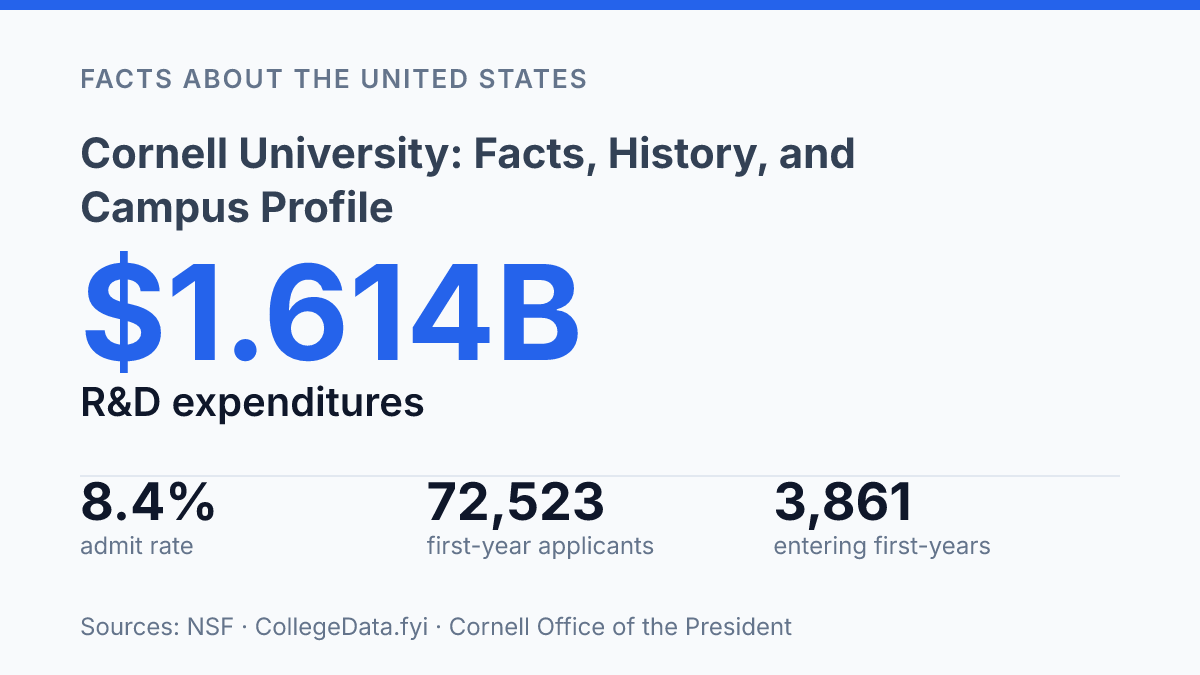
External research data show the scale behind that breadth. In the NSF/NCSES Higher Education Research and Development Survey for FY 2024, Cornell ranked 10th among U.S. institutions for total R&D expenditures, with $1.613631 billion overall and $792.078 million from federal sources.
Cornell Research & Innovation also reported $1.3309 billion in organized research expenditures for the July 1, 2024 to June 30, 2025 period, split between the Ithaca-based operation and Weill Cornell campuses. Those figures place research activity at the center of the institution’s operating model, not as a separate layer added onto undergraduate teaching.
Several schools give that research profile its distinctive shape. The Cornell SC Johnson College of Business includes the Peter and Stephanie Nolan School of Hotel Administration, a major reason hospitality management, real estate, service operations, and tourism research are associated with the university. The College of Agriculture and Life Sciences connects laboratory research with applied work in food systems, plant and animal science, sustainability, and biological sciences, while Cornell Cooperative Extension carries university-based expertise into communities across New York State through local extension associations.
This mix strengthens interdisciplinary work because computing, engineering, agriculture, business, health, and social science can meet within one institution. The same range also makes the university harder to summarize than peers known mainly for a narrower academic identity. Its strongest profile is not one field alone, but the connection between professional education, basic research, and applied public-service work.
Admissions, alumni, and public reputation
An admit rate of about 8.4% placed Cornell’s fall 2025 first-year admissions among the most competitive in U.S. higher education. Cornell’s 2025–26 Common Data Set, as reproduced by CollegeData.fyi, reported 72,523 first-year applicants, 6,077 admits, and 3,827 enrolled students, with a yield of about 63%. Those figures show both demand and commitment: many applicants seek admission, and a substantial share of those admitted choose to enroll.
Selectivity is only one part of the public profile, but it shapes how the institution is perceived. Cornell is widely regarded as one of the most selective and research-intensive universities in the United States, a reputation reinforced by national visibility across professional fields, graduate education, and faculty scholarship. The same reputation also narrows access in practical terms, since high demand produces an admissions process in which qualified applicants far outnumber available seats.
Alumni prominence adds another layer to that standing. Ruth Bader Ginsburg, who later became a U.S. Supreme Court justice, graduated from Cornell in 1954; Bill Nye earned a mechanical engineering degree in 1977 before becoming a widely recognized science communicator; and Toni Morrison earned a master’s degree in 1955 before becoming a Nobel Prize-winning novelist. These names matter not simply as celebrity examples, but because they reflect the university’s reach across law, science communication, literature, public service, and culture.
The alumni network also has measurable institutional weight. According to the Cornell Chronicle, nearly 40,000 alumni and student donors contributed to $878 million in new gifts and commitments in fiscal year 2025, while the “To Do the Greatest Good” campaign reached $5.719 billion. Public reputation, in this sense, is supported not only by admissions selectivity and academic output, but also by sustained graduate engagement and philanthropic capacity.
What Cornell’s Scale Changes
Cornell’s profile is likely to be shaped less by a single ranking than by how well it manages scale under pressure. A university with more than 28,000 students, a highly selective admissions process, major research obligations, and a donor campaign exceeding $5.7 billion operates in several public arenas at once.
That breadth brings influence, but it also raises scrutiny over affordability, research priorities, campus growth, and the balance between local responsibilities and global reach. The practical consequence is that Cornell is best understood as both a place and a system: decisions made in Ithaca can affect students, laboratories, alumni giving, and public trust far beyond the campus boundary.
Frequently Asked Questions
Q: What is Cornell University known for?
A: Cornell University is known for combining a strong research mission with a broad academic range, including undergraduate, graduate, and professional study. It is also recognized for its land-grant heritage and for having colleges that serve both public and private purposes within one institution.
Q: Where is Cornell University located?
A: Cornell University is located in Ithaca, New York, on the western edge of the Finger Lakes region. The campus sits on hilly terrain overlooking Cayuga Lake, which shapes both the setting and the day-to-day experience of campus life.
Q: Is Cornell an Ivy League school?
A: Yes, Cornell University is one of the eight Ivy League institutions. Its Ivy League status reflects long-standing academic prestige, but the university also stands out for its public-service mission and its unusually wide mix of colleges.
Q: How old is Cornell University?
A: Cornell University was founded in 1865. Its founding during the post-Civil War period shaped an institutional model that emphasized both practical education and advanced scholarship, which remains central to its identity.
Q: What makes Cornell different from other Ivy League universities?
A: Cornell University differs from many peers because it includes both privately endowed colleges and publicly funded statutory colleges. That structure expands the university’s academic scope and links it more directly to New York State’s public education system.