
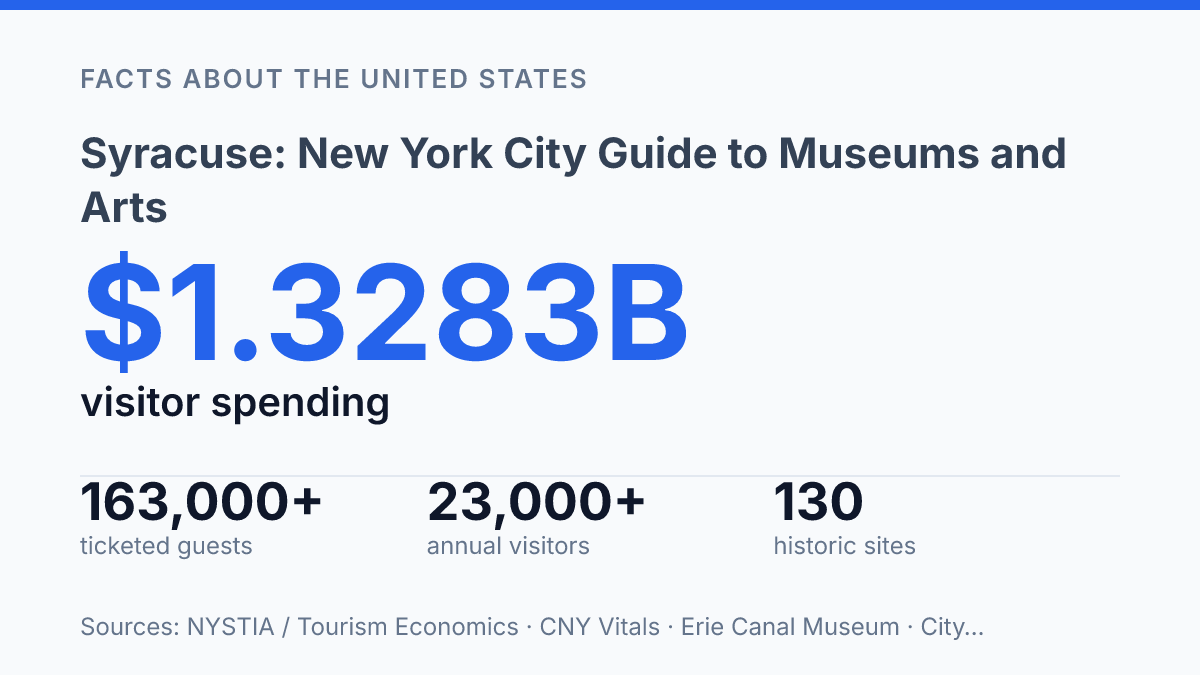
Syracuse anchors an Onondaga County visitor economy that reached $1.3283 billion in spending in 2025, with lodging and food and beverage alone accounting for more than $881 million. That scale matters because the city’s museums and arts venues are not isolated stops; they sit inside a working cultural economy shaped by preservation, touring performance, science education, and canal history. The Landmark Theatre drew more than 163,000 ticketed guests in 2024, while the Erie Canal Museum occupies what it identifies as the last remaining weighlock building in America.
The city’s built record is equally measurable, with close to 130 National Register-listed sites and districts. This guide traces the connections among major museums, landmark architecture, stage venues, and historic districts to explain why the city functions as a distinctive New York arts destination.
Top museums that define the city
Syracuse’s core museum trio is unusually varied: a canal weighlock, a former armory, and a Pei-designed art museum each anchor a different kind of cultural visit. That breadth matters because the local visitor economy is not marginal; in 2025, visitor spending in Onondaga County totaled $1.3283 billion, including $443.3 million on lodging and $437.9 million on food and beverage, according to NYSTIA / Tourism Economics. Museums are one part of that larger draw, but they help explain why the city works for history-focused travelers, families, school groups, and art audiences at the same time.
The Erie Canal Museum gives the city one of its clearest links to a nationally significant transportation story. It occupies the 1850 Weighlock Building, a rare surviving piece of canal infrastructure where boats were once weighed to assess tolls.
The museum’s emphasis is the Erie Canal as an economic, engineering, and social force rather than as a static relic, which makes the building itself part of the interpretation. The institution says it occupies the last remaining weighlock building in America and draws more than 23,000 visitors annually from all 50 states and abroad.
Science and family learning are centered at the Milton J. Rubenstein Museum of Science & Technology, commonly known as MOST. Located in the old state armory, the museum uses hands-on exhibits to make science, technology, and natural phenomena approachable for children and adults.
Onondaga County’s 2024 Official Statement describes MOST as having 35,000 square feet, more than 200 exhibits, a domed IMAX theater, and a 50-seat planetarium. That scale places it beyond the category of a small local children’s museum and makes it a repeat-use educational attraction for the region.
The Everson Museum of Art serves a different audience through its concentration on American artwork and its landmark building designed by I.M. Pei. Its collection and exhibitions place visual art at the center of the city’s museum identity, while the building gives the museum a civic presence that extends beyond the galleries. Taken together, these institutions show range rather than a single cultural personality: canal history, interactive science, and American art each define a separate entry point into the city’s arts and museum scene.
Architecture and the city’s landmark buildings
A former military armory, a canal weighlock, and a Pei-designed concrete museum give the city’s cultural map an unusually clear architectural timeline. The old state armory, now home to the Milton J. Rubenstein Museum of Science & Technology, is one of the clearest examples of adaptive reuse in Syracuse: a building created for defense and assembly has been recast as a public science institution. That shift preserves the scale and civic presence of the original structure, while changing how the building is encountered, from a symbol of state power to a place of public education and family programming.
The 1850 Weighlock Building carries a different kind of architectural significance because it preserves the physical logic of the canal era rather than simply commemorating it. Its masonry, proportions, and waterside function reflect a period when canal tolls and cargo measurement were central to New York’s economy; by 1883, according to the Erie Canal Museum, the state had collected more than $121 million in Erie Canal tolls before ending toll collection that year. As a preserved canal structure, the building makes infrastructure visible as heritage, showing how transportation systems shaped the city before rail, highway, and aviation networks altered regional movement.
The Everson Museum of Art adds a modernist counterpoint through the work of I.M. Pei, whose 1968 design treated the museum itself as a sculptural civic object. A 2024 public notice from the museum described the building as eligible for the National Register and noted a State Historic Preservation Office “conditioned no adverse effect” finding on May 28, 2024, for work involving gallery ceilings, lighting, wiring, and concrete repairs. That kind of review illustrates a practical preservation question: maintaining a modern landmark requires technical upgrades, but those changes must be managed so the architectural character remains legible.
These buildings are part of a much broader historic fabric. The City of Syracuse says there are close to 130 National Register-listed individual sites and historic districts in the city, including Armory Square, Hanover Square, the South Salina Street Downtown District, and Westcott-University. The result is not a single preserved corridor but a layered urban record in which canal-era, civic, commercial, and modernist buildings continue to shape cultural identity through both preservation and reuse.
Where Broadway shows and concerts play
In 2024, the Landmark Theatre welcomed over 163,000 ticketed guests, a scale that makes it one of the city’s clearest measures of demand for live arts, according to CNY Vitals. The same source reported another 20,000 attendees at free and private events and tours, with 37% of guests coming from outside Central New York. Those figures show that the theater functions as more than a local auditorium; it is a regional draw that helps connect downtown cultural programming with visitor activity.
Built as an opulent 1920s venue, the theater gives touring productions a setting that is part of the attraction. Its calendar has included Broadway hits, which matters because major touring musicals and stage shows require venues with enough seating, technical capacity, and audience reach to support multi-performance runs.
In this context, the building’s historic character is not separate from its performing-arts role. Patrons may come for a familiar title, but the experience is shaped by the room itself, from the decorative interior to the sense of occasion that older movie palaces and stage houses can create.
Concerts broaden that role beyond theater audiences. The Landmark’s use for live music as well as stage productions allows it to serve different segments of the arts market without becoming a general nightlife venue. That range helps stabilize the building’s relevance across seasons, since touring concerts, comedy, and theatrical runs do not depend on the same production cycles or audience habits.
The venue’s age also creates a practical tension. A historic theater can strengthen a city’s cultural identity precisely because it has not been remade into a generic performance hall, but preservation needs can limit how far the building can be altered for contemporary productions. The result is a venue whose importance rests on balancing two functions: protecting the architectural experience that distinguishes it and sustaining the technical demands of touring entertainment.
Why Syracuse stands out as a New York destination
Syracuse’s strongest cultural case is cumulative rather than singular: science, art, transportation history, architecture, and live performance sit within the same New York State city instead of being dispersed across separate day trips. That concentration gives the city a distinctive profile for visitors who want several kinds of cultural experience in one itinerary without reducing the visit to a single headline institution.
The mix matters because the attractions do not tell the same story in different formats. Transportation history connects the city to New York’s canal-era development, while science programming brings a hands-on educational dimension.
Art institutions add a visual and architectural layer, and live performance keeps the cultural calendar active after museum hours. Together, these categories make the city more varied than a museum-only destination and more historically grounded than a place defined mainly by entertainment venues.
Preservation is also part of the appeal, but it is not treated as a purely static exercise. Several cultural sites occupy or engage with buildings that carry architectural and historical significance, while their current uses depend on exhibitions, performances, school programs, tours, and other public-facing activity. That combination shows how older civic fabric can remain useful: preserved structures become working cultural infrastructure rather than background scenery.
This is why Syracuse stands out most clearly as a combined arts-and-history destination. Its visitor appeal rests on proximity, range, and continuity: institutions preserve parts of the city’s past while producing a present-day schedule of learning, viewing, and performance. The result is a cultural destination whose value comes less from one marquee stop than from the way multiple venues reinforce one another within the same urban setting.
Why active preservation changes the visit
The most useful way to read this cultural map is as a system rather than a checklist. A preserved weighlock, an I.M. Pei museum, a restored theater, and a dense inventory of protected districts all point to the same practical reality: Syracuse gains cultural weight when historic fabric remains active rather than decorative. That creates obligations as well as benefits.
Repairs at the Everson, programming at the Landmark, and interpretation at canal-era sites require funding, attendance, and public attention. For visitors, the consequence is concrete: a trip built around one museum or one show can easily become a fuller view of how a mid-sized New York city turns inherited infrastructure into present-day civic value.
Frequently Asked Questions
Q: What museums should be visited first in Syracuse?
A: The Erie Canal Museum, the Milton J. Rubenstein Museum of Science & Technology, and the Everson Museum of Art are among the city’s main cultural stops. They cover transportation history, hands-on science, and American art, so together they give a broad view of Syracuse’s museum scene. Each site is also tied to a distinctive building or collection, which adds historical context.
Q: Where is the Erie Canal Museum located?
A: The Erie Canal Museum is housed in the 1850 Weighlock Building, a structure that directly links the site to canal history. Its setting helps explain the canal’s role in regional trade and movement during the 19th century. That makes the museum useful both as an exhibition space and as a historic landmark.
Q: What can visitors see at the MOST in Syracuse?
A: The Milton J. Rubenstein Museum of Science & Technology, or MOST, features interactive exhibits and a planetarium. It is located in an old state armory, which gives the museum a notable historic setting. The hands-on format makes it especially relevant for visitors looking for science exhibits that are active rather than purely display-based.
Q: Who designed the Everson Museum of Art?
A: The Everson Museum of Art was designed by I.M. Pei, one of the best-known architects of the 20th century. The museum focuses on American artwork, which gives it a clear curatorial identity within the city’s arts offerings. Its architecture is part of the appeal as well as its collection.
Q: Is the Landmark Theatre in Syracuse still used for performances?
A: Yes. The Landmark Theatre remains a performance venue and hosts Broadway hits and concerts. Its 1920s interior is part of the draw, since the building combines historic architecture with live entertainment.