
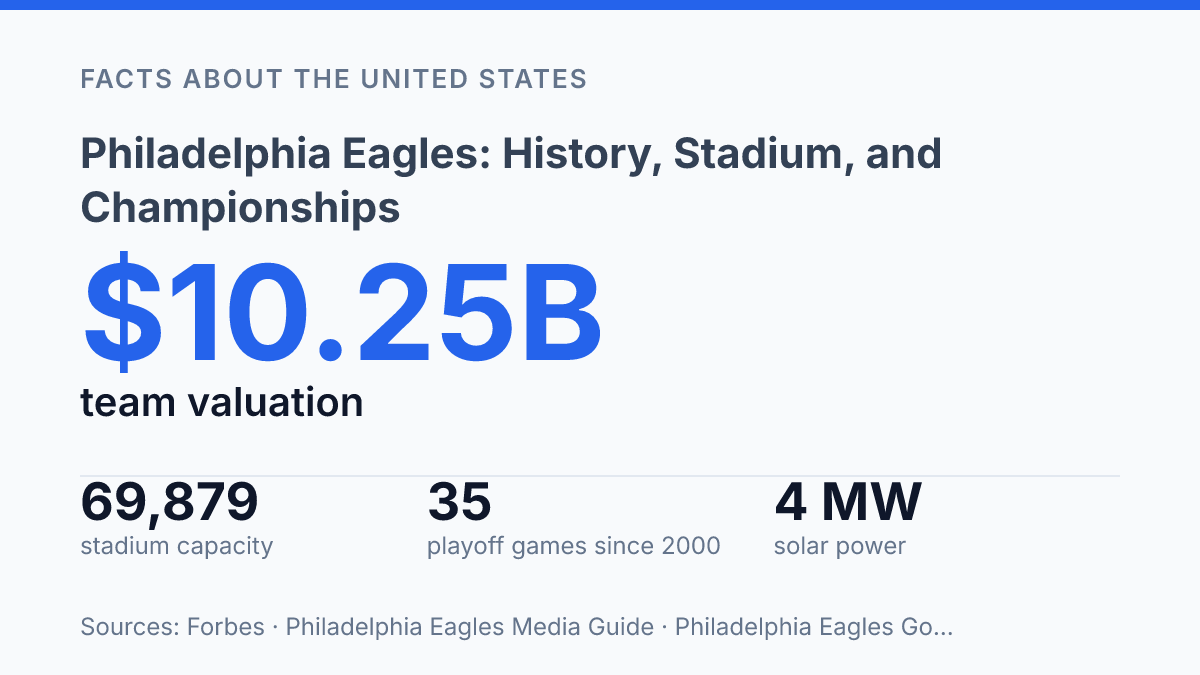
The Philadelphia Eagles began as a $2,500 franchise acquisition in 1933; Forbes listed the club at $10.25 billion in September 2026. That scale of change gives the team’s history more than a simple before-and-after shape. Bert Bell and Lud Wray built Philadelphia’s NFL successor from the remains of the Frankford Yellow Jackets, while the modern organization still ties its identity to that origin through details as precise as a 33-degree logo angle.
The same franchise now plays in a 69,879-seat stadium, has built one of the NFL’s strongest post-2000 playoff records, and added another title with a 40-22 Super Bowl LIX win over Kansas City. The story is not only about age or popularity. It is about how ownership, venue, branding, and postseason results turned a Depression-era replacement team into one of the league’s most closely measured organizations.
From 1933 replacement team to NFL mainstay
For $2,500, Bert Bell and Lud Wray acquired the former Frankford Yellow Jackets franchise in 1933, establishing the Eagles as Philadelphia’s NFL successor, according to the Pro Football Hall of Fame. The transaction mattered because the city did not receive a team in a vacuum: it followed the collapse of the bankrupt Frankford Yellow Jackets, leaving the league with both a local vacancy and an incentive to preserve professional football in Philadelphia.
Bell’s group secured the Philadelphia NFL franchise rights during a period when the league was still working toward long-term stability. The new club began as a replacement for another Philadelphia team, but it did not remain merely an administrative continuation of Frankford. Its separate name, organization, and league membership gave the franchise room to build a distinct identity while keeping the city connected to the national professional game.
The Philadelphia Eagles are now a professional American football team based in Philadelphia, Pennsylvania, and they compete in the National Football League as a member of the NFC East. That current divisional placement belongs to a much later league structure, but it helps show how far the franchise moved from its improvised beginning. What started as a response to bankruptcy became a permanent NFL presence, with the Eagles developing into one of the league’s enduring city-based clubs rather than a short-lived replacement team.
Home field, leadership, and team identity
Lincoln Financial Field is not just the Eagles’ home venue; the club says its more than 10,000 solar panels produce about 4 megawatts of clean energy annually. The team plays home games at Lincoln Financial Field in the South Philadelphia Sports Complex, a venue listed at 69,879 capacity in the Eagles’ 2025 Media Guide. That combination of scale, location, and sustainability credentials gives the stadium a role beyond hosting eight or more regular-season dates each year, making it part of the franchise’s public identity as well as its football operations.
Ownership and executive leadership give the modern organization its business structure. Jeffrey Lurie is the owner, and Don Smolenski serves as president, placing long-term franchise strategy and day-to-day organizational leadership under a stable senior group. Forbes valued the club at $10.25 billion in September 2026, a figure that reflects the financial growth of elite NFL franchises and the commercial strength attached to a major-market team with a large national following.
Team identity is also carried through symbols that are easier to recognize than executive titles or balance-sheet figures. Swoop is the mascot, while the club’s official brand standards describe a logo system with precise design rules, including an attack angle fixed at 33 degrees. That level of specification shows how carefully modern sports brands manage visual consistency across uniforms, merchandise, broadcasts, and digital channels.
A modern stadium, high-value ownership structure, and controlled brand presentation help define the club in the present. Even so, the public meaning of the franchise is not created by facilities or logos alone; those elements operate alongside decades of results, rivalries, and fan memory that continue to shape how the team is understood.
Playoff record and championship history
Thirty-two postseason appearances point to recurring contention across eras rather than a record defined only by a few isolated title runs. The Eagles’ playoff history shows a franchise that has repeatedly reached the elimination stage, even though its championships have come in a smaller number of peak seasons. That distinction matters because postseason frequency measures competitive durability, while championships measure conversion at the highest point of a season.
Division success gives the record a clearer structure. The franchise has won 17 division titles, including 14 in the NFC East, a figure that reflects long-term relevance within one of the league’s most visible divisions. Division titles do not guarantee deep playoff runs, but they usually indicate that a team has controlled its schedule well enough to earn postseason positioning rather than relying only on wild-card routes.
Before the AFL-NFL merger reshaped the championship format, the Eagles reached four NFL Championship Games and won three of them. Those victories came in 1948, 1949, and 1960, giving the club a championship record that predates the Super Bowl era and remains part of its official title history. The consecutive wins in the late 1940s are especially significant because they mark the franchise’s first sustained period of national success.
Modern postseason data adds a more recent layer to that history. Since 2000, the team ranks second in the NFL in playoff games with 35 and playoff wins with 20, and third in postseason berths with 17, according to the Eagles’ 2025 Media Guide. That span helps explain why the franchise’s contemporary reputation is tied not only to individual championship seasons, but also to repeated January participation over more than two decades.
Super Bowl wins and recent title seasons
Two wins in five Super Bowls make the Eagles’ modern-era title record compact but historically decisive. The club’s victories came in Super Bowl LII and Super Bowl LIX, while its championship-season listing identifies 2018 and 2025 as the relevant modern title years. That framing matters because repeated playoff access does not automatically translate into a championship; the final step requires winning through the conference bracket and then defeating the other conference champion on a neutral field.
The 2018 championship season supplied the franchise’s first Super Bowl-era title and reshaped how its modern history is read. Earlier championship success belongs to a different NFL structure, so the Super Bowl LII win stands apart as the point at which the club’s post-merger résumé gained a Lombardi Trophy. It also gave later teams a contemporary benchmark rather than leaving the franchise’s title identity anchored only in the pre-Super Bowl period.
The 2025 title run added a second Super Bowl win and made the recent era more than a one-title peak. According to the Philadelphia Eagles 2025 Media Guide, Philadelphia beat Kansas City 40-22 on February 9, 2025, at Caesars Superdome after a 14-3 regular season and a 10-game winning streak. The same team source says the club went 16-1 over its final 17 games including the playoffs, which places the Super Bowl LIX result within a sustained late-season surge rather than treating it as an isolated postseason upset.
Taken together, the 2018 and 2025 championships give the franchise two Super Bowl-era peaks separated by enough time to represent distinct title cycles. In historical context, that is the central point: for a team with extensive postseason history, each Super Bowl win carries disproportionate weight because it marks the rare season in which playoff qualification, conference advancement, and the championship game all aligned.
Why continuity now carries a higher standard
A club that encodes 1933 into a 33-degree logo angle is making a clear choice about continuity: the origin story remains part of the product, not just the archive. The harder question is how that continuity is judged as the organization keeps expanding in value, infrastructure, and competitive expectation.
A $10.25 billion valuation changes the scale of scrutiny, while a recent championship raises the standard for what counts as a successful era. The next useful measure is not only how many banners are added, but whether the franchise can keep aligning identity, home-field advantage, and postseason performance when each season is assessed against a much larger institutional weight.
Frequently Asked Questions
Q: When were the Philadelphia Eagles founded?
A: The franchise was established in 1933 as a replacement for the bankrupt Frankford Yellow Jackets. A group led by Bert Bell secured the rights to an NFL franchise in Philadelphia, which became the foundation of the team’s modern history.
Q: Where do the Eagles play home games?
A: The team plays at Lincoln Financial Field in the South Philadelphia Sports Complex. The stadium has been the Eagles’ home venue in Philadelphia, Pennsylvania, and it is the main site for regular-season and postseason home games.
Q: How many championships have the Eagles won?
A: The Eagles have won 2 Super Bowls, taking Super Bowls LII and LIX. They also won three pre-merger NFL Championship Games in 1948, 1949, and 1960, which gives the franchise a long championship history across different eras.
Q: How successful have the Eagles been in the playoffs?
A: The Eagles have appeared in the playoffs 32 times. That total reflects a long period of sustained competitiveness, including multiple division titles and several championship-game appearances.
Q: Who owns the Philadelphia Eagles and who is the team president?
A: The Eagles are owned by Jeffrey Lurie, and Don Smolenski serves as president. Those roles shape the franchise’s leadership structure, with ownership setting the long-term direction and the president overseeing major day-to-day operations.