
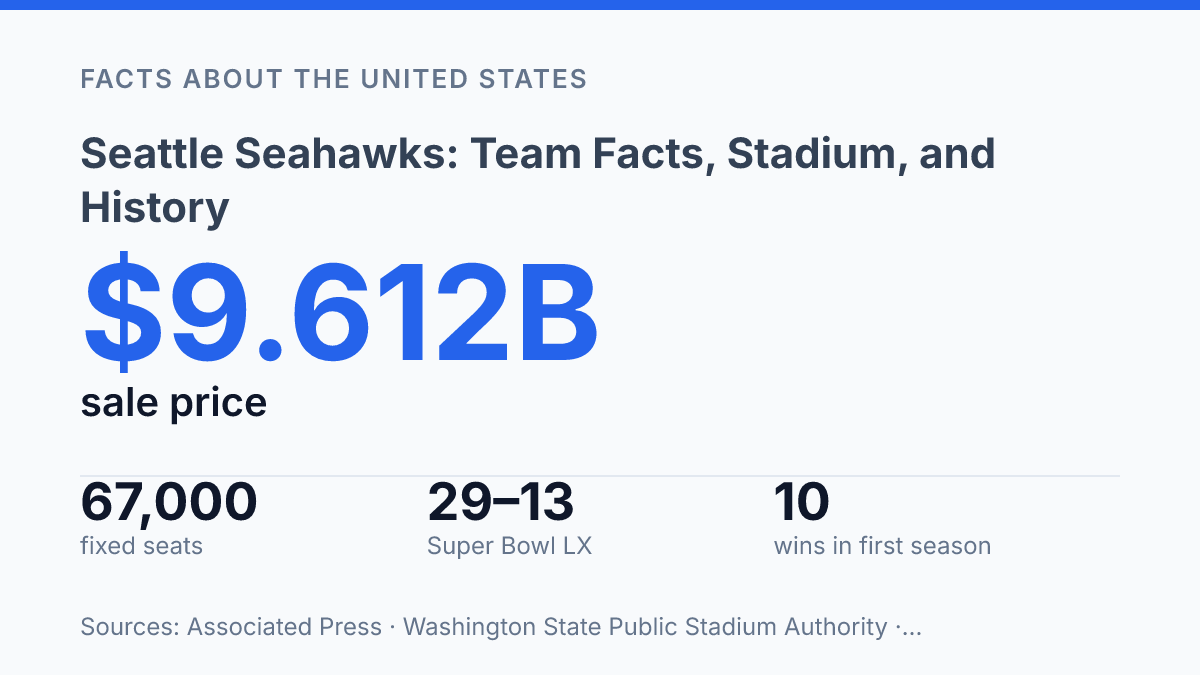
The Seattle Seahawks sit 4–3 and second in the NFC West in the NFL’s 2026 standings, but their +43 point differential points to a team profile stronger than the win total alone suggests. That contrast fits a franchise in transition rather than one defined by a single era. Mike Macdonald became the ninth head coach in team history on January 31, 2024, then set a club mark with 10 wins in his first Seattle season.
The ownership structure also changed in 2026, when the Khosla family’s purchase closed after league approval. Those developments now sit beside older identity markers: Lumen Field’s 67,000 fixed seats, the franchise’s championship record, and mascots such as Blitz, Boom, and Taima. The useful story is not only where the club plays or what it has won, but how its football, business, stadium, and public identity now fit together.
Team overview and NFL placement
As of the NFL 2026 regular-season standings page, Seattle sits second in the NFC West at 4–3, with 168 points scored, 125 allowed, and a +43 point differential. That record places the club in an active divisional race rather than simply presenting it as a regional sports brand, because NFC West placement affects common opponents, rivalry stakes, tiebreakers, and the route into the postseason.
The Seattle Seahawks are a professional American football team based in Seattle, Washington, United States. They compete in the National Football League as a member of the National Football Conference West division, commonly shortened to the NFC West. This structure matters because the team’s league identity is national, while its regular competitive frame is divisional: standings are first measured against familiar conference opponents before broader playoff seeding comes into view.
Current leadership reflects both ownership and football-operations roles. The franchise operates under controlling owner Neeru Khosla, following the ownership transition that closed on September 3, 2026.
On the football side, Mike Macdonald serves as head coach, giving the team a current regime that can be discussed separately from its longer franchise history. Together, those roles define the organization’s present placement: a Seattle-based NFL club governed by its ownership group, coached by Macdonald, and evaluated competitively through the NFC West table.
Home field at Lumen Field
A roof shielding 70% of seats helps explain why the Seahawks’ home atmosphere is loud without being fully enclosed. The team has played home games at Lumen Field since 2002, giving the franchise a long-term venue in Seattle’s SoDo neighborhood rather than a rotating or temporary home arrangement. That continuity matters because stadium familiarity shapes everything from season-ticket routines to broadcast imagery and the recurring sound profile associated with home games.
The venue’s scale is large enough to support a major NFL game-day environment while remaining closely identified with the team. According to the Washington State Public Stadium Authority, Lumen Field has 67,000 fixed seats and can expand to 72,000, with 7,000 club seats and 144 suites. Those figures describe more than capacity; they show how the building serves both mass attendance and premium hospitality, two elements that influence how modern NFL venues operate on game days.
Accessibility and sustainability features also help define the stadium beyond crowd noise. The Seahawks’ 2025 NFL media guide notes that Lumen Field has 1,400 seats for people with disabilities and companions, compared with 70 at the Kingdome, and that low-flow urinals save more than 1.3 million gallons of water each year. The same guide says 97% of Kingdome concrete was processed and recycled, connecting the current venue to the site’s earlier stadium history without making the older building the center of the team’s present identity.
Stadium identity can change even when the home field remains stable. Naming rights, renovations, and operating improvements can alter how a venue is presented, but the Seahawks’ two-decade-plus run at Lumen Field has made the building a consistent part of the franchise’s public image and home-field experience.
Championships and franchise milestones
Two championship years, 2014 and 2026, carry most of the weight in Seattle’s franchise résumé. The team is listed with NFL championships in 2014 and 2026, giving it two titles in the league’s modern competitive record. That total is the clearest shorthand for the club’s peak achievement because championships remain the most direct comparison point across franchises, even when eras, schedules, and roster-building methods differ.
The more recent title also gives the record a contemporary anchor rather than leaving the franchise’s highest achievement in the past. Seattle won Super Bowl LX on February 8, 2026, defeating the New England Patriots 29–13 at Levi’s Stadium, according to the Seahawks and the Associated Press. AP described the result as the franchise’s second Super Bowl championship, which aligns the 2026 win with the earlier 2014 championship as the defining milestones in team history.
Championship totals are useful because they compress decades of performance into a comparable measure, but they are not a complete evaluation of organizational strength. A title count does not show season-to-season consistency, roster turnover, coaching changes, injuries, or the quality of competition in a given year.
For that reason, the two championships are best understood as the clearest markers of franchise success rather than a full explanation of every competitive period. Among NFL franchises, that record places Seattle in the group of teams with multiple league titles, a standing that distinguishes the club from organizations still seeking a second championship or their first.
Mascots and team identity
A live augur hawk gives the Seahawks’ mascot program a layer that most NFL branding systems cannot replicate: an animal symbol appearing as part of the team’s pregame identity rather than only as a logo or costume. Taima is the figure most closely tied to that live hawk tradition, and the team’s official page lists the bird as hatched on April 21, 2005. That detail matters because Taima connects the franchise’s bird-of-prey imagery to a physical presence, reinforcing the name and visual identity through ceremony rather than merchandise alone.
BOOM and Blitz serve a different function as costumed mascots, translating the team’s identity into mobile, repeatable presentation pieces. The Seahawks’ media guide says BOOM arrived in Seattle on September 21, 2014, while Blitz has a longer-established public profile through appearances and team programming. In practical branding terms, these mascots help make the club’s colors, wordmarks, and bird imagery visible between plays, during entrances, and across official events where a uniformed player presence is not the focus.
The distinction among BOOM, Blitz, and Taima shows how mascot identity can operate on several levels at once. BOOM and Blitz support spectacle and accessibility because they are expressive, portable, and suited to structured in-game segments. Taima carries a more symbolic role, linking the club’s hawk theme to a live tradition with a specific animal presence.
Mascots also extend the team image beyond the field without changing the core football identity. Blitz’s official page says he has donated more than 12,000 pairs of shoes since 2020, a figure that places the character within organized community-facing work as well as entertainment. Taken together, the three mascots reinforce the Seahawks’ public image through recognizable characters, repeated visual cues, and a distinctive live-hawk element that separates tradition from routine mascot performance.
What the next era will reveal about Seattle’s staying power
The next test is less about whether Seattle has a recognizable identity than how that identity carries through a new ownership period. A franchise valued near $9.6 billion is judged by more than standings, especially when its stadium operations, community programs, coaching direction, and championship expectations all shape public perception.
The 2026 title raises the competitive standard, while the Macdonald era and Khosla ownership group give the club new reference points for measuring continuity. If the team sustains winning without weakening the traits that made its home field and fan culture distinct, the recent transition will look less like a reset and more like a controlled handoff.
Frequently Asked Questions
Q: Where do the Seattle Seahawks play their home games?
A: The Seahawks have played at Lumen Field in Seattle’s SoDo neighborhood since 2002. The stadium is central to the team’s identity and is known for its loud home atmosphere during NFL games.
Q: Which division are the Seattle Seahawks in?
A: The team competes in the NFC West, which is the western division of the National Football Conference. That placement determines most of their regular-season opponents each year and shapes their path to the playoffs.
Q: Who is the current head coach of the Seattle Seahawks?
A: The current head coach is Mike Macdonald. His role covers game planning, staff management, and overall on-field direction for the team.
Q: How many NFL championships have the Seattle Seahawks won?
A: The Seahawks are listed with 2 NFL championships, in 2014 and 2026. These titles mark the team’s highest achievements in league play and are central to its modern history.
Q: Who owns the Seattle Seahawks?
A: The team’s owner is Neeru Khosla. Ownership influences major decisions such as long-term strategy, leadership appointments, and overall franchise direction.