
Bank of America entered its modern form on September 30, 1998, as a $572 billion institution with ties to 30 million households and more than 85% of the Fortune 500. The merger of NationsBank and BankAmerica did more than join two names; it created the largest U.S. bank at the time, with roughly 8% of U.S. bank deposits, almost 5,000 offices, and nearly 14,000 ATMs.
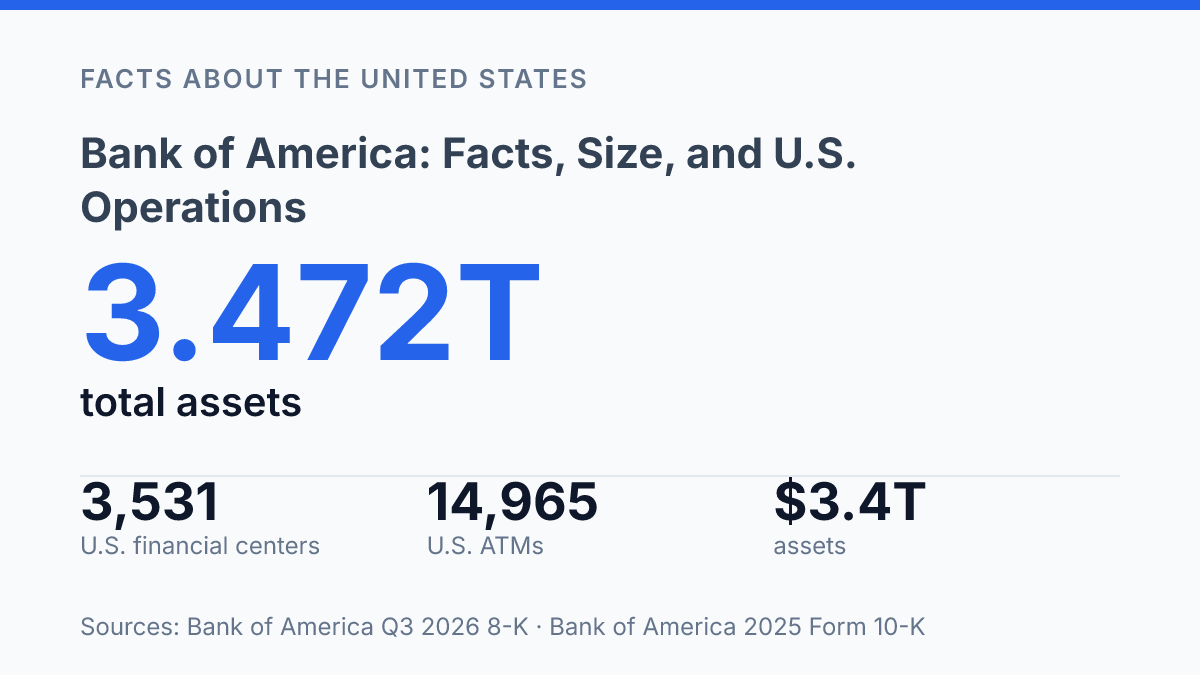
That origin helps explain why its present-day figures carry unusual weight: by September 30, 2026, the company reported $3.472 trillion in assets and a retail network of 3,531 U.S. financial centers. A clear view of the bank requires following the chain from merger structure to headquarters, business segments, peer rankings, and the regulatory consequences of operating at that scale.
How the modern bank was formed in 1998
The company carrying one of American banking’s best-known national brands took its modern corporate form on a single closing date in 1998. On September 30, 1998, NationsBank and BankAmerica closed their merger, and the new company reported $572 billion in total assets, 30 million households, 2 million business relationships, and ties to more than 85% of the Fortune 500, according to the BankAmerica/NationsBank 8-K press release. Those figures show that the merger was not simply a name change; it combined large consumer, commercial, and corporate banking relationships into a single national franchise from its first day.
The headquarters decision explains why the present institution’s geography can appear counterintuitive. Although the surviving public brand drew on the legacy West Coast-rooted BankAmerica name, the corporate center remained in Charlotte, North Carolina, reflecting the institutional base and leadership structure associated with NationsBank. The Bank of America Corporate Center in Charlotte therefore matters as more than an office tower; it marks the city’s role as the command center of the post-merger holding company.
Manhattan’s role adds a second layer to that structure. The company maintains investment banking and auxiliary headquarters functions there, aligning parts of its capital markets and corporate finance activity with New York’s financial district rather than concentrating every senior function in Charlotte. This split helps explain the modern bank’s operating identity: the brand name carries older national recognition, the legal and managerial structure dates from the 1998 combination, and key headquarters functions are distributed between Charlotte and Manhattan according to business purpose.
Where the company is based and how it is organized
The company’s legal and operating map is broader than its headquarters address suggests: Charlotte is the formal corporate base, while New York remains central to capital-markets and advisory activity. The Bank of America Corporate Center in Charlotte, North Carolina, anchors the parent company’s headquarters presence, including executive and corporate functions tied to governance, strategy, risk, and enterprise management. Its listed headquarters address is 100 N. Tryon Street, Charlotte, NC 28255, according to the company’s 2025 Form 10-K.
Bank of America Corporation is organized as an American multinational bank and financial services holding company, rather than as a single operating bank with one line of business. The 2025 Form 10-K describes it as a Delaware corporation, bank holding company, and financial holding company. That structure matters because the parent company oversees multiple banking, brokerage, wealth management, corporate finance, trading, and related financial-services activities through subsidiaries and business lines.
Operationally, the company reports through four main segments: Consumer Banking, Global Wealth & Investment Management, Global Banking, and Global Markets. This segment structure shows why more than one city is central to the institution’s identity. Charlotte functions as the corporate headquarters, while Manhattan serves as the site of investment banking and auxiliary headquarters functions, placing major dealmaking, markets, and institutional-finance operations near one of the world’s largest financial centers.
The scale of the organization reinforces that split footprint. At December 31, 2025, the company reported $3.4 trillion in assets, about 213,000 employees, and client operations in more than 35 countries and/or jurisdictions, according to its 2025 Form 10-K. Those figures describe a multinational financial group whose U.S. headquarters location is only one part of its operating geography; major corporate, consumer, wealth, investment-banking, and markets functions are distributed across specialized centers because the business itself spans distinct client groups and regulatory environments.
How it compares with other U.S. banks
The distance between first and second place in U.S. banking is measured in more than a trillion dollars on the Federal Reserve’s bank-charter table. As of June 30, 2026, the Federal Reserve ranked Bank of America, N.A. No. 2 among U.S. domestically chartered commercial banks, with $2.655 trillion in consolidated assets. The only larger U.S. bank on that measure was JPMorgan Chase Bank, which the same table listed at $4.091 trillion in consolidated assets.
That ranking places the company in the top tier of U.S. banking, but it also shows that second place is not a narrow distinction. Consolidated assets capture the size of a banking institution’s balance sheet, including loans, securities, cash, and other assets held within the reporting entity. On that basis, the bank is far larger than most domestic competitors, while still trailing the largest U.S. institution by a material margin.
Market capitalization tells a related but different story. The company’s latest quarterly filing showed a market capitalization of $376.8 billion at September 30, 2026, and its equity value has placed it as the second-largest bank in the world by market capitalization, also behind JPMorgan Chase. This comparison reflects the stock market’s valuation of the company’s publicly traded equity rather than the size of its loan book, deposit base, revenue, or branch system.
The distinction matters because a bank can rank near the top by both balance-sheet size and market value without leading every operating category. Asset rankings are grounded in accounting measures reported to regulators, while market capitalization changes with share price, investor expectations, profitability, interest-rate conditions, and perceived risk. Taken together, the two measures show that the company is one of the dominant U.S. banking groups and one of the highest-valued banking companies globally, but they should not be treated as interchangeable measures of business activity.
What these rankings mean for its role in U.S. finance
A retail network of 3,531 U.S. financial centers and 14,965 branded U.S. ATMs turns balance-sheet scale into a day-to-day distribution system, according to the company’s Q3 2026 filing. That footprint helps explain why the bank is not simply large on paper. Its size supports routine consumer banking, business credit, payments, wealth services, securities activity, and corporate finance across a wide customer base.
Large consolidated assets are significant because they represent capacity as well as size. A larger balance sheet can support more lending, hold liquid assets for payments and withdrawals, absorb market-making inventories, and connect deposit-gathering with credit and investment services. In practical terms, that scale allows one institution to serve households, small businesses, corporations, institutional investors, and governments through related financial functions rather than through a narrow banking model.
The same scale also attracts closer scrutiny because operational problems or market stress at a major institution can have effects beyond its own shareholders and customers. In June 2026, U.S. large-bank capital requirement data assigned the company a 10.0% common equity tier 1 capital requirement, including a 3.0% global systemically important bank surcharge and a 2.5% stress capital buffer. Those requirements do not predict a specific outcome, but they show that supervisory frameworks treat very large banks as institutions whose resilience matters to the broader financial system.
The split between Charlotte and Manhattan also has practical significance. A Charlotte headquarters places corporate leadership and administrative identity outside the traditional Wall Street center, reflecting the bank’s national commercial-banking roots.
Major Manhattan functions, by contrast, put investment banking and markets operations close to institutional clients, advisers, exchanges, and capital-markets talent. Together, those locations illustrate the company’s dual role in U.S. finance: a nationwide banking franchise with a major presence in the country’s primary financial district.
Why scale keeps shaping the bank’s obligations
Size is not only a ranking category for a bank of this kind; it determines how closely the institution is supervised, how much capital it must hold, and how exposed the wider financial system may be to its decisions. The clearest signal is regulatory rather than promotional: in June 2026, the Federal Reserve assigned the company a 10.0% CET1 capital requirement, including a 3.0% GSIB surcharge and a 2.5% stress capital buffer.
That requirement turns a balance-sheet statistic into a public-policy measure. Future changes in assets, deposits, branch density, or market activity will matter not just for shareholders and customers, but for how regulators define the bank’s place in U.S. financial stability.
Frequently Asked Questions
Q: Where is Bank of America headquartered?
A: Bank of America is headquartered at the Bank of America Corporate Center in Charlotte, North Carolina. It also maintains investment banking and auxiliary headquarters in Manhattan, which supports its major business lines and operational footprint.
Q: How did Bank of America get its current form?
A: The modern company was formed in 1998 through the merger of NationsBank and the legacy corporation of Bank of America. That combination created the structure that now operates as a large U.S. banking and financial services holding company.
Q: How large is Bank of America compared with other U.S. banks?
A: Bank of America is the second-largest banking institution in the United States by consolidated assets. JPMorgan Chase ranks first on that measure, which places Bank of America among the country’s largest lenders by balance-sheet size.
Q: Is Bank of America one of the largest banks in the world?
A: Yes. By market capitalization, Bank of America is the second-largest bank in the world, behind JPMorgan Chase. Market capitalization reflects how the market values the company’s equity, which is different from asset size.
Q: What type of company is Bank of America?
A: Bank of America is an American multinational bank and financial services holding company. That means its activities extend beyond traditional deposit-taking and lending into a broader range of financial services.