
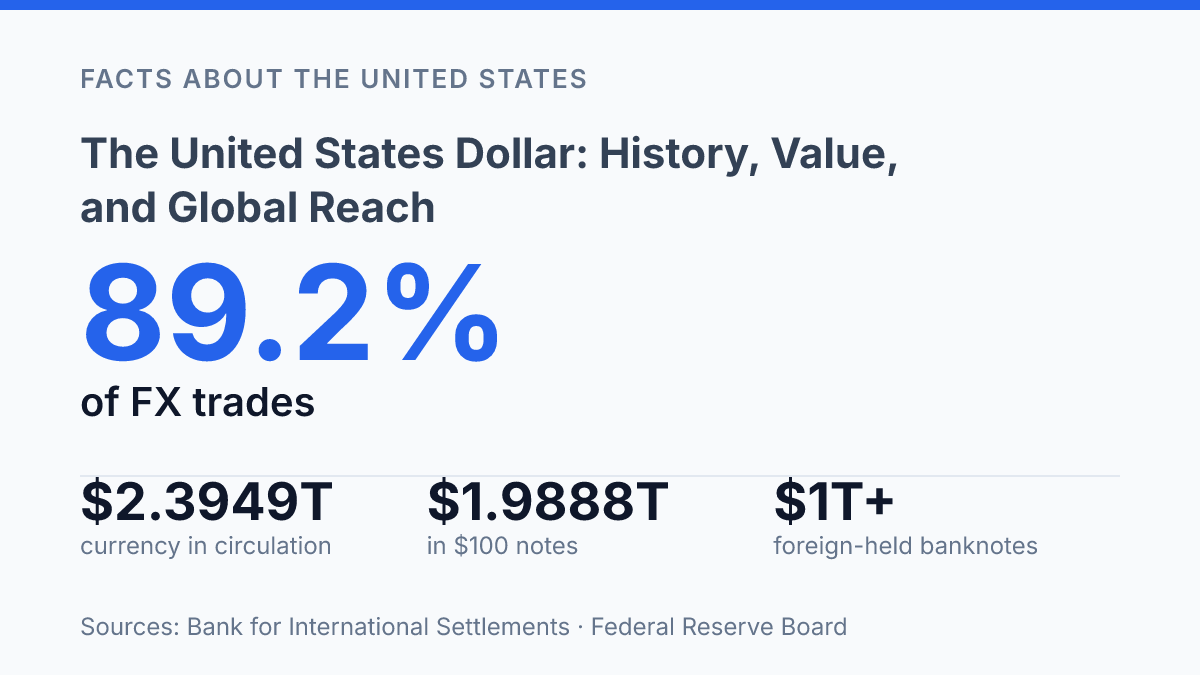
The United States dollar sat on one side of 89.2% of global over-the-counter foreign-exchange trades in April 2025, a share that shows how far a domestic monetary unit has moved beyond its national origin. Its path began with the 1792 Coinage Act, which made the dollar a decimal base unit and defined the dollar coin by its silver content. Later laws tied it more formally to gold, reset its gold price, and then severed convertibility in 1971 when foreign-held dollars had outgrown U.S. gold reserves.
The same currency also carries a Civil War nickname, greenbacks, from the green ink used on 1861 Demand Notes. Understanding the dollar means tracing both legal design and practical demand: how it became the U.S. unit of account, why gold once mattered, and why banknotes and dollar markets still function far beyond American borders.
How the dollar became the U.S. base currency
The United States dollar began as a measured quantity of silver before it became a familiar national unit of account. In 1792, the U.S. Coinage Act established the dollar as the base monetary unit of the new federal coinage system and placed it within a decimal structure. The U.S. Mint, 1792/current historical page records that the Act made the dollar a decimal base unit, set the dollar coin at 371.25 grains of pure silver, and made the cent one-hundredth of a dollar.
That decimal design was a practical departure from the pounds, shillings, and pence inherited from British usage. One dollar was divided into 100 cents, written with the cent symbol ¢, which made arithmetic in prices, taxes, and accounts more direct. The choice also gave the federal government a clear monetary standard at a time when foreign coins and state-level practices still circulated in everyday commerce.
Early dollar value was anchored in metal content rather than in an unconstrained government declaration of worth. Silver supplied the original legal definition, while later legislation adjusted the gold side of the bimetallic system, eventually tying the dollar to gold at $20.67 per troy ounce. This metal basis aimed to make money credible by connecting it to widely valued commodities, but it also meant the currency’s legal design had to contend with changing market ratios between silver and gold.
Gold links, the 1971 break, and what changed
By the 1960s, foreign claims on dollars had grown larger than the gold stock available to back them, exposing the practical limits of a currency still tied to metal. The pressure built on a structure that had been formalized by the Gold Standard Act of 1900, which moved the dollar to a gold-only link after earlier arrangements had allowed more than one metallic reference point. According to the World Gold Council and FRASER text of the act, the law defined the dollar in relation to 25.8 grains of gold nine-tenths fine and required a $150 million Treasury gold reserve, making convertibility a statutory anchor rather than only a policy convention.
The next major adjustment came during the New Deal monetary reforms. The Gold Reserve Act of 1934 reset the official gold price to $35 per troy ounce, a change that Federal Reserve History also links to the creation of a $2 billion Exchange Stabilization Fund. That revision did not remove gold from the system; it changed the official rate at which the dollar was connected to it and gave federal authorities a larger mechanism for managing exchange-market pressures.
Strains became harder to contain as dollar balances accumulated outside the United States. Federal Reserve History notes that by the end of 1962, swap lines with 9 central banks totaled up to $900 million, an effort to support the existing arrangement before President Nixon ended dollar convertibility into gold in August 1971. In 1971, the remaining gold link was repealed, ending the fixed-rate framework that had tied the dollar to a specific metal price.
The change made the modern dollar a fiat, free-floating currency rather than a claim on a fixed quantity of gold. That shift gave monetary authorities more flexibility to respond to recessions, inflation, financial stress, and changing credit conditions. It also meant that the dollar’s value would be shaped increasingly by market demand, interest-rate policy, inflation expectations, and confidence in U.S. institutions rather than by redemption at a legally fixed gold price.
Why Federal Reserve Notes are called greenbacks
The nickname did not begin as slang for modern Federal Reserve Notes: it traces to Civil War-era Demand Notes whose backs were printed in green ink. In 1861, Congress authorized non-interest-bearing Demand Notes in $5, $10, and $20 denominations, and the U.S. Currency Education Program identifies those notes as the source of the term greenbacks. The name endured because green remained strongly associated with U.S. paper money, even as note design, security features, and issuing arrangements changed over time.
Today, Federal Reserve Notes are the main form of U.S. banknotes in public use. They are obligations of the Federal Reserve System and are printed in familiar denominations such as $1, $5, $10, $20, $50, and $100. Their visibility can make paper notes seem like the whole of physical money, but coins remain part of everyday cash use for lower-value transactions, change-making, vending, transit, and small retail payments.
The value of circulating cash is concentrated much more heavily in large notes than in the bills most often used for small purchases. At year-end 2025, total U.S. currency in circulation was $2.3949 trillion, and Federal Reserve Board data show that $1.9888 trillion of that amount was held in $100 notes, about 83% of the total value outstanding. That pattern shows why the most visible notes in ordinary domestic retail settings do not necessarily represent most of the currency’s value.
Circulation patterns also vary outside the United States. In places where U.S. cash is accepted or used as everyday money, Federal Reserve Notes may be joined by U.S. coins for small payments, rather than notes alone. This distinction matters because physical currency use is shaped not only by legal status, but also by local pricing, available denominations, payment habits, and the practical need for small change.
How the dollar functions beyond U.S. borders
In April 2025, the dollar was on one side of 89.2% of all over-the-counter foreign-exchange trades, according to the Bank for International Settlements, whose survey put global FX turnover at $9.6 trillion per day. That share is especially revealing because every foreign-exchange trade has two sides, so dollar use at this scale shows that it is not merely one national currency among many but the main pricing, settlement, and liquidity reference for global markets.
The dollar’s reserve-currency role became dominant after World War II, when the Bretton Woods Agreement placed it at the center of the postwar monetary system and helped displace sterling as the leading reserve asset. Central banks and finance ministries hold dollar-denominated reserves because deep U.S. financial markets, large trade flows, and broad acceptance make the currency useful for intervention, debt service, import payments, and emergency liquidity. This reserve function reinforces transaction use: the more institutions hold and settle in dollars, the more attractive it remains for others that need predictable access to global markets.
Outside formal reserve management, the dollar is widely used by businesses, banks, and households in countries where local currencies are volatile, capital markets are shallow, or imported goods are commonly priced in dollars. The Federal Reserve Board reported that in Q1 2025, foreigners held more than $1 trillion in U.S. dollar banknotes, roughly half of all dollar banknotes outstanding. Physical cash demand reflects a different kind of confidence from electronic finance: in some economies, dollar notes serve as a store of value, a payment medium for high-value transactions, or a fallback when trust in domestic money weakens.
Several countries use the dollar as official money, including Ecuador, El Salvador, Timor-Leste, the Marshall Islands, Micronesia, and Palau, while many others rely on it unofficially in savings, real estate, tourism, remittances, or wholesale trade. This reach gives the currency unusual global depth, but it also means dollar demand is shaped by conditions well beyond the United States. Cross-border trade patterns, central-bank reserve choices, interest-rate expectations, and foreign confidence all affect how widely the currency is used and how strongly it is valued.
What the dollar’s reach now depends on
The dollar’s next phase will be judged less by metal backing than by the systems that keep it useful: deep financial markets, trusted settlement, predictable legal treatment, and broad acceptance in times of stress. Physical cash and foreign-exchange trading show two different kinds of demand. A $100 note held outside the United States serves a different purpose from a dollar position in a currency trade, but both depend on confidence that the unit will remain widely acceptable tomorrow.
That confidence is not permanent by law or habit alone. It has to be renewed through monetary credibility, institutional stability, and the absence of a more liquid substitute at comparable scale.
Frequently Asked Questions
Q: What is the official currency of the United States?
A: The official currency of the United States is the U.S. dollar, with the symbol $ and the currency code USD. It is divided into 100 cents. Federal Reserve Notes are the main banknotes in circulation, and they are often called greenbacks because of their color.
Q: When was the U.S. dollar created?
A: The dollar was established as the base unit by the Coinage Act of 1792. That law set the structure of the U.S. currency system and defined how the dollar would be subdivided into cents. It also helped standardize U.S. money after independence.
Q: Was the dollar ever tied to gold or silver?
A: Yes. The dollar began under a bimetallic standard, first linked to 371.25 grains of fine silver or, from 1834, 23.22 grains of fine gold. The Gold Standard Act of 1900 tied it solely to gold, and that link was ended in 1971 when the last gold standard connection was repealed.
Q: Why is the U.S. dollar used so widely around the world?
A: The dollar became a major reserve currency after the First World War and displaced the British pound sterling as the primary reserve currency after the Bretton Woods Agreement. It is now the most widely used currency in international transactions. That wide use reflects deep financial markets, trade invoicing patterns, and its role as a global reserve asset.
Q: Is the U.S. dollar used outside the United States?
A: Yes. The dollar is the official currency in several countries and the de facto currency in many others. In some places, Federal Reserve Notes circulate alongside local money, and in a few cases U.S. coins are also used.