
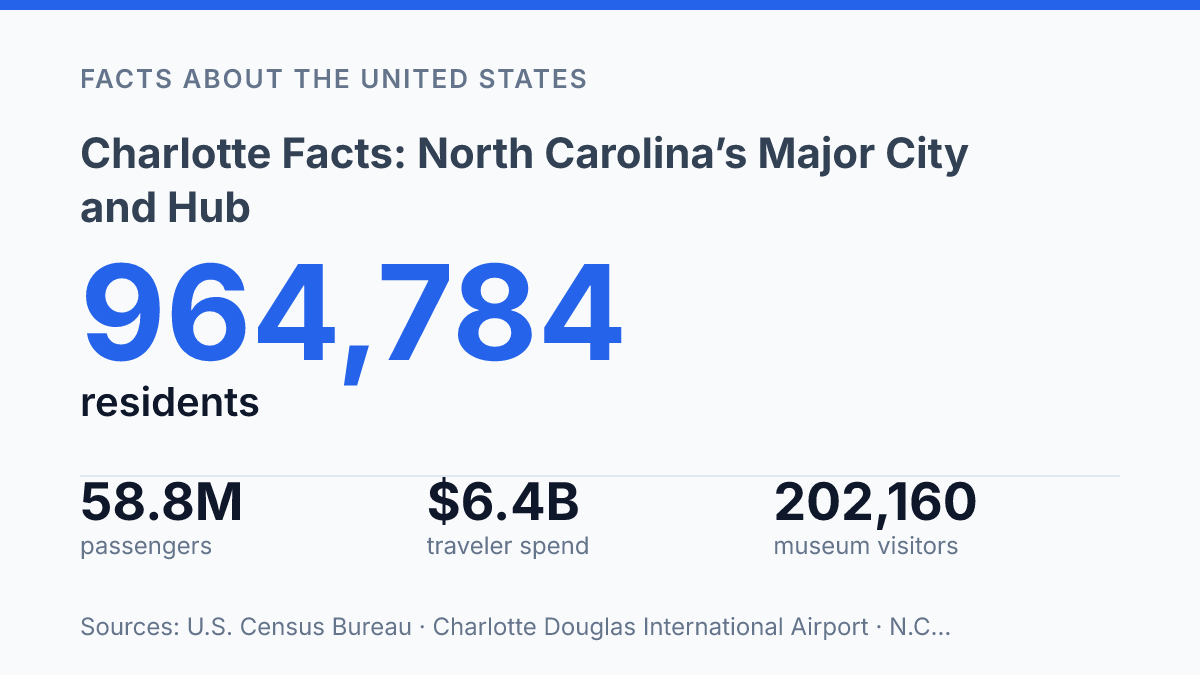
Charlotte had 964,784 residents as of July 1, 2025, after growing 10.3% from the April 2020 estimates base, a pace that helps explain why North Carolina’s largest city is treated as a regional force rather than a local market. Its influence is not only demographic. The region accounts for about 32% of total output in the Carolinas, while Charlotte Douglas International Airport handled 58.8 million passengers in 2024.
Those figures place the city at the intersection of population growth, finance, transportation, tourism, and cultural activity. The facts behind that position are clearest in Uptown, where corporate offices, museums, sports venues, restaurants, and visitor attractions sit within a compact center. They also appear in institutions such as the NASCAR Hall of Fame, which links the city’s identity to a wider regional economy built around events, mobility, and business travel.
Why Charlotte matters in North Carolina
With nearly 1 million residents and one of the nation’s densest finance concentrations, Charlotte functions less like a state city and more like a Carolinas-scale economic capital. It is North Carolina’s largest city, with 964,784 residents as of July 1, 2025, up 10.3% from the April 2020 estimates base, according to the U.S. Census Bureau. That scale matters because population growth supports a larger labor force, deeper consumer markets, and more frequent demand for transportation, housing, and business services.
The city’s economic influence is especially visible in finance and corporate headquarters activity. The municipal FY2025 annual comprehensive financial report describes the area as the nation’s second-largest banking center, anchored by Bank of America with $2.62 trillion in consolidated assets and Truist Financial with $527.5 billion. The same report notes that the broader area had 7 Fortune 500 companies and 19 Fortune 1000 companies in the June 2025 Fortune rankings, showing that the city’s business role extends beyond banking into a wider corporate base.
Geography strengthens that position. Located in the Piedmont region, the city sits between the Appalachian foothills and the Atlantic coastal plain, a location that helps connect markets across North Carolina, South Carolina, and the wider Southeast.
Its international airport reported 58.8 million passengers in 2024, a 10% increase from 2023, and said it contributed $40 billion to the economies of the two Carolinas in 2023. Those figures help explain why regional commerce, executive travel, conventions, and freight-related activity cluster around the city.
Finance and growth do not fully define the city’s identity, however. The local economy also benefits from visitor spending, cultural institutions, and sports-related tourism, which broaden its role beyond office towers and corporate balance sheets. Mecklenburg County recorded $6.4 billion in traveler expenditures in 2024, according to state tourism and economic research sources, reinforcing the point that North Carolina’s largest city is both a business center and a major destination within the state.
What to see in Uptown
In only a few Uptown blocks, a visitor itinerary can move from post-Civil War Southern history to experiment-driven science exhibits without leaving the central district. That compression is what makes Uptown the city’s most recognizable core: it is a working downtown, but its offices and civic spaces are interwoven with museums, restaurants, shops, and public attractions rather than separated from them.
Center City Partners reported that Uptown had 34 new businesses open in 2024, along with more than 150 locally owned shops and restaurants, more than 190 food-and-drink spots, and 27 arts and cultural attractions. The figures matter because they show Uptown as an active urban district rather than a place defined only by weekday office traffic. Its appeal comes from proximity: cultural stops, meals, and public spaces can be combined in a compact area.
The Levine Museum of the New South anchors the district’s historical side by focusing on the South after the Civil War, including the social, political, and economic changes that reshaped the region. The museum reported 323,137 engagements in FY2024–2025, a 59% increase over the prior fiscal year, indicating that its public-history programming reaches well beyond conventional museum attendance. Its presence gives Uptown a major interpretive institution devoted to the modern South, not only the city’s skyline and entertainment venues.
Discovery Place adds a different kind of draw through hands-on science exhibits designed around interaction rather than passive viewing. According to Discovery Place Inc.’s FY2025 filing, the institution recorded 69,668 guests at its IMAX Dome and reached 18,285 students through 419 outreach programs. In Uptown, that educational role sits beside the district’s restaurants and civic spaces, reinforcing the area’s dual identity as both an everyday center and a visitor destination.
How the NASCAR Hall of Fame fits the city
In FY2025, the NASCAR Hall of Fame drew 202,160 visitors, and more than half came from outside the local market, according to the Regional Visitors Authority’s impact report. That scale makes the Uptown attraction more than a niche museum for racing fans. It functions as a measurable tourism asset, generating 83,387 hotel room nights and $68.3 million in total economic impact, including $42.2 million in direct visitor spending.
Its location in Uptown helps connect the city’s motorsports identity with its main visitor district. The hall uses interactive exhibits, artifacts, simulator-style experiences, and films to explain how stock car racing developed, how race teams work, and why drivers, crews, tracks, and manufacturers became central to the sport’s culture. This format matters because auto racing can be difficult to understand from static displays alone; the attraction turns technical subjects such as speed, safety, pit work, and race strategy into public-facing interpretation.
The hall’s significance also depends on a wider regional racing economy rather than on museum attendance alone. The surrounding area has long been associated with stock car teams, race shops, engineering talent, fabrication businesses, and motorsports media. That concentration gives the attraction a local context that many sports halls of fame do not have: the industry being interpreted inside the building is still visibly tied to businesses and workers across the region.
This connection strengthens the city’s public image in a specific way. Banking, air travel, and corporate growth explain much of the city’s national profile, but motorsports gives it a cultural identity that is less interchangeable with other large business centers. The NASCAR Hall of Fame packages that identity for visitors while also pointing to the specialized economy that helped make the area one of American stock car racing’s central places.
Why Charlotte draws both visitors and business
A city that can draw visitors for stock-car heritage while expanding finance, museum audiences, and professional-service employment is not easily reduced to one calling card. The city had 964,784 residents as of July 1, 2025, up 10.3% from the April 2020 estimates base, according to the U.S. Census Bureau. That pace matters because population growth supports both sides of the city’s appeal: a larger labor market for employers and a larger local audience for restaurants, museums, events, and entertainment districts.
The business case is reinforced by regional output rather than by office towers alone. The city’s FY2025 annual financial reporting states that the wider regional economy accounts for about 32% of total output in the Carolinas, while the metro added 24,200 nonfarm jobs from August 2023 to August 2024. For a visitor, those figures are not abstract; they help explain why hotels, dining, meeting activity, and cultural programming cluster so strongly near the central business district.
Uptown functions as the practical meeting point between commerce and leisure. Office workers, conference attendees, museumgoers, families visiting hands-on science exhibits, and racing fans can occupy the same compact area without the district depending on a single attraction. The Levine Museum of the New South and Discovery Place broaden the city’s identity beyond finance, while the NASCAR Hall of Fame gives the center a sports-history anchor tied to the region’s industrial and cultural roots.
This breadth strengthens the city’s national reputation, but it also makes the place harder to define in a single phrase. Some cities are known first for one monument, one industry, or one historic district; this one is better understood through the overlap of corporate scale, cultural institutions, and visitor infrastructure. Its growth has turned that combination into a recognizable urban profile: a Southern commercial hub where business travel, family tourism, and sports heritage reinforce rather than replace one another.
Why the next set of numbers will matter more
Growth at this scale makes the city’s facts time-sensitive rather than fixed. A population estimate, airport total, museum attendance figure, or corporate ranking can shift within a year, which means the most accurate reading comes from comparing indicators instead of relying on a single headline number.
The stronger pattern is the connection between movement and concentration: people are arriving, firms are clustering, travelers are passing through, and cultural venues are converting that traffic into measurable economic activity. If current trends continue, the next useful question will not be whether the city matters in North Carolina, but how far its influence extends across the Carolinas.
Frequently Asked Questions
Q: What is Charlotte known for besides banking?
A: Charlotte is known for being a major city and commercial hub in North Carolina, but its downtown area, known as Uptown, also draws visitors for cultural attractions. Uptown includes the Levine Museum of the New South, Discovery Place, and the NASCAR Hall of Fame, which together reflect the city’s historical, scientific, and sporting interests.
Q: What can visitors do in Uptown Charlotte?
A: Uptown offers several major attractions in a compact area. Discovery Place focuses on hands-on science exhibits, while the Levine Museum of the New South presents post-Civil War Southern history. The NASCAR Hall of Fame adds interactive displays and films for motorsports fans.
Q: Is Charlotte a good city for families and educational trips?
A: Charlotte has several attractions that fit family and school visits because they combine learning with public exhibits. Discovery Place is especially relevant for science education, and the Levine Museum of the New South provides a history-focused visit. The mix of institutions makes the city useful for both general tourism and structured learning trips.
Q: What is the NASCAR Hall of Fame in Charlotte?
A: The NASCAR Hall of Fame is one of Uptown Charlotte’s best-known attractions. It celebrates auto racing through interactive exhibits and films, which makes the experience more hands-on than a traditional museum. Its presence also reflects the city’s broader association with motorsports.
Q: Why is Charlotte considered an important city in North Carolina?
A: Charlotte is considered important because it serves as a major city and commercial hub in the state. North Carolina depends on Charlotte for business activity, and its Uptown district adds cultural weight through museums and major attractions. That combination of commerce and public institutions gives the city influence beyond its population size.