
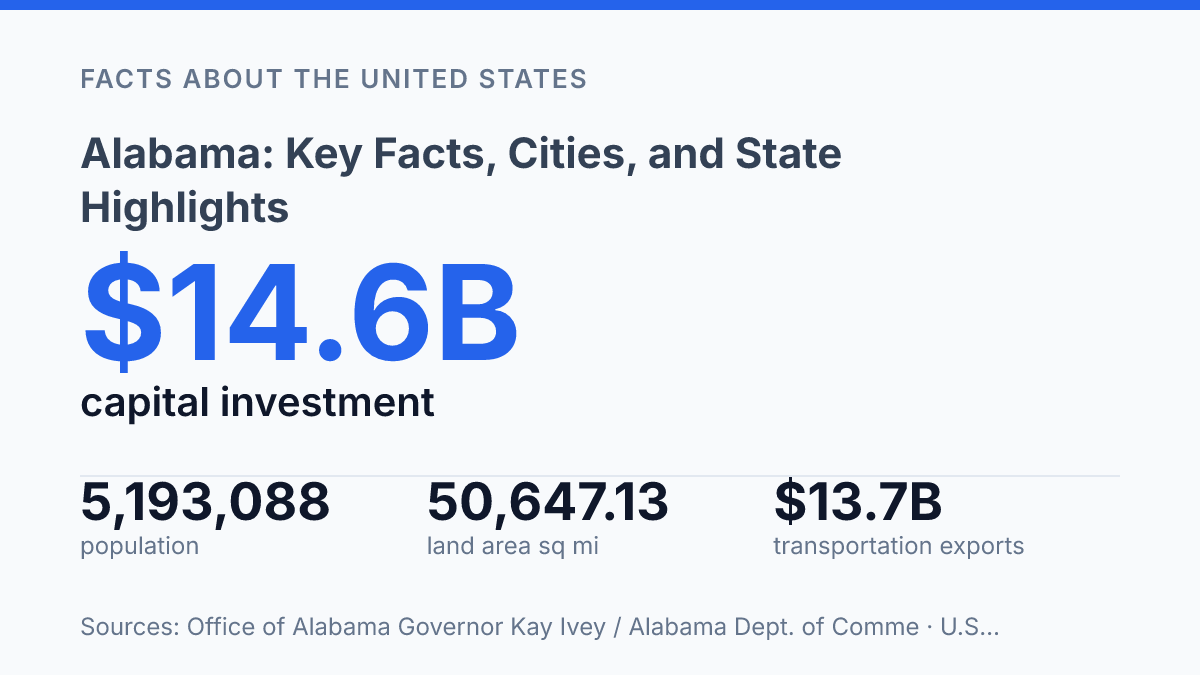
Alabama’s population pattern is unusually concentrated: in 2024, just eight of its 67 counties held more than half of all residents, led by Jefferson, Madison, and Mobile counties. That distribution helps explain why a state of 50,647 square miles can be understood through a relatively small set of anchors, including Huntsville, Mobile, Birmingham, and Montgomery. The numbers also show a state changing in specific ways rather than in broad generalities.
Huntsville ranked as the largest city in 2024 with 230,402 residents, while industry data points to major roles for auto manufacturing, aerospace, exports, and port logistics. This guide frames the state through those practical reference points: its geography and county structure, the economic sectors that carry the most weight, the cities that define regional identity, and the cultural and sports institutions that shape how the state is recognized.
Where Alabama is located and how it is organized
Only a short stretch of Gulf coastline connects Alabama to maritime routes, while most of its boundary ties it to four neighboring states. The state sits in the Deep South, bordered by Tennessee to the north, Georgia to the east, Mississippi to the west, and Florida to the south, with its Gulf of Mexico frontage centered around the Mobile area. That position helps explain why its geography is both inland and coastal, linking Appalachian foothills, river systems, agricultural counties, and port access within one state framework.
The political center is Montgomery, which serves as the state capital and anchors state government rather than ranking as its largest population center. Alabama became the 22nd state admitted to the Union on December 14, 1819, a date that places its statehood in the early 19th-century expansion of the United States. For basic organization, the state is divided into 67 counties, but population and influence are not spread evenly across them.
In 2024, just eight of the state’s 67 counties accounted for more than half of its population, led by Jefferson County with 664,744 residents, Madison County with 423,355, and Mobile County with 412,339, according to USAFacts using U.S. Census Bureau Population Estimates Program. This concentration shows why a few county seats and regional centers carry outsized weight in politics, infrastructure planning, education, and employment.
City rankings depend on the measure being used. Huntsville was the largest municipality in 2024, with 230,402 residents, ahead of Mobile, Birmingham, and Montgomery; however, Birmingham is often treated as the state’s largest urban area when the broader metropolitan region is the comparison. The distinction matters because municipal population measures people inside city limits, while metro area size reflects a wider labor market and suburban growth pattern.
What the state’s economy is built on
Motor vehicles alone accounted for $10.7 billion in exports in 2024, a scale large enough to make the state the No. 2 auto-exporting state nationally, according to the state commerce department’s 2026 Annual Trade Strategy. That figure reflects a manufacturing base anchored by assembly plants and supplier networks around Tuscaloosa, Montgomery, and the I-65 corridor.
Mercedes-Benz production near Tuscaloosa and Hyundai production in Montgomery are central examples, while parts makers, logistics firms, and related metal and plastics operations extend the sector’s reach well beyond the assembly line. The Alliance for Automotive Innovation estimates 164,900 total auto-related jobs in the state, equal to 5.69% of jobs, with $19.86 billion in gross state product tied to the industry.
Huntsville adds a different kind of economic weight through aerospace, defense, engineering, and federal contracting. NASA’s Marshall Space Flight Center had 2,224 federal employees and 20,023 contractors in the state, and NASA’s 2025 economic impact sheet credited its activity with supporting 35,494 jobs statewide.
Redstone Arsenal reinforces that concentration by bringing Army, missile-defense, aviation, and research missions into the same labor market. The result is a cluster where public-sector missions and private contractors feed demand for engineers, software specialists, advanced manufacturing workers, and technical services.
The Port of Mobile gives the economy a coastal logistics base that connects inland producers to national and international markets. In 2025, the port authority announced completion of the $366 million Mobile Harbor Modernization Project, giving the harbor a 50-foot channel and describing it as the deepest container port in the Gulf. Its rail and inland-waterway connections are especially important for heavy and bulk industries, including steel, forest products, chemicals, and other cargo that depend on cost-efficient freight movement.
Recent development figures show both breadth and unevenness. State officials reported 234 new and expanding industry projects in 2025, with $14.6 billion in capital investment and 9,388 new job commitments; rural targeted counties accounted for $2 billion of that investment and 2,011 jobs.
That distribution suggests a diversified economy, but not an evenly distributed one. High-wage technical work remains most concentrated in a few metro areas, while manufacturing and logistics investment spreads more widely through corridors, ports, and industrial sites.
Major places to know and what they are known for
Birmingham is best understood through metropolitan influence rather than city-limit rankings, because it remains the state’s largest metro even as municipal population patterns have shifted. Its older identity was built around iron, rail, and heavy industry, but its present-day role is more closely tied to health care, finance, and professional services. UAB gives the city a major medical and research anchor, while regional banking and corporate offices reinforce its status as a statewide business center.
The city’s national significance also rests on civil rights history, especially 1963, when the Birmingham campaign, the Children’s Crusade, and the bombing of the 16th Street Baptist Church made the city central to the struggle against segregation. These events are not simply local landmarks; they help explain why Birmingham occupies a larger place in American historical memory than population figures alone would suggest.
Mobile represents a different kind of importance, defined by its Gulf Coast setting and long maritime orientation. Its port activity connects the coast with inland trade routes, warehouses, rail links, and industrial waterfronts, giving the city a practical role that extends beyond local commerce. Mobile is also strongly associated with Mardi Gras; its carnival tradition is commonly traced to 1703, making it older than the better-known New Orleans celebration and a defining part of the city’s civic identity.
Huntsville shows why size, recognition, and specialization should be treated separately. Its recent growth has been tied less to traditional urban hierarchy than to aerospace, engineering, and federal research, supported by a deep technical workforce and institutions such as Cummings Research Park, often described as the second-largest research park in the United States. That gives Huntsville a distinct profile: less historic as a cultural symbol than Birmingham or Mobile, but increasingly central to the state’s high-skill growth story.
Culture, sports, and places that shape state identity
On autumn Saturdays, Bryant-Denny Stadium can hold more than 100,000 people, a scale that helps explain why college football functions as civic ritual as much as entertainment. The University of Alabama and Auburn University carry statewide influence through rivalry, alumni networks, marching-band traditions, and annual games that shape local calendars far beyond Tuscaloosa and Auburn. The Iron Bowl is the clearest example: it is a sporting event, but also a recurring marker of family identity, regional loyalty, and media attention across the state.
Civil rights memory gives that identity a different kind of national weight. Birmingham is represented not only through surviving church and downtown sites, but also through institutions such as the Birmingham Civil Rights Institute, which frames the city’s movement history for public education rather than commemoration alone.
Montgomery’s landmarks, including Dexter Avenue King Memorial Baptist Church, the Rosa Parks Museum, and the Civil Rights Memorial, connect political protest, legal change, and public mourning in a compact civic geography. In Selma, the Edmund Pettus Bridge remains closely tied to the 1965 voting-rights marches, making the city a symbol of democratic access rather than simply a preserved historic setting.
The state’s musical identity is unusually concentrated in Muscle Shoals, where FAME Studios and Muscle Shoals Sound Studio helped define Southern soul through recordings associated with artists such as Aretha Franklin, Wilson Pickett, Etta James, and the Staple Singers. That sound drew from gospel phrasing, blues rhythm, country instrumentation, and church-rooted vocal intensity, which helps explain why a relatively small recording community influenced national popular music. The result was not a single genre brand, but a working studio culture that connected Black sacred and secular traditions with the commercial reach of American soul and rock.
Taken together, these touchpoints show a state identity that is layered rather than singular. Football creates shared spectacle, civil rights landmarks preserve moral and political memory, and music links local places to national sound. Those cultural associations sit alongside the state’s newer industrial and research profile, so heritage remains central without fully defining the modern public image.
Where the next map of growth is likely to form
The state’s next phase is likely to be measured less by a single dominant city than by how well its major anchors connect. Huntsville’s aerospace base, the auto corridor, rural industrial recruitment, and Mobile’s 50-foot shipping channel point to a development model built across regions rather than within one metropolitan center.
That creates a practical test for transportation planning, workforce training, and county-level investment: growth will matter most where local assets can link to statewide systems. The most telling indicator may not be which city ranks first in population, but whether smaller counties can turn access to ports, rail, universities, defense work, and manufacturing suppliers into durable employment.
Frequently Asked Questions
Q: What is Alabama best known for?
A: Alabama is known for its role in the civil rights movement, its Gulf Coast beaches, and a strong presence in aerospace, manufacturing, and agriculture. The state also has a deep college sports culture, especially around football, which shapes much of its public identity.
Q: What are the largest cities in Alabama?
A: Birmingham is the largest city by population, followed by Huntsville, Montgomery, and Mobile. These cities anchor different parts of the state’s economy, with Birmingham tied to finance and industry, Huntsville to aerospace and defense, Montgomery to government, and Mobile to the port and shipping sectors.
Q: What is the capital of Alabama?
A: Montgomery is the state capital of Alabama. It serves as the center of state government and is also closely associated with civil rights history, including major events and institutions from the 1950s and 1960s.
Q: What region of the United States is Alabama in?
A: Alabama is in the southeastern United States. It borders Tennessee, Georgia, Florida, Mississippi, and the Gulf of Mexico, which gives it both inland transport links and a direct coastal connection for trade and tourism.
Q: What are some major attractions or places to visit in Alabama?
A: Popular destinations include Gulf State Park, the U.S. Space & Rocket Center in Huntsville, and historic sites in Montgomery and Birmingham. The state also draws visitors to its beaches, state parks, and museums that document both natural history and civil rights history.