
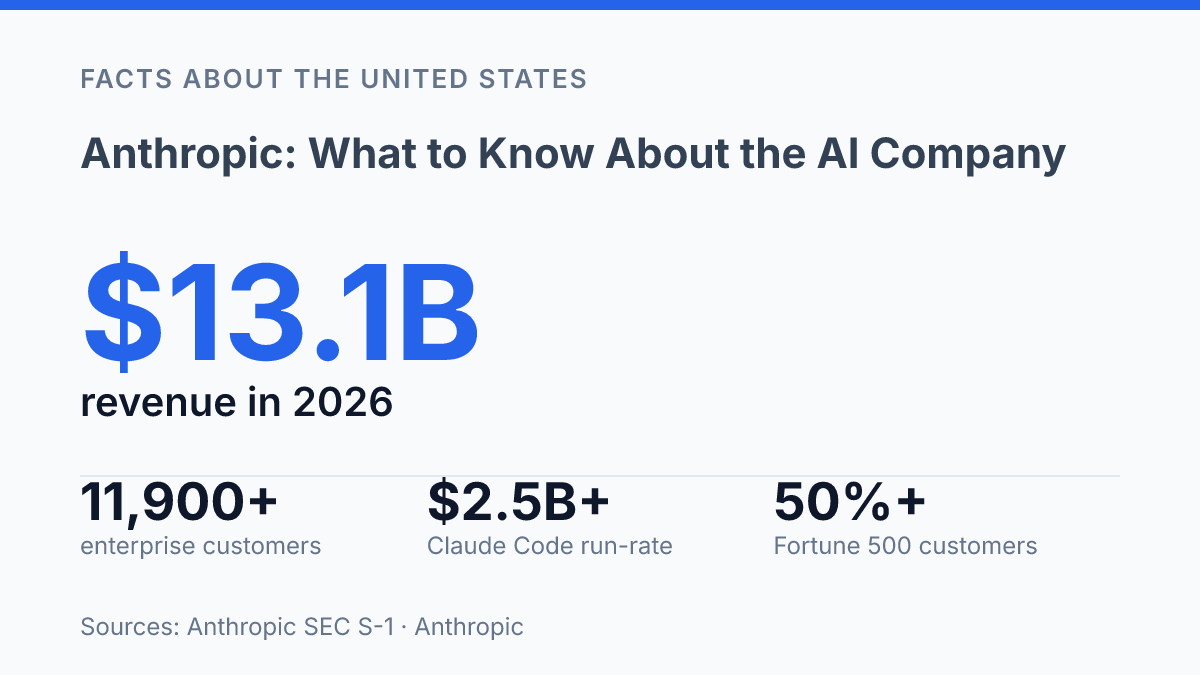
Anthropic grew from a January 2021 Delaware public benefit corporation into a San Francisco AI company reporting $13.1 billion in consumption-based revenue for the six months ended June 30, 2026. That scale gives the company a different profile from an AI lab known mainly through product demos: its commercial engine is Claude, sold through platform access, applications such as Claude Code, and industry-specific deployments. The corporate form also matters because its stated public-benefit purpose is to “responsibly develop and maintain advanced AI for the long-term benefit of humanity,” a promise now tested against rapid enterprise uptake.
Public filings show more than 11,900 customers at $100,000 or more in trailing-12-month revenue as of September 30, 2026. Understanding the company therefore requires connecting location, legal structure, leadership under Dario and Daniela Amodei, and the role it plays in U.S. scrutiny of advanced AI.
What Anthropic is and where it is based
Anthropic, PBC is not organized as a conventional private technology company, but as an American artificial intelligence public benefit corporation. The company is headquartered in San Francisco, California, placing its corporate base in the same city where it was founded on January 26, 2021, in San Francisco, California, United States.
According to the Anthropic SEC S-1, the company is a Delaware public benefit corporation incorporated in January 2021 with a public-benefit purpose to “responsibly develop and maintain advanced AI for the long-term benefit of humanity,” and it is headquartered in San Francisco, California. That legal form is relevant because a public benefit corporation is designed to identify a broader public-purpose objective alongside business activity, rather than defining the company only by shareholder value.
The structure should not be overread on its own. A public benefit corporation designation signals a formal social-purpose framing, but it does not by itself demonstrate how that purpose affects day-to-day product choices, commercial priorities, board oversight, or governance outcomes. For basic identification, the key points are narrower and more concrete: the organization is an American AI company, legally structured as a Delaware public benefit corporation, founded and based in San Francisco.
How Claude fits into the company’s business
Claude is not a single app but the proprietary model family through which much of the company’s usage-based business is packaged and sold. Claude is Anthropic’s flagship product, and the line is best understood as both an AI assistant and a series of proprietary large language models that can be accessed through consumer-facing interfaces, developer tools, and enterprise products.
That positioning matters commercially because the company can sell Claude in more than one form. According to the company’s SEC S-1, revenue is generated as customers use Claude through its platform and applications, including Claude Code, Claude Cowork, and industry-specific offerings. Consumption-based revenue rose to $13.1 billion for the six months ended June 30, 2026, or 80% of total revenue, showing that paid usage of the model family is central to the business rather than an ancillary product line.
Claude Code illustrates how the model family can expand into specialized workflows without becoming a wholly separate business. After its full launch in May 2025, the product was generating more than $500 million in run-rate revenue, with usage growing more than 10-fold in three months, according to company reporting. A later 2026 update said Claude Code had surpassed $2.5 billion in run-rate revenue, indicating that coding assistance had become one of the clearest commercial expressions of the Claude platform.
The proprietary nature of Claude gives the company tighter control over product behavior, deployment, safety features, and monetization. The tradeoff is that outside researchers and customers have less visibility than they would with open-weight model alternatives, where model parameters are publicly released. For a company selling advanced AI to businesses, that structure supports a controlled product strategy, while also making trust, documentation, and performance evidence more important to market acceptance.
Leadership and company profile
The most useful leadership detail for identifying the company is that Daniela Amodei is listed as Co-Founder and President, a role that reaches across both technical and commercial functions. According to the company’s 2026 leadership page, she oversees research, engineering, product, governance, and commercial execution, and manages the executive team. That scope makes the title more than a ceremonial label; it places her in the set of executives relevant to reporting on how the company connects model development, product direction, and market strategy.
Leadership naming also helps distinguish the firm from other AI companies formed by technically similar founding groups in the early 2020s. Public profiles of frontier-model companies often emphasize products, funding, and safety claims, but executive names provide a more stable reference point for separating one organization from another when coverage involves related labs, overlapping talent pools, or comparable business models. In this case, the leadership page also identifies Dario Amodei as Co-Founder and CEO, which clarifies the executive pairing without requiring a longer corporate history.
The San Francisco connection gives that profile additional context because the company emerged from the same local and sector conditions that shaped many early-2020s AI startups: proximity to technical talent, investors, cloud partners, and policy attention around advanced systems. A leadership snapshot is therefore useful not only as a biographical marker but as a reporting aid for a company whose identity is tied to both frontier-model development and a specific Bay Area institutional setting.
Organizational titles should still be treated as current-profile information rather than permanent facts. Executive responsibilities can change as a company scales, prepares regulatory filings, or reorganizes around new products, so the most reliable reference for leadership details is the company’s latest official disclosure or leadership page.
Why Anthropic matters in U.S. AI coverage
By September 30, 2026, the company reported more than 11,900 customers generating at least $100,000 in trailing-12-month revenue, according to its 2026 SEC S-1. That scale helps explain why a San Francisco-based American AI developer is treated as a recurring subject in U.S. technology coverage rather than as a narrow research lab or single-product startup.
For readers seeking factual company information, the two orientation points that most often matter are its public benefit corporation status and the Claude product line. The legal form signals that the company presents itself through a stated public-benefit framework, while the model and assistant products explain how its technology reaches businesses, developers, and other users. Together, those facts place the firm at the intersection of corporate governance, frontier-model development, and commercial AI adoption.
Its 2021 launch also situates the company within the recent wave of U.S. generative AI firms that emerged as large language models moved from research systems into widely deployed software products. That timing matters because much of the public record around these companies is still being formed through product releases, enterprise contracts, regulatory filings, and leadership disclosures, rather than through decades of operating history.
The company’s relevance is reinforced by large-enterprise adoption. As of September 30, 2026, its filing said more than 50% of the Fortune 500 and more than 30% of the Global 2000 were customers producing at least $100,000 in trailing-12-month revenue. The same filing said model versions released in the six months ended September 30, 2026 accounted for over 80% of revenue in that quarter, showing how closely commercial performance is tied to rapid model-release cycles.
That combination of youth, U.S. base, corporate structure, and product reach explains its prominence in current AI reporting. Its longer-term influence is still developing, but the available company data already makes it a useful reference point for understanding how American generative AI firms are organized, commercialized, and covered in public sources.
Where the release cycle becomes the story
The next question is not only how large the company can become, but how durable its growth remains when product cycles, compute costs, enterprise budgets, and safety expectations move at different speeds. One filing detail captures that pressure: model versions released in the six months ended September 30, 2026 accounted for over 80% of revenue in the quarter ended that date.
That links commercial performance directly to fresh model releases, not just broad demand for AI tools. For U.S. AI coverage, the practical consequence is clear: future assessments of the company will need to watch both adoption metrics and the cadence of new models, because the two appear increasingly inseparable.
Frequently Asked Questions
Q: What is Anthropic and what does it do?
A: Anthropic, PBC is an American artificial intelligence public benefit corporation focused on developing large language models. Its main product is Claude, a family of proprietary AI models used for conversational and text-based tasks.
Q: Where is Anthropic headquartered?
A: Anthropic is headquartered in San Francisco, California. That location places the company in one of the main centers of U.S. AI development and startup activity.
Q: When was Anthropic founded?
A: Anthropic was founded on January 26, 2021, in San Francisco, California, United States. Its relatively recent founding places it among the newer major AI companies, despite its rapid visibility in the market.
Q: Who leads Anthropic?
A: The company’s president is Daniela Amodei. Leadership at the company has been closely associated with product development and the broader direction of Claude.
Q: What is Claude in relation to Anthropic?
A: Claude is Anthropic’s flagship product and refers to its series of proprietary large language models. The models are designed to generate and process natural language, which makes them relevant for chat, writing, summarization, and other language tasks.