
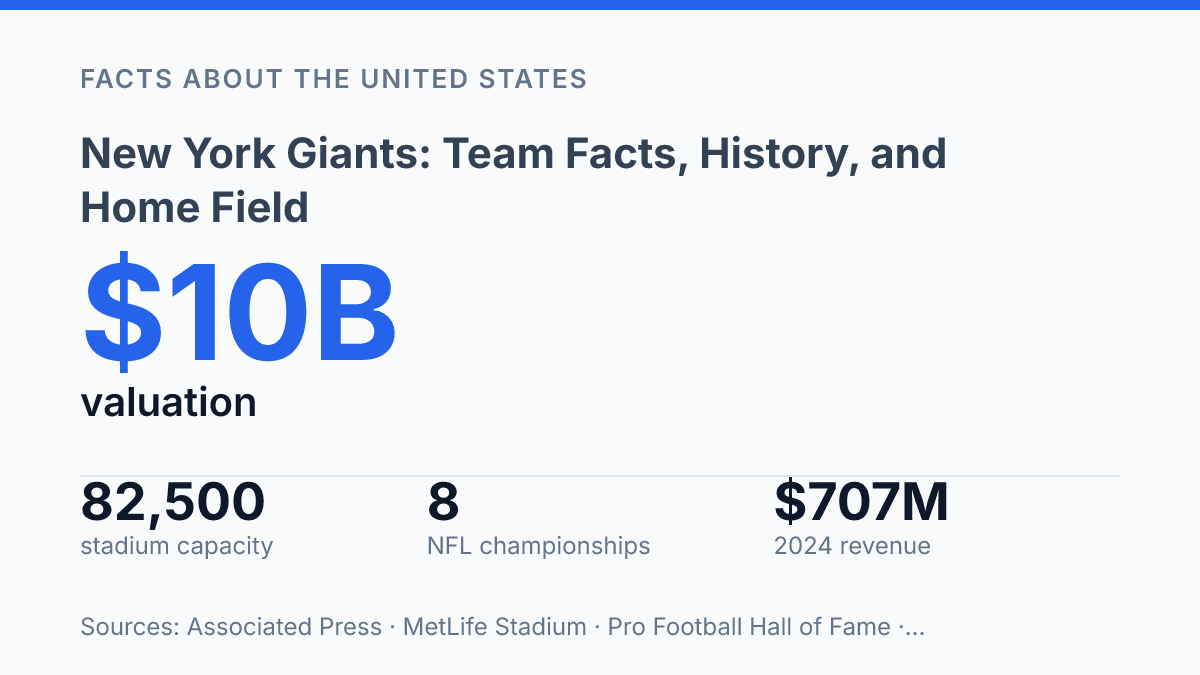
The New York Giants entered the 2026 season with a 728-676-34 all-time record, eight NFL championships, and a franchise origin story that began with Tim Mara’s reported $500 purchase in 1925. That range, from a small pre-Depression investment to a modern club linked to a reported $10 billion valuation, gives the team a wider frame than wins and losses alone. The franchise also sits inside the nation’s largest television market, plays in an 82,500-seat stadium, and moved into 2026 with John Harbaugh installed as its 21st head coach.
Those details help explain why the Giants are best understood through several connected lenses: league alignment, championship history, stadium scale, ownership economics, and football operations. The following sections place the team’s record, home field, milestones, and leadership structure in context rather than treating them as separate facts.
Team profile and NFL alignment
Although the name points to New York City, the franchise’s identity is tied to the wider New York metropolitan area in the United States rather than to a single borough. The New York Giants are a professional American football team whose league identity is defined less by municipal boundaries than by their place in the country’s largest regional sports market.
The team competes in the National Football League as a member of the National Football Conference East division. That alignment places the Giants in one of the NFL’s four-team divisional structures, where regular-season scheduling, standings, and playoff seeding are shaped first by conference and division membership. In practical terms, the NFC East is the team’s primary competitive frame before any broader league comparison is made.
The franchise profile at NFL.com lists the club as established in 1925, playing at MetLife Stadium, owned by John Mara and Steve Tisch, with John Harbaugh as head coach; as of the page crawl, the team was 4-2-1 and first in the NFC East. Those details combine institutional identity with current league status, separating long-term franchise facts from a single-season snapshot.
Ownership is led by John Mara and Steve Tisch, with Mara also serving as president and chief executive officer. This structure gives Mara a dual role: he is both an owner and the senior executive publicly associated with the club’s business and organizational direction. Tisch’s co-ownership reflects the shared ownership model common among major professional sports franchises, where strategic authority sits above day-to-day football operations.
Championship years and franchise milestones
Four modern title seasons are officially attached to the preceding regular seasons, which is why the club’s most cited championship years often appear as 1987, 1991, 2008, and 2012 rather than 1986, 1990, 2007, and 2011. According to the Pro Football Hall of Fame, the Giants’ official Super Bowl victories are tied to the 1986, 1990, 2007, and 2011 seasons, a distinction that reflects how NFL championship games are played after the regular-season calendar year ends. Those four titles form the modern core of the franchise’s achievement record, while the Hall of Fame credits the organization with 8 total NFL championships across its full history.
The 1987 and 1991 championship games marked the high point of the Bill Parcells era, when the franchise translated defense-led, postseason football into two national titles within five seasons. The 2008 and 2012 victories belonged to a different competitive cycle, with Tom Coughlin’s teams winning Super Bowl XLII and Super Bowl XLVI. Those later championships carried added national weight because both came against New England, including the 2008 win that ended the Patriots’ bid for an undefeated season.
This championship record gives the franchise a prominent place in professional football history, but it also shows why its legacy is better understood as episodic rather than continuously dominant. The titles are separated by long intervals, and they stand out as peaks across distinct eras rather than evidence of uninterrupted year-to-year control. That pattern has helped make the club nationally recognizable: its biggest seasons have produced memorable postseason moments, and those moments have kept the Giants in the broader historical conversation even when regular-season success has fluctuated.
MetLife Stadium and the New York market
The club’s home field is not inside New York City, a geographic wrinkle that has done little to weaken its New York sports identity. The Giants play at MetLife Stadium in East Rutherford, New Jersey, a venue located within the New York metropolitan area and tied operationally to the same regional fan base that follows the city’s major professional teams. That location gives the franchise a suburban stadium address while preserving its commercial and cultural association with New York sports.
Scale helps explain why the venue remains central to the team’s regional reach. MetLife Stadium lists a capacity of 82,500, placing it among the largest NFL home venues, and reports that it has hosted more than 600 major events and 3,000 special events. Those figures matter because the stadium functions as more than a weekly football site; it is a high-capacity regional asset serving one of the country’s densest sports and entertainment markets.
The media market reinforces that identity. National Media Spots, using Nielsen estimates for 2025, ranked New York as the No. 1 U.S. television market, with 7,494,510 TV homes and a 5.972% national share. For the Giants, playing just outside city limits does not separate the franchise from that audience.
It places the club inside the same advertising, broadcast, and fan economy associated with New York’s broader professional sports profile. The practical result is a team whose stadium address is in New Jersey but whose market identity remains unmistakably New York-centered.
Coaching and front-office structure
The most easily mishandled leadership detail in current Giants references is that John Harbaugh appears as head coach in the supplied team notes rather than as a legacy figure. Giants.com reported that Harbaugh was announced on January 20, 2026 as the franchise’s 21st head coach, so a reference profile should present him as the current coaching lead only where that source context is being used. That framing avoids importing unrelated coaching history or implying conclusions about future results before a fuller tenure record exists with the club.
John Mara is the key executive figure in the listed front-office structure because he is identified as both president and CEO. Those titles place him at the center of the organization’s formal business leadership, separate from the on-field responsibilities assigned to the head coach. In a concise team fact profile, the distinction matters: Harbaugh belongs to football operations as the coaching lead, while Mara is the principal named executive across the club’s corporate structure.
The leadership notes are unusually concentrated because ownership and executive authority overlap through the Mara family structure. The club is listed with Mara family leadership at the top of both ownership and management, while the football staff is headed by Harbaugh. A careful reference entry should therefore state the roles plainly and avoid filling gaps with unsupported assumptions about internal decision-making, reporting lines, or performance evaluation.
What the franchise’s scale changes next
The next phase of the Giants’ history will be measured against unusually large reference points: a century-old franchise record, a stadium built for national events, a media market with 7,494,510 TV homes, and an ownership valuation report that exceeded the 2023 Commanders sale record. Those conditions raise the standard for every football decision because market strength can increase visibility, but it does not solve roster construction, coaching fit, or division competition.
Harbaugh’s arrival gives the organization a defined football direction, while the minority stake sale shows how rare NFL assets are being priced. For the New York Giants, the practical question is whether institutional scale can translate into sustained competitive clarity.
Frequently Asked Questions
Q: Who owns the New York Giants?
A: The team is owned by John Mara and Steve Tisch. John Mara also serves as president and CEO, giving him a central role in the franchise’s leadership structure. That ownership arrangement has been in place for years and is one of the club’s defining organizational features.
Q: Where do the New York Giants play home games?
A: The Giants play at MetLife Stadium in the New York metropolitan area. The stadium is a shared NFL venue and serves as the team’s home field for regular-season and postseason games. Its location allows the franchise to represent the broader New York market rather than a single city boundary.
Q: What division do the New York Giants play in?
A: The Giants are part of the National Football Conference East division. Division membership determines their primary set of rivals and shapes much of their regular-season schedule. It also affects playoff qualification because division performance is a major factor in postseason seeding.
Q: Who is the head coach of the New York Giants?
A: The listed head coach is John Harbaugh. A head coach directs game planning, staff coordination, and in-game decisions, so the role has a direct effect on team performance. Coaching stability or turnover often influences how quickly a roster can develop.
Q: How many NFL championships have the New York Giants won?
A: The Giants have won four NFL championships, with titles in 2012, 2008, 1991, and 1987. Those seasons are part of the franchise’s historical record and are often used to measure its long-term success. Championship history remains one of the main reference points for evaluating the team.