
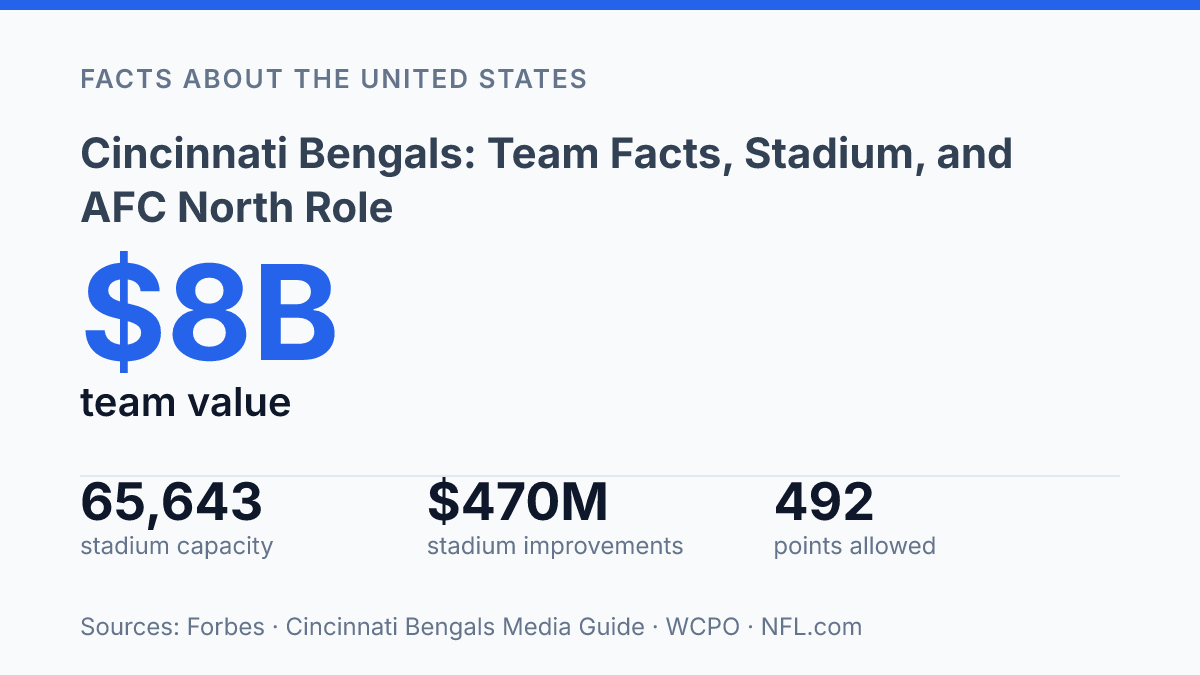
The Cincinnati Bengals enter their next stadium era with a signed lease through June 2036, option years that could run to 2046, and a $470 million Paycor Stadium renovation plan tied to Hamilton County. The agreement gives the franchise rare long-range venue certainty, but it also makes the stadium’s economics part of any serious reading of the team’s future. Hamilton County’s 2025 presentation put $350 million of the renovation cost on the county and $120 million on the team, shifting the public share to 75% after earlier projects carried a higher county burden.
Paycor Stadium remains a major civic asset as well as an NFL facility, with 65,643 seats and a sellout record in 27 of 29 games entering 2025. The team’s home base, ownership structure, coaching direction, and AFC North position all sit inside that larger frame of financial commitment, fan demand, and competitive pressure.
Team snapshot and home base
The Cincinnati Bengals are Cincinnati, Ohio’s NFL franchise, giving the city a direct place in the United States’ highest professional level of American football. The team is based in Cincinnati, Ohio, United States, and is identified with the city in both its official name and its regional fan base.
Within league structure, the Bengals compete in the National Football League as a member of the American Football Conference North division. That divisional placement matters for basic orientation because it determines a core part of the team’s annual schedule and places the franchise within the AFC rather than the NFC.
The franchise’s home base is in Cincinnati, with home games staged at Paycor Stadium in the city’s downtown area. For a snapshot-level view, the essential point is geographic and organizational: Cincinnati is the market, the NFL is the league, and the AFC North is the divisional setting.
Paycor Stadium and Cincinnati game-day setting
A lease finalized on August 1, 2025 made the Bengals’ riverfront home a long-term civic fixture, not just a weekly football venue. The Bengals and Hamilton County agreed to keep the team at Paycor Stadium through June 2036, with 10 additional option years that could extend the arrangement through June 2046, according to the Cincinnati Bengals. That agreement matters because stadium certainty links the franchise’s business planning, public partnership, and local identity to the same downtown site for more than a decade.
Home games are played at Paycor Stadium, a downtown Cincinnati venue that places the team close to the city’s core sports district rather than on the edge of the metropolitan area. That setting gives Bengals game days a visible place in the city’s central rhythm: office towers, riverfront development, and nearby entertainment areas frame the team’s presence as part of Cincinnati’s public face. The stadium functions first as an NFL facility, but its location makes the club’s home schedule feel closely attached to the city center.
The venue also gives the franchise a consistent civic address. For a team whose identity is strongly tied to its local fan base, remaining in the same downtown stadium supports continuity across seasons, branding, and public memory. Paycor Stadium is therefore more than the site of eight or nine regular-season home dates in a typical year; it is the physical point where the team’s commercial operations, county partnership, and local sports culture meet.
Ownership, coaching, and team identity
The franchise’s current public face is split among three non-interchangeable roles: Mike Brown owns the club, Zac Taylor leads the team on the sideline, and Who Dey represents its mascot branding. That distinction matters because ownership, coaching, and symbols shape recognition in different ways. The owner is tied to institutional control and continuity, the head coach is the football staff member most visibly associated with game preparation and in-game decisions, and the mascot functions as a public-facing identifier for fans and media appearances.
Brown’s role places him at the top of the organization’s ownership structure, making his name one of the most closely associated with the franchise beyond the roster itself. Ownership status is a factual identifier rather than a measure of competitive direction, so it is best understood as part of the club’s governance profile. In practical terms, this helps separate who controls the franchise from who coaches the team each week.
Taylor’s position as head coach gives him a distinct form of visibility. The head coach is the central football leadership figure on the sideline, but that role should not be treated as the same kind of authority as ownership. Coaching titles describe football operations responsibility; ownership describes control of the business entity.
Who Dey rounds out the identity picture as the team’s recognizable mascot presence. The name is closely tied to Bengals branding and fan recognition, but it serves a representational role rather than an operational one. Taken together, these three identifiers explain how the organization is recognized publicly without collapsing ownership, coaching, and branding into the same category.
What the AFC North means for the franchise
Six games on the regular-season schedule are fixed before any rotation is considered: home-and-away meetings with the three other clubs in the same division. That structure makes divisional membership more than a label, because it guarantees repeated matchups and creates a separate body of results that is tracked within the standings.
The AFC North includes the Cincinnati Bengals alongside the Baltimore Ravens, Cleveland Browns, and Pittsburgh Steelers. Within the NFL’s conference-and-division alignment, those four-team groupings help organize regular-season competition by determining a recurring portion of each club’s schedule. Each team faces its three division opponents twice, once at home and once away, which gives those games a predictable place in every season rather than leaving them to the league’s rotating interconference and intraconference schedule formulas.
That repetition gives the division practical importance. Games against division opponents count in the overall standings, but they are also separated out as division records, which can matter in evaluating a team’s season and in tiebreaking contexts.
As a concrete example, NFL.com’s final 2025 standings listed Cincinnati at 3–3 in division games, showing how those matchups are recorded distinctly from the rest of the schedule. The consequence is that the franchise’s competitive setting is shaped every year by familiar opponents, repeated preparation cycles, and results that carry added structural weight within the league format.
What the lease makes measurable next
A fixed home through at least 2036 changes the terms of evaluation for the franchise. Stadium uncertainty no longer explains the next phase; performance, revenue growth, roster construction, and the public return on renovation spending become easier to measure. The AFC North will still set the competitive standard, especially for a club that went 6–11 in 2025 despite splitting its division games.
The difference is that the business foundation is now more settled than the on-field outlook. If the option years are exercised through 2046, Paycor Stadium will not just be where the team plays; it will be the long-running test site for whether venue investment, fan demand, and football results can move in the same direction.
Frequently Asked Questions
Q: Where do the Cincinnati Bengals play their home games?
A: The Cincinnati Bengals play at Paycor Stadium in downtown Cincinnati. The venue anchors the team’s home schedule and places it close to the city center, which has made it one of the most visible NFL stadium settings in Ohio.
Q: What division are the Cincinnati Bengals in?
A: The Bengals compete in the AFC North, one of the NFL’s most physical divisions. That alignment means regular matchups with Baltimore, Pittsburgh, and Cleveland, which gives the team a clear divisional identity and frequent high-stakes games.
Q: Who owns the Cincinnati Bengals?
A: The team is owned by Mike Brown. His long tenure has made ownership one of the most stable elements of the franchise’s modern history, especially compared with teams that have changed hands more often.
Q: Who is the head coach of the Cincinnati Bengals?
A: The Bengals’ head coach is Zac Taylor. He has been the public face of the team’s football operations and is responsible for guiding game planning, roster use, and overall performance direction.
Q: What is the Cincinnati Bengals mascot called?
A: The Bengals’ mascot is Who Dey. The name is tied to the team’s fan identity and is widely associated with the club’s rallying cry and game-day culture.