
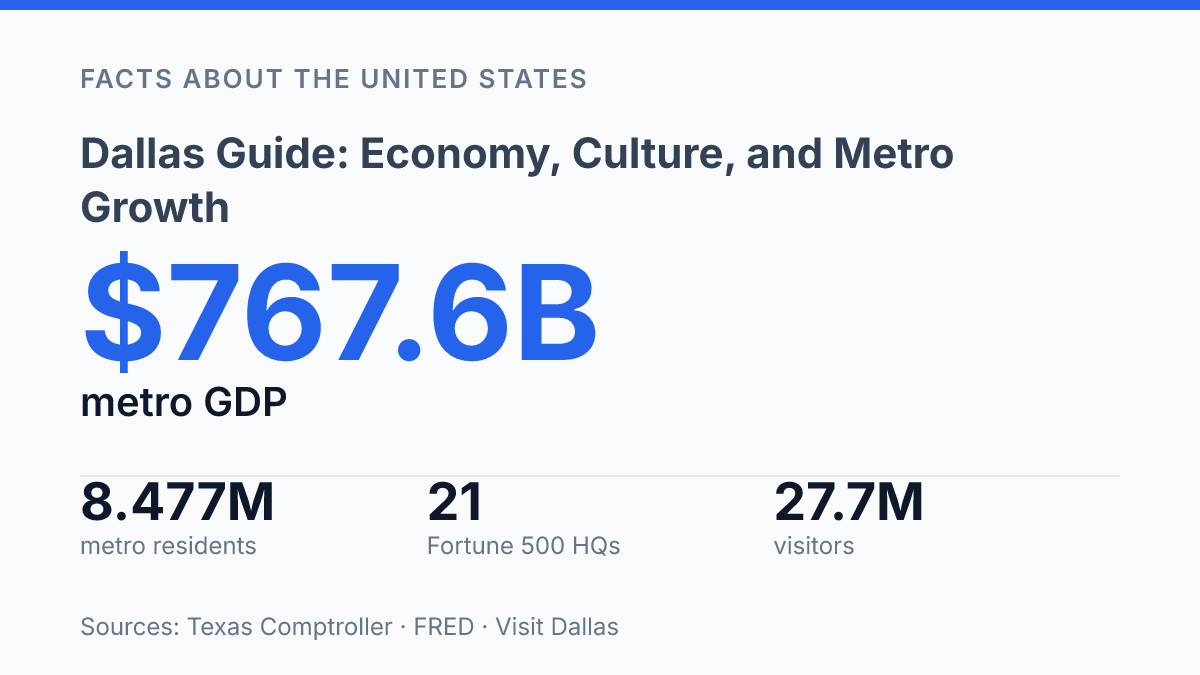
Dallas anchors a metro area that reached 8.477 million residents in 2025 and produced $767.6 billion in GDP in 2023, equal to 29.7% of Texas output. That scale explains why the city is often discussed less as a stand-alone municipality of 1,329,491 residents and more as the core of a North Texas system built around corporate headquarters, air travel, sports brands, arts infrastructure, and suburban expansion.
The numbers create a useful contrast: a city with a median owner-occupied home value of $320,700 for 2020–2024 sits inside one of the country’s largest economic regions, with 21 Fortune 500 headquarters and an airport that handled 87.8 million passengers in 2024. The guide examines how those forces connect, from business concentration and visitor spending to cultural institutions, professional sports, transport links, and the widening regional footprint.
Dallas at a Glance
A city of about 1.3 million residents sits inside a North Texas urban region of more than 8.5 million, so its practical scale is larger than its municipal boundary suggests. The city is in North Texas and serves as a major city in the Dallas–Fort Worth metroplex, a multi-city urban area that functions as one of the country’s largest population centers.
Its population reached 1,329,491 residents as of July 1, 2025, up 1.9% from the April 2020 estimates base, according to U.S. Census Bureau QuickFacts, Vintage 2025/. That figure anchors the city as a large municipality in its own right, rather than merely a component of a wider region.
The broader metroplex changes the frame. Municipal population describes local scale, but the regional count better explains how the area is experienced: as a connected North Texas urban system spanning multiple employment centers, suburbs, and civic identities. This distinction matters because many institutions, commutes, media markets, sports audiences, and cultural patterns operate across the metro area rather than stopping at city limits.
Why the City Matters Economically
A metro economy large enough to generate $767.6 billion in output gives the city influence that extends well beyond its municipal boundaries. According to the Texas Comptroller’s 2025 Metroplex Region Snapshot, the Dallas–Fort Worth–Arlington economy accounted for 29.7% of Texas’ gross domestic product in 2023. That share reflects more than local business activity; it shows the area’s role as one of the state’s primary centers for finance, professional services, logistics, technology, health care administration, and corporate management.
Corporate concentration is a central reason the city matters economically. The Dallas–Fort Worth area had 21 Fortune 500 headquarters in 2025, according to the Texas Comptroller’s “Headquarters of Headquarters” reporting, placing the region among the country’s leading corporate decision-making centers.
Headquarters create direct employment in executive, legal, accounting, marketing, and technology functions, but their influence also spreads through suppliers, contractors, real estate demand, and business travel. The effect is regional rather than confined to one city hall jurisdiction, because offices, distribution centers, and workforce housing are distributed across multiple North Texas communities.
The city’s financial role is reinforced by institutions that connect local markets to national policy and banking systems. The Federal Reserve Bank of Dallas, part of the Federal Reserve System, oversees the Eleventh Federal Reserve District, which covers Texas and parts of Louisiana and New Mexico. Its presence signals the area’s importance in banking supervision, economic research, and monetary-policy implementation across a multistate energy, trade, and finance corridor.
Economic strength is therefore concentrated in high-value corporate and service sectors, while much of the physical expansion tied to that strength is absorbed by the broader region. That pattern helps explain why the city functions as a command center even when job growth, office campuses, warehouses, and residential development appear across surrounding suburbs and satellite business districts.
Culture, Arts, and Sports Identity
At 118 acres, the Dallas Arts District is described by its governing organization as the largest contiguous urban arts district in the United States, giving the city’s cultural image an unusually concentrated institutional core. The district grew from 68 acres after City Council approval on January 27, 2021, according to the district’s About page, a change that linked major arts venues, public spaces, and civic planning more tightly than a smaller cultural campus would allow.
Institutional density is central to that identity. The AT&T Performing Arts Center, Morton H. Meyerson Symphony Center, Nasher Sculpture Center, and Crow Museum of Asian Art help define the area as more than a collection of venues; they support a year-round civic arts platform spanning performance, sculpture, music, exhibitions, and public programming. This concentration gives the city a polished cultural profile associated with philanthropy, architecture, and formal arts presentation, especially in and around the central business district.
High-profile sports broaden that public image beyond museums and performance halls. The Dallas Cowboys remain one of the strongest examples: Forbes valued the franchise at $13 billion in 2025, after it became the first sports team valued above $10 billion in 2024, and estimated its 2024 season revenue at $1.2 billion. Those figures show that the team functions not only as an athletic brand but also as a media, sponsorship, and merchandising force closely tied to the city’s name.
Large entertainment venues add a further layer to the cultural mix. American Airlines Center, associated with the Mavericks, the Stars, concerts, and touring events, connects professional sports with mass entertainment rather than separating the two. The result is a civic identity that balances formal arts infrastructure with nationally visible teams and arena-scale events, making culture here both institutional and commercially amplified.
Growth, Transportation, and Regional Reach
An airport moving nearly 88 million passengers a year makes North Texas less dependent on any single downtown for access to national and global markets. Dallas–Fort Worth International Airport handled 87,817,864 passengers in 2024, up 7.4% from 2023, and ranked No. 2 in North America by passenger traffic, according to Airports Council International–North America. That scale supports both business travel and cargo-linked activity across the region, since the airport sits between the two largest urban anchors rather than inside either core.
Highway access reinforces that polycentric pattern. Interstates 30 and 20 run east–west across the metro area, while I-35E, I-35W, I-45, and U.S. 75 connect the central city with Fort Worth, southern logistics corridors, and northern suburbs. Toll facilities such as the President George Bush Turnpike and Sam Rayburn Tollway extend that network around fast-growing suburban job centers, making regional movement less dependent on one radial commute into the central business district.
Rail and commuter services add another layer of connection, although the automobile remains central to daily mobility across much of North Texas. The Trinity Railway Express links the two major downtowns, while DART light rail and bus service connect the urban core with surrounding municipalities.
DART’s 26-mile Silver Line opened on October 25, 2025, connecting Plano, Richardson, Addison, Carrollton, Coppell, Grapevine, and the airport, according to the agency’s release. Its route illustrates how new transit investment is increasingly aimed at cross-suburban movement as well as traditional downtown access.
Recent growth has followed the same regional logic. U.S. Census Bureau data via FRED show that the metropolitan area added about 123,000 residents from 2024 to 2025, a one-year increase large enough to sustain housing, retail, road, and employment expansion well beyond the historic core. The result is not simply outward sprawl, but a broader metroplex of multiple employment nodes, airport-linked districts, university suburbs, logistics corridors, and residential communities that function as an integrated market while retaining separate local centers.
What the next phase of regional scale will test
The next measure of North Texas will be how well scale converts into access. A region can add residents, corporate headquarters, visitors, and flights while still facing pressure on housing costs, commute patterns, public services, and cultural funding.
The 26-mile Silver Line, opened in 2025, points to the type of infrastructure that may matter most: connections that link job centers, airports, suburbs, and civic destinations rather than treating growth as a collection of separate local gains. If the metro keeps expanding at its recent pace, its competitive advantage will depend less on size alone and more on whether that size becomes easier to navigate.
Frequently Asked Questions
Q: What makes Dallas an important city in Texas?
A: Dallas is a major commercial, cultural, and financial center in North Texas. Its role is reinforced by a large urban base and strong regional connectivity, which support corporate activity, arts institutions, and service-sector growth.
Q: How large is the Dallas metro area?
A: The city has an estimated population of 1.3 million. The broader Dallas–Fort Worth metroplex has over 8.5 million residents, placing it among the largest metropolitan areas in the United States.
Q: Is Dallas mainly known for business or culture?
A: It is known for both. Dallas has a large corporate and financial presence, while also supporting museums, performing arts, and other cultural institutions that shape its regional identity.
Q: Why has the Dallas area continued to grow?
A: Population growth has been supported by a strong regional economy, job opportunities, and extensive suburban expansion across the metroplex. The scale of the metropolitan area also helps attract investment and new residents.
Q: How does Dallas compare with the wider metroplex?
A: The city of Dallas is the core urban center, but the metroplex is much larger in population and economic reach. This means regional growth is spread across multiple cities, with Dallas remaining a central hub for commerce and culture.