
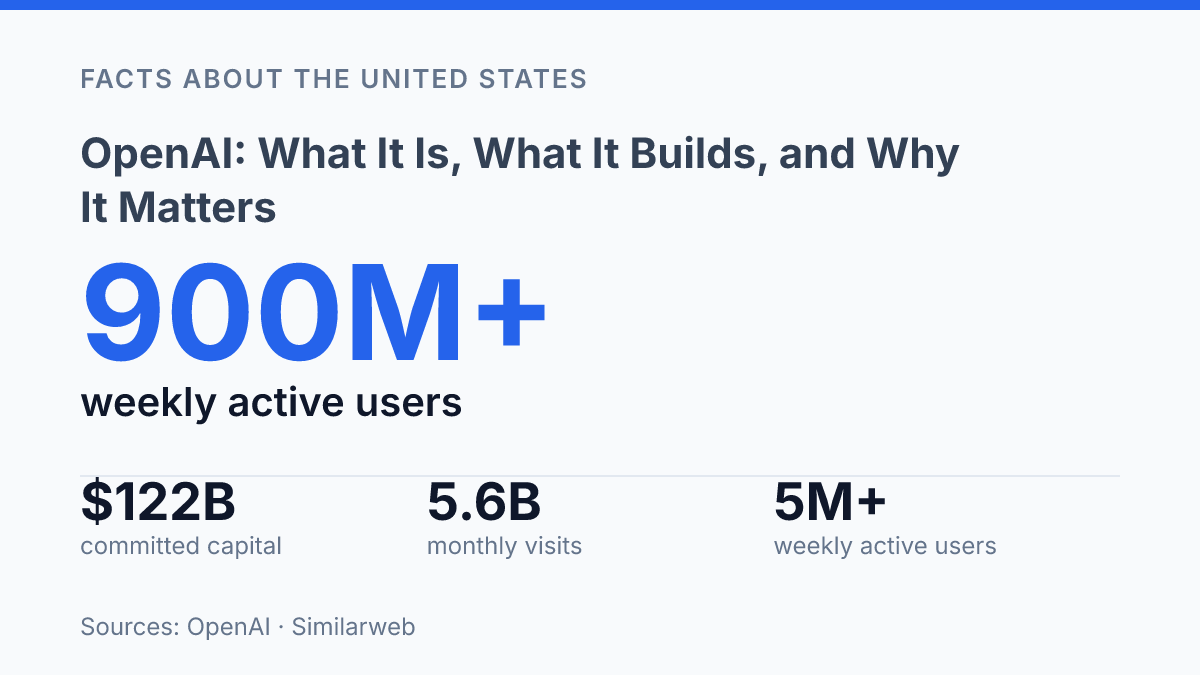
OpenAI reported more than 900 million weekly active ChatGPT users in February 2026, a scale that puts the company’s products closer to mass consumer infrastructure than to a conventional software suite. That reach sits beside a less visible story: a company that began as a nonprofit in 2015, added a for-profit subsidiary in 2019, and announced a new structure on October 28, 2025, with the nonprofit becoming the OpenAI Foundation and the commercial arm becoming OpenAI Group PBC.
The result is an unusually scrutinized organization, judged not only by model performance but by governance, capital needs, and its effect on work. Its GPT models, ChatGPT, Codex, and image tools made generative AI familiar to the public, while reported financing and revenue figures pushed it into direct comparison with the largest technology companies.
How the company is structured and where it is based
The central corporate distinction is that the AI developer carries a public-benefit mandate while remaining outside the public stock market. The company is an American artificial intelligence public benefit corporation, a for-profit legal form designed to permit pursuit of a stated public benefit alongside commercial objectives. That status separates it from a conventional publicly traded technology company: its shares are not listed on an exchange, and ordinary public-market disclosure rules do not apply in the same way they would to a listed issuer.
According to the company’s structure page, the current arrangement was formally announced on October 28, 2025: the nonprofit became the OpenAI Foundation, while the for-profit arm became OpenAI Group PBC; the same account says the organization began as a nonprofit in 2015 and created a for-profit subsidiary in 2019. This sequence matters because it shows a deliberate shift from a purely nonprofit origin toward a structure that can raise and deploy large amounts of private capital while still presenting a mission-oriented corporate identity.
Its headquarters are in San Francisco, California, and its physical presence has remained concentrated there rather than being dispersed across a traditional multi-headquarters model. In March 2026, the San Francisco Chronicle reported that the company had subleased about 280,000 square feet at 1800 Owens St., taking its San Francisco office footprint past 1 million square feet, all in Mission Bay. That concentration reinforces San Francisco’s role not only as a mailing address but as the company’s operational base.
The public benefit corporation model does not eliminate questions about governance, financing, or control. It creates a legal framework in which mission and profit can be considered together, but the company’s private status means that many strategic decisions are shaped through board governance, investor agreements, and internal priorities rather than through the scrutiny of public shareholders. This is the key structural context for understanding the organization before considering the systems and services it builds.
GPT models, ChatGPT, and the products that made it known
ChatGPT turned the GPT family into a consumer product large enough to exceed 900 million weekly active users by February 2026, according to a company update. Its public release in November 2022 gave non-specialists a direct way to interact with advanced text-generation systems through ordinary prompts, rather than through research demos or developer-only tools. That interface helped make the underlying model family recognizable far beyond technical audiences.
Behind that interface is the GPT series of large language models, built on the generative pre-trained transformer approach. In practical terms, the systems are trained to model patterns in language at very large scale, then adapted so they can answer questions, draft text, summarize material, translate, reason through tasks, and follow conversational instructions. The technical basis matters less to most users than the product result: a general-purpose text system that can be accessed through chat, APIs, and workplace tools.
The company’s public profile is not limited to chat. Its GPT Image models extended the same general product strategy into image generation, making visual creation part of the broader generative AI offering. When gpt-image-1 came to the API on April 23, 2025, a company announcement said more than 130 million users had created over 700 million images in the feature’s first week inside ChatGPT, showing how quickly image tools could spread when placed inside an already widely used assistant.
Codex represents the coding side of the product set. Designed as an AI coding agent, it can assist with programming tasks such as generating code, explaining repositories, suggesting changes, and supporting software workflows.
A June 2026 company update reported that Codex had more than 5 million weekly active users, rising more than sixfold since the desktop app launched in February, with knowledge workers making up about 20% of users. That mix suggests the product is not only a developer aid but also part of a broader shift toward AI-assisted work across technical and semi-technical roles.
Why ChatGPT changed the AI market
ChatGPT changed the market less by introducing AI to researchers than by making generative AI a mass consumer habit at web scale. Its rapid public adoption helped catalyze the AI boom because it gave investors, employers, educators, software companies, and policymakers a visible measure of demand that earlier AI systems had rarely produced outside specialist or enterprise settings. Before this shift, many AI tools were experienced indirectly through recommendation systems, search ranking, fraud detection, or business analytics; ChatGPT made interaction with a general-purpose model a direct, repeatable activity for ordinary users.
As of September 2026, ChatGPT was the fifth-most-visited website globally, placing it in the same traffic tier as the largest consumer internet platforms. Similarweb’s global web ranking for August 2026 put chatgpt.com at number five, with 5.6 billion monthly visits and 3.45% month-over-month growth, while clarifying that the figure covered desktop and mobile web traffic rather than app usage. That distinction matters because the ranking already shows exceptional reach without counting every way people access the service.
The scale of adoption also changed the commercial assumptions around AI. Earlier public-facing AI tools often gained attention as demonstrations, narrow assistants, or embedded features; ChatGPT became a destination in its own right. This helped shift generative AI from a research-led category into a market where user engagement, subscription conversion, workplace deployment, and infrastructure demand could be measured at consumer-internet scale.
High traffic, however, is evidence of reach rather than proof of dependable output. Broad use does not settle questions about factual errors, hallucinated citations, privacy practices, copyright exposure, or uneven performance across tasks and languages. The turning point was therefore not that a chatbot solved every reliability problem, but that it made those problems mainstream business and policy questions because so many people began using the technology directly.
Funding, valuation, and rivalries in frontier AI
A $122 billion commitment in a single financing round placed the company in a valuation tier usually associated with the largest public technology platforms, not specialist AI laboratories. In its March 31, 2026 announcement, OpenAI said it had closed committed capital at a US$852 billion post-money valuation and was generating $2 billion in revenue per month. The size of that round signals investor belief that frontier AI can support platform-scale revenue, but it also makes capital discipline, commercial conversion, and model performance central to how the company will be assessed from this point onward.
Valuation at this level is tied as much to expected infrastructure demand as to current product revenue. Training and serving frontier models require large commitments to compute, data-center capacity, engineering talent, and distribution partnerships, which means funding is not simply a balance-sheet milestone.
It helps explain why the leading firms in this category are often measured by their ability to finance the next generation of systems before those systems produce mature returns. High valuation can therefore widen strategic options while narrowing tolerance for slow growth or technical setbacks.
The closest comparison in the AI pure-play category is Anthropic, which has emerged as the other major specialist developer competing at the frontier rather than as a product line within a broader technology conglomerate. The comparison matters because both firms are judged on similar axes: model quality, enterprise adoption, safety positioning, access to compute, and the ability to convert research capability into durable commercial contracts. That rivalry is narrower than a general AI market comparison, but it is the relevant benchmark for understanding how investors price independent frontier-model companies.
Revenue momentum has strengthened the investment case, although it also raises expectations. Axios reported on September 29, 2026, that the company’s annualized revenue run rate was nearing $70 billion, with business-to-business revenue more than doubling since the start of the third quarter.
If sustained, that shift would indicate that workplace and enterprise spending is becoming a larger part of the business model, rather than growth depending only on consumer subscriptions. The consequence is a more demanding competitive standard: frontier AI leaders must keep improving models while proving that adoption can support the cost of operating at global scale.
What scale changes next
The next phase is less about whether demand exists and more about how durable that demand becomes when costs, competition, regulation, and enterprise adoption all move at once. A company that reported $122 billion in committed capital, an $852 billion post-money valuation, and $2 billion in monthly revenue on March 31, 2026 is no longer only a research lab with popular software.
It is part of an industrial contest over compute, distribution, talent, and trust. The practical measure to watch is not a single model release, but how much routine work is redesigned around systems that are expensive to train, cheap to query, and difficult to govern at mass scale.
Frequently Asked Questions
Q: What does OpenAI do?
A: OpenAI is an American artificial intelligence public benefit corporation headquartered in San Francisco, California. It develops proprietary generative AI models, especially the GPT series of large language models, along with tools such as GPT Image and Codex.
Q: Why is ChatGPT associated with OpenAI?
A: ChatGPT is one of OpenAI’s best-known products, released in November 2022. Its launch is widely credited with accelerating public interest and investment in generative AI, which helped drive the broader AI boom.
Q: How popular is ChatGPT compared with other websites?
A: As of September 2026, ChatGPT was the fifth-most-visited website globally. That level of traffic shows how quickly a generative AI product moved from a specialist tool to a mainstream digital service.
Q: What makes OpenAI different from other AI companies?
A: OpenAI is often distinguished by its focus on proprietary generative AI systems rather than general-purpose AI research alone. Its market position is also notable, with a March 2026 funding round valuing the company at US$852 billion.
Q: What other products has OpenAI released besides ChatGPT?
A: OpenAI has released the GPT Image models and Codex, an AI coding agent. These products extend the company’s work beyond text chat into image generation and software development assistance.