
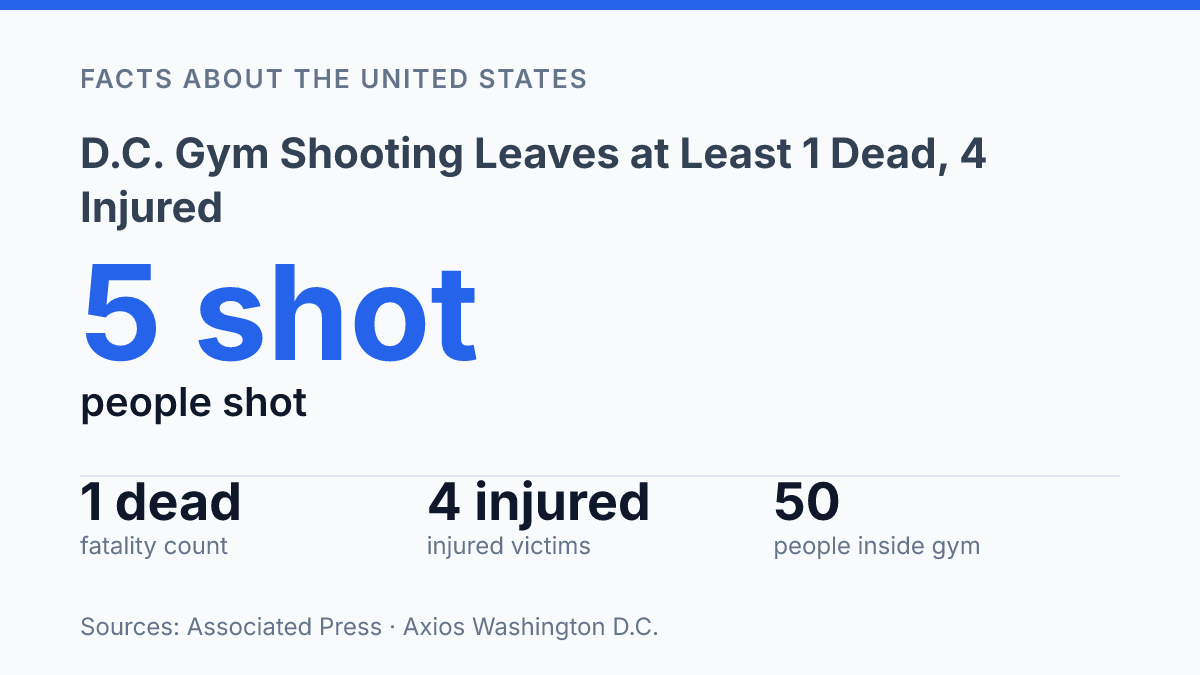
The D.C. gym shooting leaves at least 1 person dead, 4 injured at VIDA Fitness in Logan Circle, about 1 mile north of the White House, after gunfire broke out around 8 a.m. on Nov. 12, 2026. The Associated Press reported that witness James Spellman estimated roughly 50 people were inside the gym when the first shots were fired, followed by more gunfire outside. Police accounts cited by AP and Axios place victims not only inside the fitness center near 15th and P streets NW, but also near a parking-garage elevator and a construction site across the street.
The suspected gunman later killed himself during the police response, according to law-enforcement accounts. The incident now sits at the intersection of an active investigation and a more complicated citywide pattern: homicides are down in D.C. this year, while assaults with dangerous weapons have risen sharply.
What happened inside the Northwest Washington gym
About 50 people were inside VIDA Fitness near 15th and P Streets NW when the first shots were reported around 8 a.m., according to a witness account from the gym. On Nov. 12, 2026, the Associated Press reported that 5 people were shot in Logan Circle, 1 fatally, and that the suspected gunman later shot and killed himself during the police response; AP placed the scene about 1 mile north of the White House.
Local reports citing police placed the fatal shooting inside VIDA Fitness, while other injuries were reported nearby, including at a construction site across the street. The early account indicates that the violence did not remain confined to one room or doorway, which helps explain why officers and emergency crews treated the area around 15th and P Streets NW as a broader active scene rather than only a gym interior.
The Metropolitan Police Department response included securing the area and directing the public to avoid nearby blocks while officers searched and contained the suspect. Police later said the barricade had ended and the scene was safe at about 11:10 a.m., though residents were still advised to stay clear of the area as investigators and emergency personnel continued their work.
The reported toll stood at at least one person dead and four others injured in the first public accounts. The wounded were transported to hospitals for treatment, with preliminary reporting describing three injuries as non-life-threatening and one victim as seriously injured. Those figures should be read as early casualty counts from a fast-moving response, since police and hospitals can revise totals or injury descriptions as victims are identified, treated, and formally counted.
What police and emergency crews said in the first hours
Within the first hours, police were treating the response not as a single indoor shooting scene but as a sequence that ended in a barricade in a nearby apartment building. According to Axios Washington D.C., the Metropolitan Police Department said the suspect moved to an apartment building in the 1500 block of 15th Street NW after the initial gunfire, shifting the response from emergency medical aid and scene control to a containment operation.
AP, citing law-enforcement officials, reported that investigators believed the suspected gunman shot at least one person inside the gym, another person in a parking-garage elevator, and then barricaded himself on the 7th floor of the building. AP also reported that the suspect later shot and killed himself during the police response. Early reports did not include a publicly released suspect name, and the available official accounts did not confirm whether a firearm had been recovered.
The police perimeter affected nearby blocks beyond the gym itself. Axios reported that after the barricade ended, residents were still being told to avoid the area, indicating that officers were continuing to manage access, preserve the scene, or complete safety checks even after the most immediate threat had passed. The available first reports did not confirm a formal evacuation order or list specific street closures, but they did describe an active law-enforcement presence around the 1500 block of 15th Street NW.
The limited detail in those early statements is consistent with how major police responses are typically communicated on Nov. 12, 2026: public-safety information came first, while a fuller account of motive, weapon evidence, and investigative findings remained pending. That distinction matters because the first official briefings established where the public should avoid and whether a threat remained, but they did not yet answer the central investigative questions.
How the incident fits into D.C. gun violence trends
The most telling citywide contrast is that killings were lower while serious weapon assaults were higher, meaning the broader violence picture in Washington was moving in two directions at once. The Metropolitan Police Department’s year-to-date crime table for 2026 showed 88 homicides, compared with 119 at the same point in 2025, a 26% decrease. Over the same period, assaults with a dangerous weapon rose from 812 to 1,127, a 39% increase, while total violent crime was up 11%, according to MPD data.
What remains unclear as the investigation continues
The most consequential gap in the public record is not a theory of motive, but the absence of official victim identifications that would anchor the case in verifiable records. As of reports published on Nov. 12, 2026, police had not publicly released the names of the deceased person or the injured victims in available official accounts, and those accounts did not state whether family notification had been completed for every person. That distinction matters because law enforcement agencies commonly withhold names until relatives have been notified, while hospitals face separate privacy limits unless patients or families authorize disclosure.
The investigative status also remains limited in public view. Available reporting did not identify any filed charges or arrests connected to the case, and no public charging document had laid out probable cause, offense classifications, or whether investigators believe any other person faces potential criminal exposure. Without such a filing, the most precise public description is an active police investigation rather than a completed criminal case.
A later MPD briefing or written release is the most likely source for confirmed updates on victim identities, investigative findings, and any evidence police are prepared to disclose. Court records would become especially important if prosecutors seek charges, warrants, or other judicial action. Hospital statements could clarify the conditions of surviving victims, but only within privacy rules and with appropriate authorization, while the Office of the Chief Medical Examiner could provide formal identification or cause-and-manner findings when its process allows public release.
For now, the useful boundary is clear: confirmed reporting can describe what authorities have said, while motive, relationships among those involved, and any wider investigative theory remain open questions until officials or court records support them.
What the unresolved facts will determine
The next measure of this case will not be the first casualty count, but the evidence that explains movement, intent, and warning signs. Investigators still have to connect witness accounts, security footage, ballistic evidence, and the suspect’s path from the gym to the apartment building where the barricade ended. The public record also has to hold two realities at once: D.C. reported fewer homicides year to date in 2026, yet more assaults with dangerous weapons and higher total violent crime.
That distinction matters because a lower homicide count does not necessarily mean public exposure to gunfire is falling at the same pace. For Logan Circle residents, the practical consequence is narrower and more immediate: whether police can explain how a morning workout became a multi-location shooting scene.
Frequently Asked Questions
Q: What happened in the D.C. gym shooting incident?
A: A shooting at a gym in Washington, D.C., left at least one person dead and four others injured. The available details point to a mass-casualty incident, but the exact motive and sequence of events were not included in the provided information.
Q: How many people were hurt in the shooting?
A: The reported toll was four injured and one killed, for a total of five victims. That figure can change if authorities later revise their count or if additional information becomes available.
Q: Was the shooter identified?
A: No identification details were provided in the source information. In incidents like this, police typically confirm a suspect only after the investigation has established basic facts and any public safety risk has been addressed.
Q: What is known about the victims’ condition?
A: The only confirmed information is that four people were injured and one person died. No further medical status, ages, or identities were supplied, so any deeper assessment would be speculative.
Q: Why are early reports on shootings sometimes revised?
A: Early reports often come from fragmented witness accounts, first responders, and preliminary police updates. As hospitals, investigators, and scene evidence are checked, casualty numbers and other details can be corrected for accuracy.