
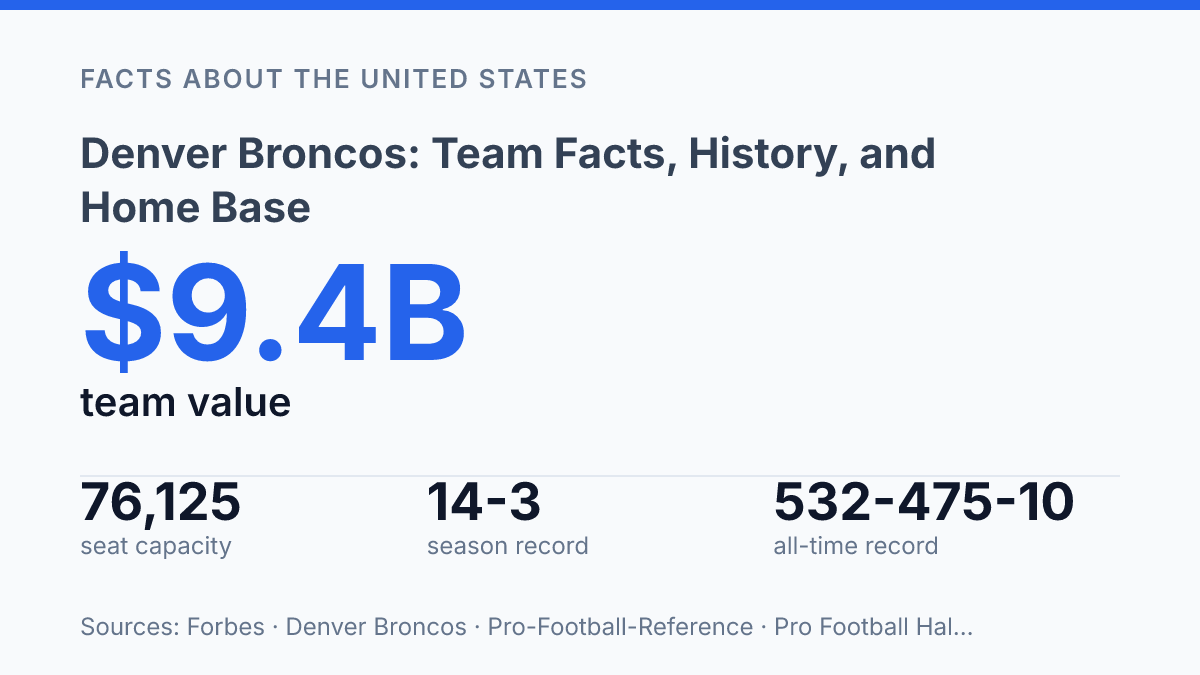
The Denver Broncos nearly doubled in estimated franchise value from the Walton-Penner group’s $4.65 billion purchase price in 2022 to Forbes’ $9.4 billion valuation in 2026, a shift that mirrors the team’s recent rise on the field. The franchise enters current coverage with a rare combination of ownership stability, stadium demand, and competitive momentum: a 14–3 season in 2025, its first AFC West title since 2015, and a defense that allowed only 18.3 points per game. Those numbers give the team’s history and home base more than archival value.
They help explain why the club’s identity is tied as much to Mile High demand and divisional standards as to its three Super Bowl championships. This profile places the team’s structure, milestones, stadium setting, and AFC West position in context, showing how business strength and football results now reinforce each other.
Team profile and current structure
The Denver Broncos carry Denver in their public identity, yet their headquarters and football operations are in Englewood, a separate Colorado city. That split is common in the NFL: the market-facing identity is tied to the home city, while practice facilities, executive offices, scouting departments, and administrative staff may operate from a purpose-built suburban base.
The club is based in Denver, Colorado, United States, and competes in the National Football League as part of the American Football Conference’s West division. That placement matters because divisional membership shapes the regular-season schedule, standings race, and playoff path more directly than broader conference affiliation. The AFC West is the team’s primary competitive frame within the league structure.
Current football operations are led by head coach Sean Payton, while ownership sits with the Walton-Penner Family Ownership Group. The group was unanimously approved to purchase the franchise on Aug. 9, 2022, establishing the current governance structure after one of the most closely watched ownership transitions in modern NFL business.
The team’s market position also reflects the scale of contemporary NFL ownership. Forbes valued the franchise at $9.4 billion in 2026, ranking it No. 15 among NFL teams, with $695 million in revenue and $97 million in operating income; the Walton-Penner purchase price was $4.65 billion. Those figures place the club’s current structure in a wider business context, where team value, ownership stability, league affiliation, and local identity all contribute to how an NFL franchise is understood beyond the weekly schedule.
Championship seasons and franchise milestones
The franchise’s modern legacy rests on championship games won in 1998, 1999, and 2016, a sequence that spans two distinct eras rather than one uninterrupted dynasty. Those titles are commonly discussed by Super Bowl season as 1997, 1998, and 2015, while the championship games themselves were played in the following calendar years. That distinction matters because it explains why official historical references may use one set of years while fans often remember the dates on which the trophies were secured.
The back-to-back championships in 1998 and 1999 transformed the Broncos from a successful but often frustrated contender into a title-winning franchise. The first of those victories ended years of near-misses on the sport’s biggest stage, and the second confirmed that the achievement was not an isolated peak. John Elway remains the central name associated with that breakthrough period, because those championships closed the defining chapter of his playing career with consecutive Super Bowl wins.
The 2016 championship is the team’s most recent NFL title, and it carries a different historical meaning. Rather than extending the late-1990s run, it re-established the franchise at the top of the league after a long interval without another championship. The gap between 1999 and 2016 shows both the strength and the limits of the club’s résumé: 3 titles form a powerful core, but sustained championship-level continuity has varied across eras.
Broader franchise records reinforce that profile. The Pro Football Hall of Fame lists the Broncos with three Super Bowl championships and eight conference championships, placing the club among teams with repeated appearances at the highest competitive level rather than a single isolated title run. The result is a legacy built less on constant dominance than on three defining peaks that continue to shape how the franchise is measured historically.
Stadium, city, and fan identity
At 5,280 feet above sea level, the Broncos’ home setting turns geography into part of the club’s public image rather than a neutral backdrop. Empower Field at Mile High has a listed capacity of 76,125, with 132 luxury suites and 8,800 club seats, according to the club’s 2025 NFL Media Guide. The venue’s altitude, scale, and name all reinforce the same association: this is a franchise whose home identity is tied closely to Denver’s mountain setting and civic profile.
The club’s public identity still starts with Denver, Colorado, but its audience operates at the scale of the wider United States football market. That dual identity matters because NFL teams are local institutions and national media properties at the same time. Denver supplies the place-based identity, while national broadcasts, merchandise, fantasy football, and digital coverage extend the brand well beyond Colorado.
Demand for the home experience shows how durable that local connection has been. Sports Business Journal reported that single-game ticket sales were up 41% versus 2024 after the 2025 schedule release, and it noted that the team’s sellout streak dates to 1970. A long run of full stadiums does not measure every form of fandom, but it is a strong indicator that the Broncos’ relationship with the city has remained commercially and culturally significant across many roster cycles.
Brand identity is also maintained through public-facing symbols that do not depend on weekly results. The mascots Thunder and Miles give the club recognizable figures for game days, community events, children’s programming, and promotional appearances.
Thunder connects directly to the horse imagery embedded in the team name, while Miles reinforces the Mile High association that links the stadium, the city, and the franchise’s broader presentation. In that sense, mascots are not decorative extras; they help translate a Denver-centered identity into visible, repeatable symbols for supporters of different ages and levels of football knowledge.
Where the Broncos fit in the AFC West
Six games every regular season are reserved for the same three divisional opponents, making the AFC West the most predictable competitive frame around the Broncos’ schedule. The division has four members: the Broncos, Kansas City Chiefs, Las Vegas Raiders, and Los Angeles Chargers. That structure gives the club annual home-and-away matchups against each divisional opponent before the rest of the schedule is filled out through the NFL’s rotating formula.
The AFC West matters because divisional results influence both standings position and playoff access. Winning the division guarantees a postseason berth, while losses inside the division can create tiebreaker problems even when a team’s overall record is competitive. This is why familiar opponents carry more practical weight than ordinary repeat matchups; they shape the route to January as much as they shape the weekly rivalry calendar.
Recent results show how quickly divisional performance can redefine a season’s outlook. According to Pro-Football-Reference, Denver finished the 2025 season at 14–3 and first in the division, while the team announced on Dec. 27, 2025, that it had clinched its 16th AFC West title and its first since 2015.
That achievement did more than add another line to the record book. It changed the club’s postseason positioning and showed how success against familiar opponents can turn a strong season into a division-winning one.
Division membership creates a stable competitive rhythm, but it does not make outcomes predictable. The same opponents appear year after year, allowing trends, coaching adjustments, roster strengths, and weaknesses to be tested repeatedly. For the Broncos, that means the path through the regular season is partly national and partly local to the division: overall quality matters, but AFC West results often determine whether that quality produces a playoff path or leaves the team chasing one.
The standard Denver now has to meet
The next meaningful benchmark for the franchise may not be a single playoff result, but whether its current stability can be converted into repeatable competitiveness. A 14–3 season changes expectations, while a $9.4 billion valuation and a sellout streak dating to 1970 raise the standard for how the organization is judged off the field.
The AFC West rarely allows reputations to stand still, so the practical consequence is clear: Denver’s recent gains now function as a baseline rather than a peak. Future seasons will show whether the ownership structure, stadium demand, and defensive core can support a longer competitive cycle.
Frequently Asked Questions
Q: Where are the Denver Broncos based?
A: The Denver Broncos are based in Denver, Colorado, United States, with their headquarters in Englewood, Colorado. That separation is common for NFL teams, where administrative operations are often located outside the city named in the franchise identity.
Q: What division do the Denver Broncos play in?
A: The Broncos compete in the NFL’s AFC West division. That places them alongside the Kansas City Chiefs, Las Vegas Raiders, and Los Angeles Chargers, which shapes their regular-season schedule and divisional rivalries.
Q: Who owns the Denver Broncos now?
A: The team is owned by the Walton-Penner Family Ownership Group. Ownership matters because it sets the long-term direction of the franchise, including leadership hires, facilities, and broader team strategy.
Q: Who is the head coach of the Denver Broncos?
A: Sean Payton is the current head coach of the Denver Broncos. His role covers game planning, coaching staff oversight, and the overall on-field direction of the team.
Q: How many NFL championships have the Denver Broncos won?
A: The Broncos have won three NFL championships, in 2016, 1999, and 1998. Those titles are a major part of the franchise’s history and place the team among the league’s more successful long-running organizations.