
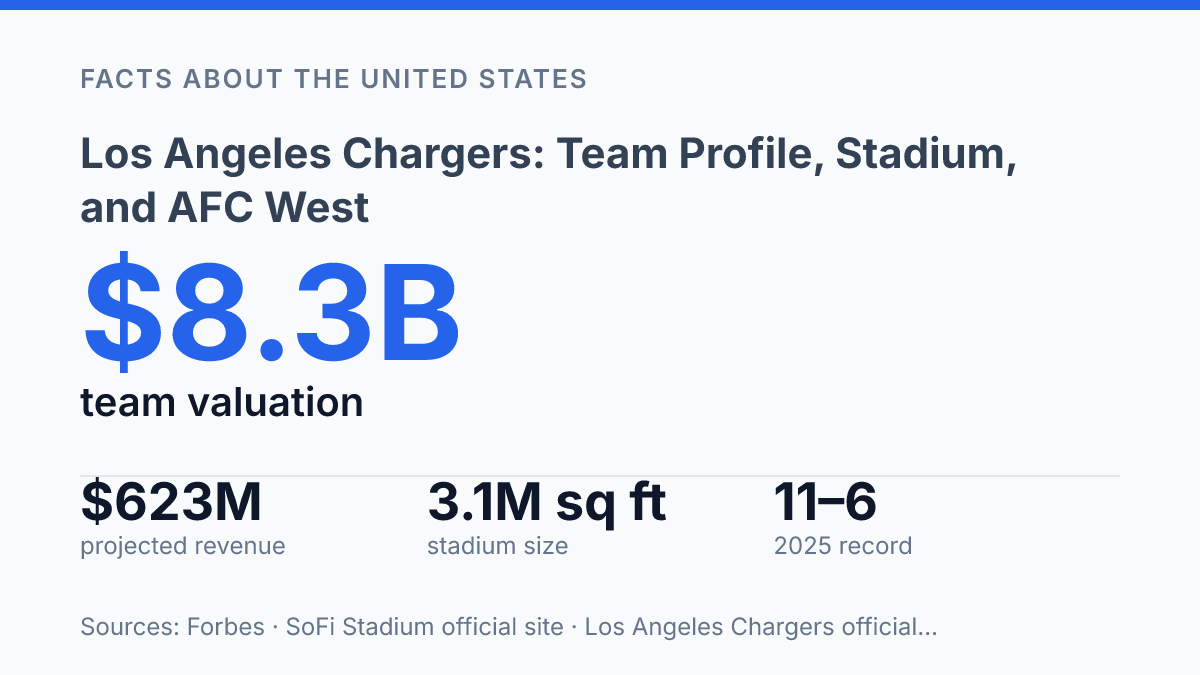
The Los Angeles Chargers are valued by Forbes at $8.3 billion, a figure that places the franchise No. 22 in the NFL while framing its 11–6 season in 2025 as more than a standings note. The team is operating at the intersection of high financial scale, modern infrastructure, and a sharper football identity under Jim Harbaugh, who agreed to a five-year deal on January 24, 2024.
That combination matters because the Chargers are not just trying to compete in Los Angeles; they are trying to define what sustained relevance looks like in a division that also produced a 14–3 Denver team. This profile looks at how the franchise is positioned through its roster identity, SoFi Stadium, its El Segundo headquarters, Harbaugh’s low-mistake approach, and the competitive pressure of the AFC West.
Team overview and current identity
Forbes’ $8.3 billion valuation underscores that the Los Angeles Chargers are not merely a local club but a major NFL property in the country’s second-largest media market, according to Forbes in 2026. The team is a professional American football franchise based in Los Angeles, California, United States, and it competes in the National Football League as a member of the American Football Conference West division. That placement defines both its league structure and its competitive frame, since the AFC West determines the six annual divisional games that shape much of the club’s season.
The franchise’s current identity is tied to Los Angeles, but its fan and commercial footprint is better understood as regional rather than neighborhood-specific. The club represents the Greater Los Angeles area, a market with multiple sports allegiances, large suburban population centers, and a media reach that stretches well beyond the city proper. This gives the Chargers a broad platform, while also making brand identity an ongoing part of how the organization presents itself.
Ownership is held by Michael A. Spanos, keeping the Spanos family central to the team’s control and public identity. NFL.com reported that league owners approved Tom Gores’ purchase of a 27% stake in the franchise in 2024, adding a notable minority ownership development without changing the basic top-line identification of the club. Within the NFL structure, the Chargers are therefore best understood through three current markers: a Los Angeles base, AFC West membership, and Spanos-led ownership.
SoFi Stadium and the home-field setup
SoFi Stadium can expand from about 70,000 seats to 100,000, a scale that makes a Chargers home game part of a much larger entertainment operation rather than a stand-alone football event. The venue is the Chargers’ home field and is located in Inglewood, within the Greater Los Angeles area, placing the club inside one of the country’s most active live-sports and events markets. According to the stadium’s official site, the building spans 3.1 million square feet and includes more than 260 luxury suites and 13,000 premium seats, which gives the franchise a high-capacity platform for ticketing, hospitality, sponsorship activation, and national broadcast presentation.
That setting raises the team’s visibility, but it also shapes attendance patterns in ways that differ from smaller or less crowded NFL markets. Los Angeles County contains several major sports and entertainment venues, and Inglewood itself sits near other prominent event properties, including the Kia Forum and Intuit Dome.
The result is a market where casual sports spending, corporate hospitality budgets, parking demand, and weekend attention can be divided among multiple events. For the Chargers, the stadium’s scale creates commercial upside, while the surrounding competition means home-game atmosphere depends not only on team performance but also on scheduling, opponent draw, and the broader event calendar.
Game-day presentation benefits from the venue’s premium infrastructure. Large suite inventory and premium seating support business-to-business sales, while the stadium’s size and design allow the team to stage home games with the production values expected in a national media market. The practical consequence is that the Chargers operate from one of the NFL’s most visible facilities, but they do so in a shared major-venue environment where prominence must be earned repeatedly across the season.
Jim Harbaugh and the coaching direction
A five-year hire announced on January 24, 2024 made the head coach, rather than any single roster move, the clearest marker of the Chargers’ football reset. According to NFL.com, Jim Harbaugh agreed to lead the team after a long record of high-profile college and professional coaching experience, giving the organization a defined on-field reference point for standards, staffing, and week-to-week preparation. In practical terms, the head coach becomes the figure through whom the team’s football identity is interpreted: how physical the roster needs to be, how much risk the offense should carry, and what type of players fit the preferred style of play.
That kind of leadership matters because coaching direction links personnel decisions to scheme rather than treating the roster as a collection of isolated talent. A Harbaugh-led program is commonly evaluated through line-of-scrimmage play, defensive structure, ball security, and situational discipline, all of which influence how a front office weighs depth, contract priorities, and positional competition. The Chargers’ official coach bio notes that the 2024 offense committed only 8 turnovers, a franchise record and tied for the second fewest offensive turnovers in a single NFL season, which supports the view that mistake reduction became a measurable part of the team’s identity.
A prominent head coach can raise expectations quickly, but coaching reputation does not remove the normal constraints of NFL team-building. Season evaluation still depends on roster depth, quarterback performance, injury variance, and the strength of opponents within the schedule. Harbaugh’s value, in that context, is not a guarantee of outcomes; it is the organizing framework for how the Chargers define acceptable football, allocate roles, and judge whether the roster is matching the intended scheme.
What the AFC West means for the Chargers
A 5–1 division record was still not enough to put the Chargers on top of the standings in 2025, which shows how little margin can exist inside this part of the schedule. Denver finished 14–3 that season, while the Chargers went 11–6, Kansas City finished 6–11, and Las Vegas went 3–14. The split between a strong divisional mark and second place overall illustrates a core feature of NFL competition: winning familiar matchups matters, but total conference and league results still determine positioning.
Competing in the AFC West means the Chargers are measured every year against opponents they see twice, creating a six-game block that carries outsized practical weight. Repeated games against the Broncos, Chiefs, and Raiders reduce the informational gaps that can exist in one-off matchups, because coaching staffs and players build recent evidence against each other. That familiarity often raises the value of execution, injury management, game-planning adjustments, and situational football, since opponents are less likely to be surprised by base tendencies.
Division standing also connects directly to playoff pressure. In the NFL format, each division winner earns a playoff place, while non-division winners must compete for wild-card spots within the conference.
That structure makes divisional games more than rivalry fixtures: they can affect the title race, common-opponent comparisons, conference seeding, and tiebreaker pathways. A strong record inside the division can sharpen a team’s postseason case, but it does not remove the need to bank wins outside those six games.
The business scale around the franchise increases the visibility of that competitive context rather than changing the rules of it. Forbes valued the Chargers at $8.3 billion, ranked them No. 22 among NFL franchises, and estimated 2025-season revenue of $623 million with operating income of $57 million. Those figures place divisional performance within a large-market, high-value operation, but the annual football equation remains comparatively simple: in a compact division race, a few head-to-head results can reshape the route to January.
What the next phase will measure
The next measure is not whether the Chargers have the platform of a major NFL franchise; the financial valuation, stadium scale, and training infrastructure already answer that. The more useful question is how efficiently those assets translate into repeatable football outcomes. A team that can pair low-turnover play with strong divisional performance has a clear competitive base, but the AFC West rarely allows static advantages to last.
Denver’s 14–3 season in 2025 raised the standard, while Kansas City’s poor year showed how quickly the order can shift. For the Chargers, the practical consequence is clear: the Harbaugh era will be judged less by the size of the setup than by whether it produces January results with the same discipline shown in the regular season.
Frequently Asked Questions
Q: Where do the Los Angeles Chargers play home games?
A: The Los Angeles Chargers play at SoFi Stadium in Inglewood, California, which serves as the team’s home venue in the Greater Los Angeles area. The stadium is shared with the Rams and is one of the NFL’s newest facilities.
Q: Which division are the Chargers in?
A: The team competes in the AFC West, the division that also includes the Broncos, Chiefs, and Raiders. Division placement matters because it determines most of the Chargers’ regular-season opponents each year.
Q: Who is the Chargers’ head coach?
A: The Chargers are coached by Jim Harbaugh. His role is central to the team’s on-field identity because the head coach oversees game planning, player development, and staff coordination.
Q: Who owns the Los Angeles Chargers?
A: The franchise is owned by Michael A. Spanos. Ownership affects long-term direction through decisions on leadership, facilities, and organizational strategy.
Q: Are the Chargers based in Los Angeles or another city?
A: The Chargers are based in Los Angeles, California, United States, as part of the broader Greater Los Angeles area. The team’s current market identity reflects its relocation and its place in one of the NFL’s largest media markets.