
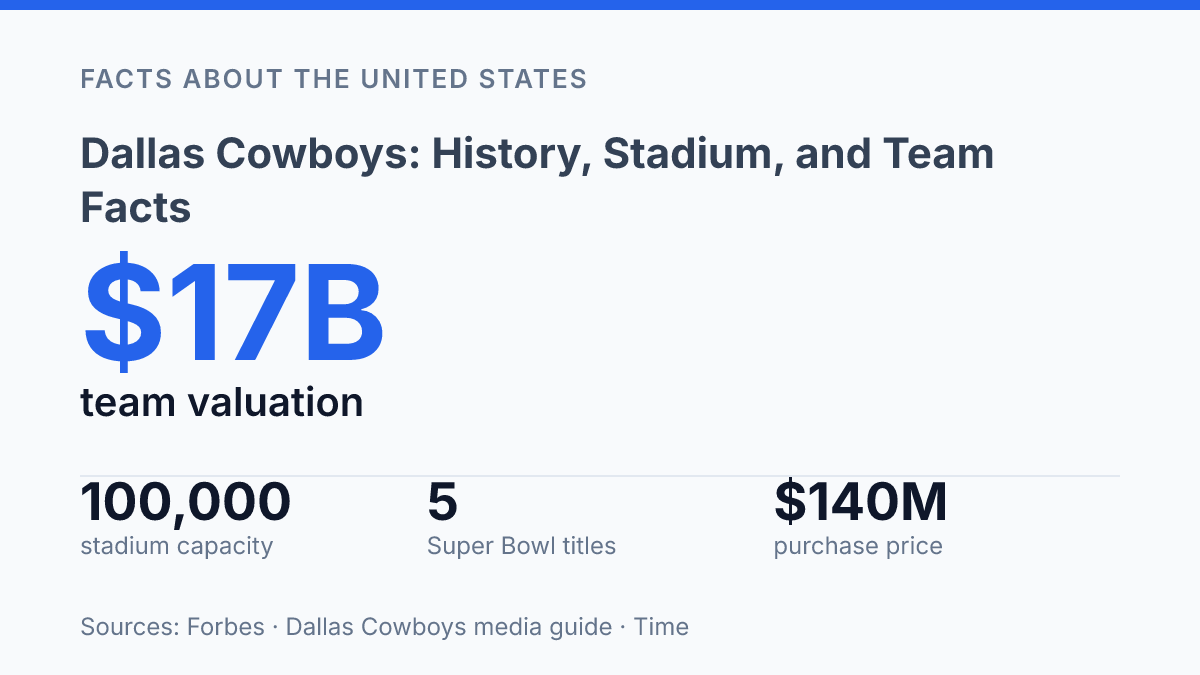
The Dallas Cowboys enter Forbes’ 2026 rankings valued at $17 billion, a figure that is roughly 121 times the $140 million Jerry Jones paid for the club in 1989. That gap explains why the franchise is often examined through two lenses at once: as a football team with five Super Bowl titles and as a business case that has led Forbes’ NFL valuation list for 20 straight years.
Its identity is shaped by both results and structure, from Jones’s combined role as owner, president, and general manager to Brian Schottenheimer’s move into the head coach position in 2025. The same pattern appears in the club’s physical footprint, where AT&T Stadium, Ford Center at The Star, and even Rowdy the mascot help define a brand built around scale, continuity, and public visibility.
Team identity and place in the NFL
A franchise named for one city is treated financially like a national brand: Forbes valued the Dallas Cowboys at $17 billion in 2026, up from $13 billion a year earlier, and reported that Dallas had led its most valuable NFL teams list for 20 straight years, with estimated revenue of $1.28 billion and operating income of $677 million last season.
The club is a professional American football team based in the Dallas–Fort Worth metroplex and competes in the National Football League. Within the league structure, it belongs to the National Football Conference East division, commonly shortened to the NFC East. That alignment places the team in one of the NFL’s two conferences and establishes its divisional grouping for scheduling, standings, and rivalry context.
The Dallas name is central to the franchise’s identity, but its regional footprint is wider than the city label alone suggests. The Dallas–Fort Worth metroplex functions as a shared sports market across North Texas, so the team’s public identity is tied to both a major city brand and a broader metropolitan fan base. This distinction helps explain why the franchise can carry local, regional, and national significance at the same time.
Owner, coach, and team leadership
Few NFL ownership structures are as concentrated as one in which the same person is listed as owner, president, and general manager. The team’s official front-office listing identifies Jerry Jones in all three roles, giving him influence over both the business presentation of the franchise and the football decision-making apparatus. Time reported in 2025 that Jones bought the club for $140 million in 1989, a purchase that has become central to how the organization is discussed as a sports business as well as a football team.
Jones’s tenure also gives the franchise a clear continuity point across eras of roster construction, media strategy, and executive decision-making. His official team biography notes that he was inducted into the Pro Football Hall of Fame in 2017 as only the 15th owner to receive a bust in Canton, according to the club’s site. That distinction reflects not only team success under his ownership but also the prominence of ownership itself in the organization’s public identity.
On the football staff, Brian Schottenheimer is the head coach. The club’s official coaching biography says he was named the 10th head coach in team history on Jan. 24, 2025, after two seasons as offensive coordinator, and it lists 26 years of coaching experience. That background places him within the existing offensive structure rather than as an entirely external appointment.
The relationship between ownership and coaching is central to how the franchise operates. A single, highly visible owner can create consistency in priorities, branding, and external messaging, while also concentrating authority around football operations and organizational narrative. The head coach, by contrast, carries the day-to-day responsibility for preparing the roster, directing the staff, and translating front-office decisions into on-field plans.
Championship seasons and club legacy
The club’s five league titles are clustered into two championship windows separated by 15 years, then followed by a longer gap that underlines how rare repeat success is in the NFL. According to the 2025 Cowboys media guide, the franchise has five Super Bowl championships in total, a figure that anchors its historical reputation more than any regular-season milestone.
In chronological order, the championship years are:
- 1972, when the franchise secured its first NFL championship with a Super Bowl VI victory.
- 1978, when it added a second title by winning Super Bowl XII.
- 1993, when a new championship era began with a Super Bowl XXVII win.
- 1994, when the team repeated as champion in Super Bowl XXVIII.
- 1996, when it won Super Bowl XXX, completing its fifth title run.
The Pro Football Hall of Fame lists those Super Bowl titles as VI, XII, XXVII, XXVIII, and XXX, corresponding to championship games played after the 1971, 1977, 1992, 1993, and 1995 seasons. That distinction matters because football championships are often remembered by the calendar year of the game, while team records may classify them by the season that produced the title.
The distribution of those championships explains much of the franchise’s legacy. The early titles established national credibility during the 1970s, while the three titles in the 1990s made the club one of the defining teams of that decade.
At the same time, the absence of another championship since the mid-1990s shows how difficult it is to convert brand strength, fan expectations, and competitive rosters into the final achievement. The title list remains a marker of long-term prestige, but its spacing also reflects the NFL’s high bar for sustained dominance.
AT&T Stadium, Ford Center, and the Rowdy mascot
The Cowboys’ first regular-season game at AT&T Stadium drew 105,121 spectators on Sept. 20, 2009, according to the 2025 team media guide. AT&T Stadium is the team’s home stadium, and its scale helps explain why it functions as more than a weekly football venue.
The same media guide lists the building at 3.0 million square feet, with capacity up to 100,000, and notes that it was awarded nine matches for the 2026 FIFA World Cup, including a semifinal. That combination of team use, crowd capacity, and major-event hosting makes the stadium a competitive setting and a commercial symbol for the franchise’s public profile.
Ford Center at The Star serves a more practical role as the club’s training ground. The Dallas Sports Commission describes it as part of a 400,000-square-foot Cowboys facility with a 12,000-seat indoor venue and more than 30 flexible event spaces.
Unlike AT&T Stadium, which is highly visible through game broadcasts and large public events, Ford Center is tied more closely to preparation, practices, and organizational operations. Its role is less theatrical but central to how the football side of the club is housed and supported.
Rowdy, the team mascot, adds a different kind of visibility to the brand. The official mascot bio lists Rowdy’s birthday as Aug. 19, 1996, favorite number as 00, and height as 6’1″, or 6’2½” with the hat. Those biographical details are deliberately light, but they show how the mascot works within the club’s public image: approachable, recognizable, and suited to appearances that extend the team identity beyond the field itself.
What scale allows the franchise to do next
The more useful question is not whether the franchise is large, but what that scale allows it to do next. A team valued at $17 billion can function as a football operation, an events business, a media property, and a civic venue at the same time. AT&T Stadium’s selection for nine 2026 FIFA World Cup matches, including a semifinal, shows how the club’s infrastructure now reaches beyond the NFL calendar.
The next test is whether that institutional strength can be matched by postseason results under a newer coaching structure. For a franchise this visible, competitive gaps are not hidden by commercial success; they are measured against it.
Frequently Asked Questions
Q: When were the Dallas Cowboys founded?
A: The franchise was established in 1960 and has been based in the Dallas–Fort Worth metroplex since its founding. That long history is part of why the team remains one of the NFL’s most recognizable brands.
Q: How many championships have the Dallas Cowboys won?
A: The team has won five NFL championships, with titles in 1972, 1978, 1993, 1994, and 1996. Those seasons define the Cowboys’ most successful era and still shape how the franchise is discussed today.
Q: Where do the Dallas Cowboys play home games?
A: The Cowboys play home games at AT&T Stadium in Arlington, Texas. The venue is one of the NFL’s largest and is closely associated with the team’s modern identity.
Q: Who owns the Dallas Cowboys?
A: The team is owned by Jerry Jones, who has been one of the most influential figures in modern NFL ownership. His leadership has shaped both the business side and the public profile of the franchise.
Q: Who is the current head coach of the Dallas Cowboys?
A: The current head coach is Brian Schottenheimer. Coaching changes are significant for the Cowboys because they can affect both the team’s scheme and its short-term competitiveness.