
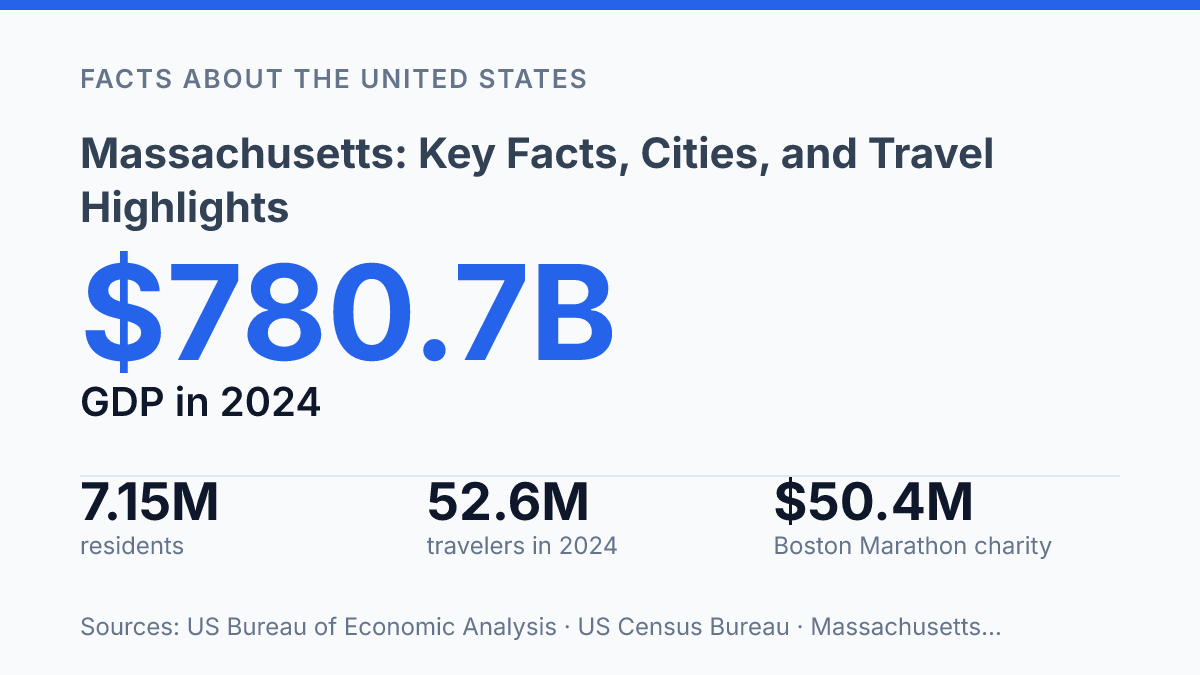
Massachusetts squeezes 7,154,084 residents and a $780.7 billion economy into one of the smallest states by land area, which is the kind of mismatch that makes it hard to explain with a single label. It’s slow-growing by population, up just 1.7% from the 2020 estimates base, but its pull is much larger than its size suggests. Boston brings the state into view for many visitors, students, patients, investors, and sports fans, yet the story doesn’t stop at Logan Airport or the Freedom Trail.
The numbers point to a place where old public spaces, research clusters, coastal towns, and annual traditions all carry real weight. This guide looks at the state through that mix: the basic facts, Boston’s outsized role, historic milestones, and the places and customs that help make the map feel less abstract.
Massachusetts at a glance
Massachusetts fits more than seven million people into a compact corner of New England, which is why its influence can feel larger than its footprint. Its state capital is Boston, the main seat of government and one of the easiest reference points for placing the state on a map. From there, the state stretches west toward the Berkshires and east to the Atlantic coast, with a dense mix of cities, suburbs, college towns, and coastal communities packed into a relatively small area.
Geographically, it sits in the northeastern United States and is bordered by New York to the west, Vermont and New Hampshire to the north, Connecticut and Rhode Island to the south, and the Atlantic Ocean to the east. That coastal position matters because it helps explain the state’s long-running ties to shipping, fishing, higher education, tourism, and international travel, without needing to turn this quick overview into a history lesson.
At the 2020 Census, the state’s official population was 7,029,917. More recent estimates show continued modest growth: the Bay State had 7,154,084 residents as of July 1, 2025, up 1.7% from the 2020 estimates base, according to the U.S. Census Bureau. So, while it isn’t a sprawling state geographically, it carries the weight of a much larger place in daily life, business, education, and travel.
Why Boston matters to the state
One city gives the commonwealth its seat of government, biggest population center, most visible harbor, and strongest international gateway. That city is Boston, and its influence is why many people outside New England associate the whole state with the capital first, even when they know little about its mill towns, farms, college communities, or hill towns farther west.
Boston’s role starts with government, but it doesn’t stop there. State agencies, major courts, political institutions, large hospitals, media organizations, and corporate offices are concentrated in and around the city, so decisions made there often ripple statewide. Meet Boston reported 43,236,013 total passengers through Boston Logan Airport in its 2025 figures, including more than 10 million international passengers, which helps explain why the city functions as the commonwealth’s main front door for business, students, conferences, and visitors.
The academic pull is just as important. Harvard University, across the Charles River in Cambridge, and MIT are separate institutions with global reputations, but they’re tightly tied to the Boston area’s economy and identity.
Their research networks, graduates, labs, and partnerships help feed the region’s strength in medicine, technology, engineering, finance, and life sciences. Boston itself has also become a major life-sciences center; MassBio reported that Boston-based biopharma companies attracted $2.124 billion in venture investment in 2025, surpassing Cambridge for the second straight year.
Boston Harbor gives the city a deeper reason for mattering. Long before airports and research districts, the harbor made Boston a port city, linking local merchants, shipbuilders, and political leaders to Atlantic trade. Its waterfront has changed many times, but the harbor still helps explain the city’s layout, its historic importance, and its continued role in moving goods and people.
Still, Boston shouldn’t be treated as a stand-in for the entire state. Central and western communities have different economies, accents, landscapes, and civic identities. Boston may set much of the public image, but it’s the anchor, not the whole story.
History, milestones, and firsts
Three moments separated by less than two centuries still do much of the heavy lifting in how people understand the state’s place in American history. The landing of the Mayflower at Plymouth in 1620 anchors one of the country’s best-known colonial stories, especially because Plymouth became linked with Pilgrim settlement, early self-government, and the Thanksgiving tradition that later grew around that history.
The Boston Tea Party in 1773 is the other event many readers look for first, but it’s best understood as a political protest rather than a complete summary of the Revolution. Colonists opposed British taxation by destroying tea shipped by the East India Company, turning a local act of resistance into a symbol that traveled far beyond the city. The event matters because it helped harden tensions between Britain and its colonies, not because it tells the whole story by itself.
A quieter but equally important milestone came in 1788, when the commonwealth became the sixth state to ratify the U.S. Constitution. That detail often gets less attention than the protests and battles, yet it places the state firmly inside the founding process, moving from colonial resistance into the creation of a federal government.
Not every “first” here belongs to the colonial era. Revere Beach Reservation is recognized by the National Park Service as the first ocean beach in the United States acquired for public recreation, with public opening activity beginning in July 1895.
That kind of milestone points to a broader pattern: the state is remembered for early U.S. history, but its identity didn’t freeze there. Its later reputation also grew through research, health care, public institutions, and technology-driven industries, which is why historic sites and modern innovation sit so close together in the state’s story.
Places and traditions worth knowing
The same Cape Cod, Martha’s Vineyard, and Nantucket trips that define many summer vacations can feel almost like a different region once winter quiets the ferries, beaches, and village centers. Cape Cod is the broadest name to know, with sandy shoreline, small towns, seafood stops, and a strong summer-home culture.
Martha’s Vineyard and Nantucket sit offshore with their own identities, drawing visitors for beaches, harbors, historic streets, and a slower island rhythm. They’re not hidden gems, and that’s part of the point: these coastal places help shape how many travelers picture the state.
Tourism is more than a postcard here. According to the state travel office and Mass.gov, the commonwealth hosted 52.6 million domestic and international travelers in 2024, generating $24.2 billion in direct spending and supporting 155,808 jobs.
Those numbers explain why seasonal shifts matter so much. A July weekend on the Cape or islands can mean traffic, packed restaurants, and premium lodging, while the colder months bring quieter streets, limited schedules, and a more local feel.
One tradition with worldwide recognition is the Boston Marathon, a major annual race that turns distance running into a civic event. Its impact goes well beyond the finish line: the Boston Athletic Association reported that the 2025 race raised a record $50.4 million for charitable causes through 176 nonprofit organizations and other participant fundraising. That mix of athletic prestige, neighborhood turnout, and philanthropy is a big reason the marathon stands apart from a typical sporting event.
The state’s official symbols add a quieter kind of personality. The state flower is the mayflower, a small woodland blossom with a name that neatly echoes early colonial memory without needing a monument or museum.
The state bird is the chickadee, a familiar, hardy songbird that fits the region’s wooded neighborhoods and cold winters. Together, those symbols balance the big-name coastlines and headline events with something smaller and more everyday.
Why the small-state label misses the point
The useful way to read the state is as a set of overlaps, not a checklist. A beach that opened to public recreation in 1895, a marathon that raised $50.4 million in 2025, and national park sites tied to nearly $950.4 million in visitor spending all point in the same direction: history here keeps generating present-day movement.
If you’re planning a trip, choosing a city to study, or just trying to understand the state’s economy, the practical move is to connect the famous names with the numbers behind them. That’s where the scale becomes clearer.
Frequently Asked Questions
Q: What is Massachusetts best known for?
A: Massachusetts is known for its role in early American history, especially around Boston, Lexington, and Concord. It’s also recognized for strong universities, coastal towns, and fall foliage that draws visitors each year.
Q: What are the biggest cities in Massachusetts?
A: Boston is the largest city and the state capital, followed by Worcester and Springfield. These cities offer very different experiences, from museums and sports to family-friendly parks and local dining.
Q: Is Massachusetts a good place to visit year-round?
A: Yes, but the experience changes a lot by season. Summer is popular for beaches and island trips, while fall is famous for leaf-peeping, and winter can be cold with snow in many parts of the state.
Q: How many people live in Massachusetts?
A: Massachusetts has a population of about 7 million people. Most residents live in the eastern part of the state, especially around the Boston metro area.
Q: What should first-time visitors see in Massachusetts?
A: For a first trip, Boston’s historic sites, Cape Cod, and the Berkshires are all strong choices. That mix gives you city history, beaches, and scenic countryside without needing to cover too much ground.