
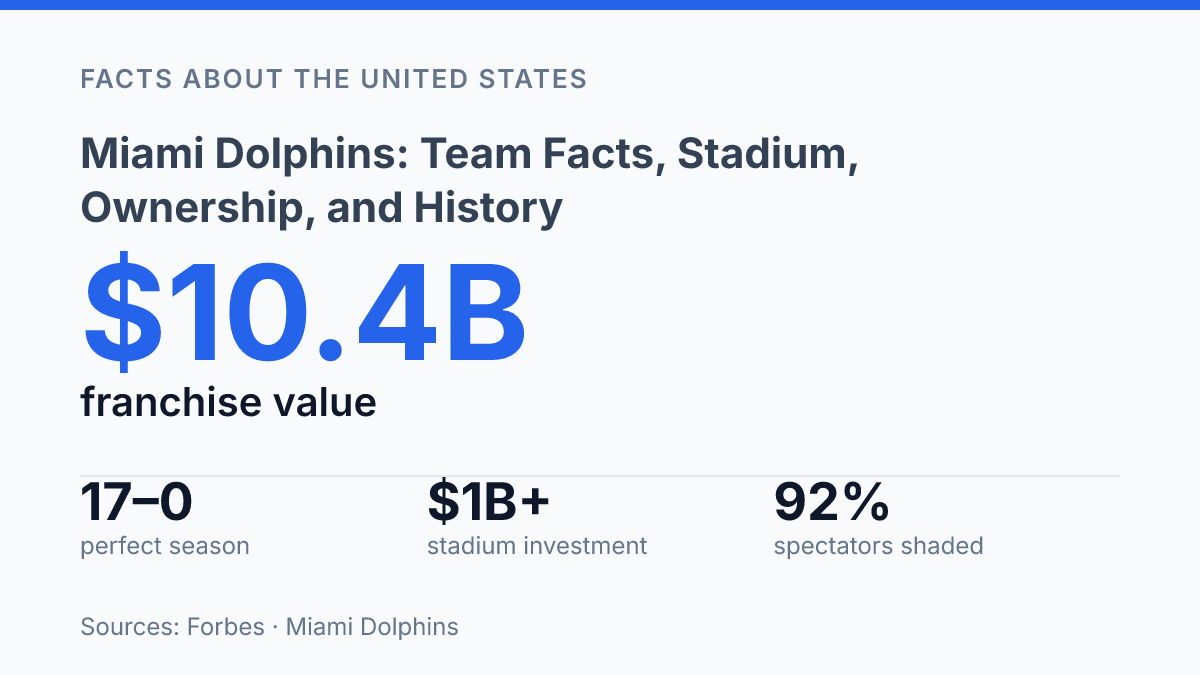
The Miami Dolphins entered 2026 with a rare split profile: a 1–5 record and -59 point differential in the AFC East, yet a Forbes valuation of $10.4 billion that ranked sixth among NFL franchises. That contrast makes the club more than a standings entry. It is a franchise trying to reconnect football results with the scale of its market position, stadium investment, and historical identity.
A 7–10 finish in 2025 led into a leadership reset, with Jeff Hafley hired as head coach and Jon-Eric Sullivan brought in as general manager. At the same time, Hard Rock Stadium reflects more than $1 billion in owner Stephen Ross’s venue-related spending since 2014. The facts behind the team reveal how current performance, ownership strategy, home-field conditions, and championship history intersect.
Team snapshot and AFC East role
A South Florida brand with an AFC East scorecard, the Miami Dolphins are judged as much against Buffalo, New England, and the New York Jets as against the wider NFL. The franchise is based in Miami, Florida, United States, and plays professional American football in the National Football League. Its divisional home is the American Football Conference East division, a structure that gives the team a fixed set of annual rivals and a clearer competitive reference point than geography alone can provide.
That divisional context can be seen in current standings rather than branding language. In 2026, the Dolphins were 1–5, with a .167 winning percentage and a -59 point differential after scoring 98 points and allowing 157, placing them behind the Bills, Patriots, and Jets in the AFC East, according to NFL.com. Those figures show how the division functions as the team’s immediate benchmark: progress is measured not only by overall league position, but by whether Miami can gain ground on the three clubs it faces within its conference grouping.
The team’s public identity also includes a formal mascot, T.D., whose name reflects the football abbreviation for touchdown. That role belongs to the franchise’s presentation and fan-facing image, while the AFC East placement defines the competitive framework. Together, location, league membership, divisional alignment, and mascot identity provide the basic snapshot needed before examining the organization’s venue, leadership, or longer historical record.
Hard Rock Stadium and home-field setting
A home venue identified with Dolphins Sundays has also become the center of more than $1 billion in stadium-area investment, according to the Miami Dolphins 2025 Media Guide. Hard Rock Stadium is the team’s home field, but its commercial value now extends beyond regular-season football through adjacent event assets, premium seating, large-scale entertainment infrastructure, and year-round programming. That broader use helps explain why the stadium is central to the franchise’s business identity as well as its game-day presentation.
The stadium is located in Miami Gardens, a city within the Miami metropolitan area, rather than in downtown Miami itself. That setting gives the club a suburban campus-style home with room for parking, tailgating, training-related facilities, and major event operations. The location also reinforces a regional identity: the team carries the Miami name, while its home-field experience is rooted in a wider South Florida market that draws fans from across Miami-Dade, Broward, and Palm Beach counties.
Modern upgrades have shaped how the venue functions in South Florida conditions. The 2016 canopy, highlighted in the team’s media guide, shades up to 92% of spectators and was paired with four high-definition video boards, improving sightlines, comfort, and in-stadium presentation without turning the building into an enclosed dome. 2016 is therefore a key reference point for the current fan experience, because the renovation addressed heat and sun exposure while preserving an open-air setting.
Hard Rock Stadium is also a multi-purpose host for events that extend well beyond the team schedule. The venue has been tied to major NFL staging, including Super Bowls hosted at the stadium site, and it sits within a broader complex associated with the Miami Open and Miami International Autodrome.
This creates a useful contrast in franchise identity: a modern, shared venue can support revenue, sponsorship, and major-event visibility, but it also means the team’s home is not a football-only shrine. Its meaning is built through both Dolphins game days and the wider event calendar that keeps the site prominent throughout the year.
Ownership structure and front-office leadership
A 95% ownership stake gives Stephen M. Ross effective control of the franchise, making the ownership structure far more concentrated than the presence of several public-facing minority investors might suggest. In practical terms, that level of ownership generally centralizes final authority at the principal-owner level, while smaller minority stakes function more as investment positions than as indicators of operational control.
Championship years and franchise legacy
The franchise’s championship identity rests on a tight two-year window: NFL championships in 1973 and 1974, a pair of consecutive titles that still define its early historical peak. Those championships correspond to Super Bowl VII and Super Bowl VIII, giving the club one of the clearest early-era success markers in professional football. The first title also completed the only full unbeaten season in NFL history, a 17–0 finish that remains central to how the team is measured in league history.
Because the Super Bowl is played after the regular season, the titles are often discussed through both the 1972 and 1973 seasons and the 1973 and 1974 championship games. Under Don Shula, that run gave the franchise a legacy built not only on winning, but on sustained control across consecutive title seasons. The distinction matters because many teams have isolated championship moments; fewer have paired back-to-back titles with an unbeaten season that has never been duplicated.
Later decades have produced playoff appearances, notable players, and periods of national relevance, but they have not displaced those championships as the franchise’s historical center of gravity. Recent results reinforce that contrast: Miami finished 7–10 in 2025 and third in the AFC East, according to Pro-Football-Reference, which places the modern team in a different competitive frame from its title era. As a result, historical coverage continues to return to the early 1970s not out of nostalgia alone, but because those seasons remain the franchise’s highest verified achievements and its strongest claim to NFL permanence.
Where resources and results have to meet
The next measure of this franchise will be whether its financial strength can produce a clearer football direction. A valuable brand, upgraded stadium, and deep historical record create stability, but they do not shorten a rebuild by themselves. The practical test sits in roster construction, coaching alignment, and whether the front office can turn resources into durable AFC East competitiveness.
Miami’s legacy includes the NFL’s only 17–0 season, yet its current position is defined by decisions still being made. That gap between inherited prestige and present performance is the central fact to watch.
Frequently Asked Questions
Q: Where do the Miami Dolphins play their home games?
A: The team plays at Hard Rock Stadium in Miami Gardens, Florida, which is part of the Miami metropolitan area. The venue has been the Dolphins’ home since 1987 and also hosts major events beyond football.
Q: Who owns the Miami Dolphins?
A: Stephen M. Ross is the principal owner with a 95% stake in the franchise. Serena Williams also holds an approximately 0.5% minority stake, reflecting a small but notable ownership interest.
Q: What division are the Miami Dolphins in?
A: The Dolphins compete in the National Football League’s American Football Conference East division. That places them in one of the league’s most closely followed divisional matchups, with each game carrying clear playoff implications.
Q: How many NFL championships have the Miami Dolphins won?
A: The Dolphins have won two NFL championships, in 1973 and 1974. Those seasons remain the high point of the franchise’s early history and are still central to its identity.
Q: Who is the Miami Dolphins’ head coach and mascot?
A: The head coach is Jeff Hafley, and the mascot is T.D. These are two of the most visible figures associated with the team on game days and in public appearances.