
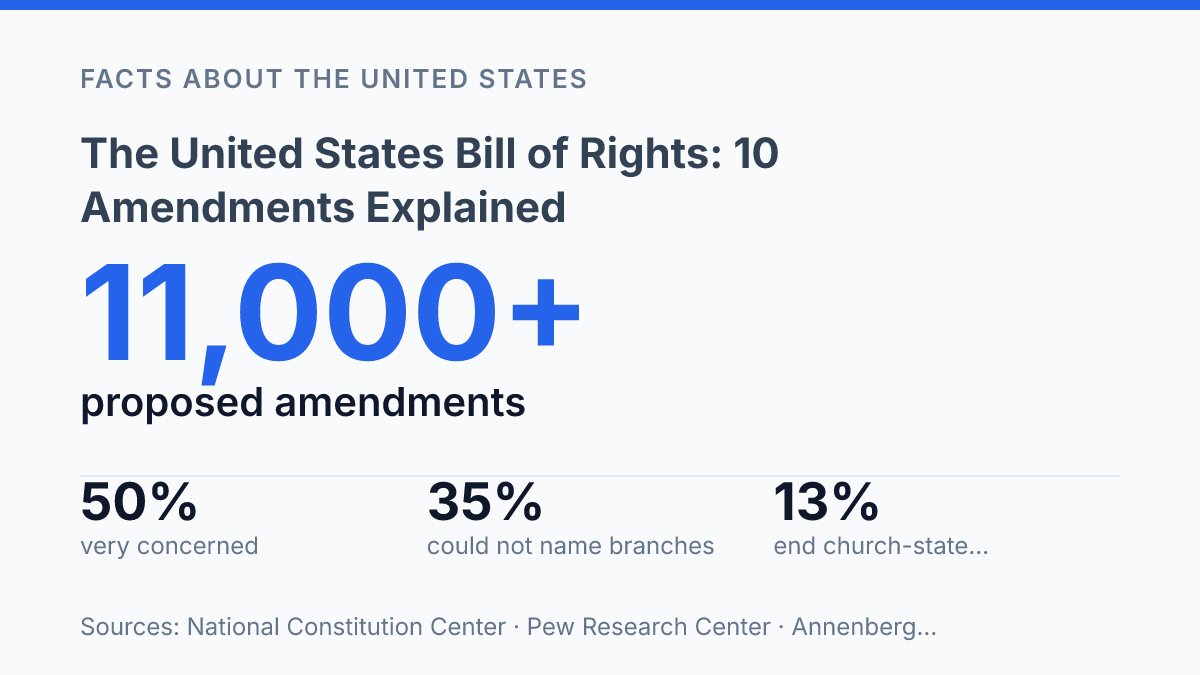
The United States Bill of Rights began as a set of 12 proposed amendments, not 10; Congress sent them to the states in 1789, and ten were ratified on December 15, 1791. That correction matters because constitutional change is rare: more than 11,000 amendments have been proposed in Congress, but only 27 have been ratified. One rejected proposal on congressional pay resurfaced two centuries later as the 27th Amendment in 1992, showing how long constitutional ideas can remain legally alive.
The first ten amendments are often taught as a fixed list of freedoms, but their meaning depends on text, history, and application. The article explains what each amendment protects, why James Madison proposed the package, how ratification settled early objections to the Constitution, and why modern disputes over speech, guns, policing, religion, and punishment still turn on these concise provisions.
What the first ten amendments cover
A single constitutional label covers protections for conscience, political dissent, criminal defendants, private property, and the boundary between civilian life and federal authority. The Bill of Rights is the first ten amendments to the U.S. Constitution, which means it is part of the Constitution itself rather than a separate charter sitting outside it. Its legal force comes from its placement in the constitutional text: it limits what the federal government may do, even when government action is backed by legislation, prosecution, or official policy.
The protections fall into several broad categories rather than one narrow subject. They safeguard expressive and religious liberty, including speech, religion, press, assembly, and petition.
They also protect interests tied to weapons possession, homes and searches, criminal accusation and trial, punishment, civil disputes, and private property. Taken together, these guarantees mark out areas where individual liberty, procedural fairness, and ownership cannot be overridden simply because the federal government finds action convenient or popular.
The amendments are often written in broad language, which gives them lasting reach but also leaves room for legal interpretation. Terms such as “reasonable,” “due process,” “public trial,” and “cruel and unusual” do not answer every practical question by themselves.
Courts, legislatures, and officials have had to apply those phrases to changing forms of communication, policing, punishment, and public protest. This is why the document is both fixed constitutional text and a continuing source of legal disputes.
Public understanding of the rights it protects is uneven, which matters because many of the guarantees concern everyday government power. In the Annenberg Public Policy Center’s 2026 Constitution Day Civics Survey, under half of U.S. adults could name four of the five First Amendment rights. That gap does not alter the legal scope of the amendments, but it helps explain why the same set of constitutional restraints remains a recurring subject in schools, courts, elections, and public debate.
Which rights each amendment protects
The most uneven feature of the ten amendments is that some state broad principles in only a few words, while others set out procedural rules with far more precision. That difference helps explain why open-ended guarantees such as free speech and unreasonable-search protections have generated especially sustained litigation, while provisions such as the Third Amendment appear far less often in modern disputes.
- The First Amendment protects religious exercise, bars government establishment of religion, and safeguards speech, press, peaceful assembly, and petitions for redress.
- The Second Amendment protects the right to keep and bear arms, a provision now often litigated through questions about the scope of permissible firearm regulation.
- The Third Amendment restricts the quartering of soldiers in private homes, reflecting a narrow protection against a specific form of government intrusion.
- The Fourth Amendment protects against unreasonable searches and seizures and generally requires warrants to rest on probable cause and describe the place searched and items or persons seized.
- The Fifth Amendment protects grand jury indictment in serious federal criminal cases, bars double jeopardy, protects against compelled self-incrimination, requires due process, and limits government takings of private property without just compensation.
- The Sixth Amendment guarantees criminal defendants a speedy and public trial, an impartial jury, notice of the accusation, confrontation of witnesses, compulsory process for defense witnesses, and assistance of counsel.
- The Seventh Amendment preserves the right to a jury trial in many federal civil cases and limits judicial reexamination of jury findings.
- The Eighth Amendment bars excessive bail, excessive fines, and cruel and unusual punishments.
- The Ninth Amendment says the listing of certain rights should not be read to deny or disparage other rights retained by the people.
- The Tenth Amendment reserves powers not delegated to the national government, and not prohibited to the states, to the states or to the people.
The Fourth, Fifth, Sixth, and Eighth Amendments form the document’s central criminal justice framework. Together, they regulate police investigation, prosecution, trial procedure, punishment, and financial penalties, which makes them especially important in cases involving searches, confessions, counsel, bail, sentencing, and fines.
By contrast, the Ninth and Tenth Amendments operate more as interpretive boundary markers than as detailed procedural commands. The Ninth warns against treating an enumerated list as an exhaustive catalog of liberty, while the Tenth reinforces the constitutional structure of limited national powers and reserved authority outside the federal grant.
Why James Madison proposed it and how it was ratified
The original proposal that became the Bill of Rights contained 12 amendments, and the familiar ten emerged only after the states declined to ratify two of them. Congress sent those 12 proposals to the states, 10 were ratified on December 15, 1791, one rejected compensation proposal was later adopted on May 7, 1992, as the 27th Amendment, and more than 11,000 amendments have been proposed in Congress while only 37 have gone to the states and 27 have been ratified, according to the National Constitution Center Constitution FAQ (accessed. Those numbers show that the early rights amendments were not an automatic appendix to the founding charter; they passed through the demanding amendment process and survived a high threshold for constitutional change.
James Madison proposed the amendments in the First Congress after repeated calls for stronger written safeguards during the early republic. The political pressure came largely from Anti-Federalists and ratifying-convention critics who argued that the original constitutional text did not clearly enough protect individual liberties against the new national government. Madison had initially been skeptical of the need for a separate list, partly because many Federalists believed the federal government already had only delegated powers and therefore lacked authority to infringe rights not granted to it.
The compromise lay in translating political assurances into constitutional text. Supporters of explicit guarantees wanted rights stated in writing so that future officials, courts, and citizens could point to a fixed legal standard rather than rely on structural limits alone.
Opponents of a rights list worried that naming some liberties might imply that unnamed ones were less secure, a concern reflected in the broader drafting choices of the final package. Ratification therefore served both a legal and political function: it placed enforceable limits into the constitutional framework while helping answer the Anti-Federalist objection that liberty had been left too dependent on implication.
How courts and governments apply it today
A phone’s stored location trail can now raise constitutional questions that eighteenth-century text could not have named, which is why modern application depends heavily on judicial interpretation. In 2018, Carpenter v.
United States held that police generally need a warrant to obtain extensive historical cell-site location records, treating long-term digital tracking as more intrusive than ordinary business records. That reasoning did not rewrite search-and-seizure doctrine; it applied established privacy principles to data capable of reconstructing a person’s movements in unusually detailed form.
Free-speech law shows the same pattern of old language being tested against new settings. The Supreme Court has protected political advocacy unless it is directed to and likely to produce imminent lawless action, while allowing some regulation of obscenity, true threats, defamation, and speech in government-controlled settings such as public schools.
Online disputes continue to refine those boundaries: on June 27, 2025, Free Speech Coalition v. Paxton upheld a Texas age-verification law for certain adult-content websites, with six justices in the majority, because the Court treated the burden on adults’ protected speech as incidental and reviewed the law under intermediate scrutiny, according to Justia’s text of the decision.
Criminal procedure protections are also applied through rules created case by case. Miranda v. Arizona required warnings before custodial interrogation so that statements are not treated as voluntary simply because no physical coercion occurred. Gideon v.
Wainwright required appointed counsel for indigent defendants in serious criminal cases, and Mapp v. Ohio applied the exclusionary rule to evidence obtained through unconstitutional searches. These doctrines shape police conduct and trial practice because they attach practical remedies to constitutional guarantees rather than leaving the text as an abstract command.
The main reason these protections matter in state courts is the incorporation doctrine under the Fourteenth Amendment. Through selective incorporation, the Court has made many guarantees enforceable against state and local governments, but not always with identical scope in every context. Federalism still matters because state courts may interpret their own constitutions to provide greater protection, while federal constitutional doctrine sets a national floor.
Recent cases show that application remains unsettled rather than frozen. In United States v. Rahimi, the Court upheld temporary disarmament of a person judicially found to pose a credible threat to an intimate partner, an 8–1 result that treated gun rights as compatible with historically grounded restrictions for dangerous individuals.
In Barnes v. Felix, the Court unanimously rejected a narrow moment-of-threat approach in excessive-force analysis, requiring courts to consider the totality of the circumstances rather than only the final seconds before a shooting.
Where constitutional meaning is tested next
The durability of these protections depends less on ceremonial agreement than on how precisely courts identify the government action at issue. A website age-verification rule, a temporary gun restriction for a domestic-violence threat, a police shooting assessed under the totality of circumstances, and a proposed forfeiture of a $95,000 Cessna all raise different constitutional questions because the right, burden, and remedy differ. That is why civic knowledge matters in practical terms.
When public surveys show many adults cannot name basic constitutional structures or First Amendment rights, legal protections remain available but harder to understand, invoke, and scrutinize. The next disputes will not ask whether rights exist; they will ask what evidence justifies limiting them.
Frequently Asked Questions
Q: What is the Bill of Rights in the United States Constitution?
A: The Bill of Rights is the collective name for the first ten amendments to the U.S. Constitution. It was designed to protect specific civil liberties and to limit federal power in areas such as speech, religion, and due process.
Q: When was the Bill of Rights ratified?
A: The Bill of Rights was ratified on December 15, 1791. That date marked the point when the first ten amendments became part of the Constitution and took legal effect.
Q: Who proposed the Bill of Rights?
A: James Madison proposed the amendments that became the Bill of Rights. He developed them in response to calls for clearer constitutional protections for individual liberties and limits on federal authority.
Q: What does the Bill of Rights protect?
A: The Bill of Rights protects core civil liberties, including freedom of speech, religion, assembly, and the press. It also sets out protections in criminal and legal proceedings, which helps define how government power can be exercised.
Q: Why are the first ten amendments important?
A: The first ten amendments are important because they establish the constitutional baseline for individual rights in the United States. Their legal limits on the federal government shape both public freedoms and the reach of federal law.