
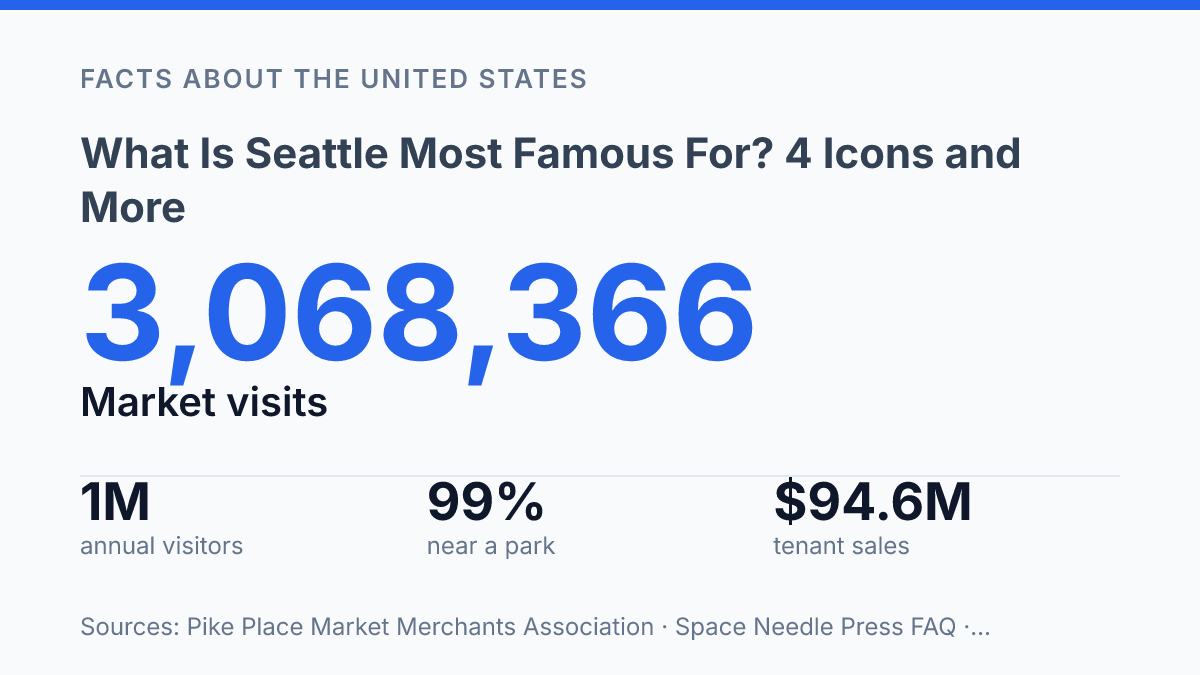
“What is Seattle most famous for?” can be answered in numbers as well as symbols: the Space Needle draws about 1 million visitors a year, and Pike Place Market recorded 3,068,366 visits in the first half of 2026. Those figures matter because Seattle’s reputation is not built only on postcards; it rests on places, tastes, sounds, and industries that still shape daily commerce and travel. The city’s best-known image begins with midcentury architecture and a working public market, then extends into coffee culture, where the first Starbucks opened at Pike Place in 1971 and local prices still run above the U.S. median.
Its cultural reach also includes grunge, seafood, mountain-and-water scenery, public parks, and a technology economy that changed how outsiders read the city. The question is less about choosing one symbol than understanding why several keep reinforcing one another.
The Space Needle and Pike Place Market
A fairground tower built for a six-month exposition has become Seattle’s shorthand more reliably than any skyline, street, or sports venue. The Space Needle was constructed for the 1962 World’s Fair, when Seattle presented itself as a forward-looking Pacific city during the height of Space Age design. Its 605-foot height made it visible across much of the city, and the saucer-shaped observation deck gave visitors an elevated way to connect downtown with Puget Sound, Lake Union, and the mountain views beyond.
The tower’s fame has also been reinforced by constant renewal rather than nostalgia alone. According to the Space Needle Press FAQ, about 1 million people visit each year, and its $100 million Century Project added 176 tons of glass, including the 37-ton Loupe, billed as the world’s first revolving glass floor. That renovation matters because the landmark still functions as a contemporary attraction, not only as a preserved emblem from a past exposition.
Pike Place Market carries a different kind of recognition because it is tied less to a skyline image and more to public life. As one of the oldest continuously operating public farmers’ markets in the United States, it condenses several parts of Seattle’s identity into one place: seafood stalls, produce stands, small food businesses, craft vendors, and daily foot traffic. The fish-throwing vendors have become a performative symbol of the market, while the original Starbucks nearby adds another layer of recognition without turning the market itself into only a coffee landmark.
The contrast between the two sites helps explain why they anchor so many first-time searches about the city. The Space Needle is the cleanest visual symbol, easy to identify from a distance and widely reproduced in tourism imagery. Pike Place Market, by comparison, shapes a more lived-in image of Seattle because it combines food, commerce, local history, and spectacle in an active public setting rather than a single architectural form.
Why coffee culture defines the city
A cup of regular hot coffee in Seattle cost a median of $4.50 in August 2025, far above the U.S. median of $3.52, according to Axios Seattle and Toast. That price signal is not just a measure of inflation; it reflects a city where coffee remains a daily habit, a visitor expectation, and a visible part of neighborhood life.
Starbucks gave Seattle’s coffee reputation its widest international reach, but the city’s association with the drink began as a local retail story. The company’s official history says its first store opened at Pike Place Market in April 1971 as a 1,000-square-foot mercantile space selling more than 30 varieties of whole-bean coffee. That origin matters because it tied Seattle to specialty coffee before espresso bars and branded cafe culture became familiar across much of the United States.
The city’s coffee identity cannot be reduced to one company headquarters or one famous storefront. Seattle became a base for Starbucks while also supporting independent roasters, espresso bars, and neighborhood cafes that helped shape local expectations around sourcing, roast style, barista skill, and cafe design. The result is a coffee culture with two scales operating at once: a global corporate symbol that made Seattle legible worldwide, and a dense local scene that keeps the reputation credible on the ground.
Travel writing often treats coffee as shorthand for Seattle itself, alongside rain, music, waterfront views, and evergreen scenery. Tourism coverage uses cafes as accessible cultural stops because they are easy to experience without specialized knowledge, yet still feel specific to place. This is why coffee functions as more than a beverage in the city’s national identity: it gives visitors a practical way to participate in an image Seattle has exported for decades, while independent cafes help prevent that image from belonging to a single brand alone.
Grunge, music, and the 1990s sound
Nirvana’s commercial reach gives Seattle’s grunge reputation a scale few local music scenes ever achieve: Billboard reported in 2024 that the band had sold 30.3 million albums in total. That figure helps explain why grunge is still one of the city’s most recognisable cultural exports, even for people with only a passing knowledge of alternative rock. Nirvana and Pearl Jam remain the two names most widely associated with the Seattle sound because their recordings, touring, and media visibility carried a local style into mainstream rock culture.
The turning point came in the early 1990s, when grunge moved from regional clubs and record shops into national radio, MTV rotation, and international music markets. The sound was often linked with distorted guitars, direct vocals, and a less polished image than much of late-1980s rock, but its significance was not only musical. It gave Seattle a cultural identity that was rougher, more local, and more youth-driven than the city’s postcard icons.
Seattle’s grunge legacy is better understood as a network than as the product of one venue or one album. Clubs gave bands places to build audiences, independent labels such as Sub Pop helped circulate the music beyond the city, and local media and record stores reinforced a shared scene before major labels amplified it. That structure matters because it shows why grunge felt tied to place: the fame came from a cluster of artists, rooms, releases, and audiences rather than from a single landmark.
The city continues to curate this history, which shows how firmly the era remains attached to Seattle’s public image. The Museum of Pop Culture announced that its exhibition “Nirvana: Taking Punk to the Masses” would close in 2025 after 14 years, a sign that grunge has become both memory and museum subject. Its centrality to Seattle’s fame is real, but it represents a distinct historical moment rather than the full measure of the city’s current cultural output.
Food, scenery, and the tech economy
Cold Pacific waters help explain why salmon, Dungeness crab, and oysters are part of Seattle’s identity rather than occasional menu items. The city’s seafood profile draws from Puget Sound and the wider Washington coast, where cold-water shellfish and finfish shape restaurant menus, market displays, and regional food tourism.
A 2025 Washington legislative report found that state shellfish aquaculture generated $252.5 million in direct annual output and $416.05 million in total annual economic impact, supporting 2,396 jobs when indirect and induced effects were included. That economic base helps explain why oysters in particular are not just a culinary symbol, but part of a working coastal food system.
Why Seattle’s fame still depends on daily use
Seattle’s public image will likely keep shifting because its best-known symbols are still working systems, not fixed exhibits. A market with rising tenant sales, a coffee scene affected by higher prices, and parks within a 10-minute walk for 99% of residents all point to the same condition: fame depends on upkeep, access, and local use.
The Space Needle can be photographed from miles away, but the city’s reputation is renewed closer to the ground, through whether visitors and residents can still buy seafood, hear local music, reach green space, and find public places that feel active rather than preserved. That is the measure that will decide which Seattle icons remain recognizable a decade from now.
Frequently Asked Questions
Q: Why is Seattle so well known to visitors and residents alike?
A: Seattle is most closely associated with the Space Needle, coffee culture, and the city’s influence on 1990s grunge music. Its identity also comes from landmarks such as Pike Place Market and its setting between Puget Sound and Lake Washington. Those elements combine to make the city recognizable for both tourism and culture.
Q: What is Seattle’s most famous landmark?
A: The Space Needle is Seattle’s most famous landmark. It stands 605 feet tall and was built for the 1962 World’s Fair, which gave it lasting symbolic status. Its observation areas are known for wide views of the city, Mount Rainier, and the surrounding region.
Q: Why is Seattle associated with coffee?
A: Seattle is strongly linked to coffee because the first Starbucks opened there in 1971. The city also has a large network of independent roasters and cafes, which helped build a broader coffee culture beyond one brand. That history is why Seattle is often used as a shorthand for American specialty coffee.
Q: Is Pike Place Market still an active market?
A: Yes, Pike Place Market remains one of the oldest continuously operating public farmers’ markets in the United States. It is known for fish-throwing vendors and for housing the original Starbucks, which makes it a major stop for both local commerce and tourism. Its longevity helps explain why it remains central to Seattle’s public identity.
Q: What food is Seattle known for eating?
A: Seattle is known for fresh seafood, especially Pacific salmon, Dungeness crab, and oysters from nearby cold waters. Local specialties also include Seattle-style hot dogs with cream cheese and grilled onions, along with teriyaki and clam chowder. These dishes reflect the city’s mix of Pacific Northwest ingredients and regional food traditions.