
Philadelphia occupies an unusual position among American cities: one building, Independence Hall, is tied to both the Declaration of Independence and the U.S. Constitution, documents UNESCO describes as influential far beyond the United States. The familiar July 4 date also hides a more precise sequence, since the National Archives records adoption on July 4, 1776, the order for the engrossed parchment on July 19, and the signed copy dated August 2. That mix of civic symbolism and historical detail helps explain why the city’s past still draws large modern crowds.
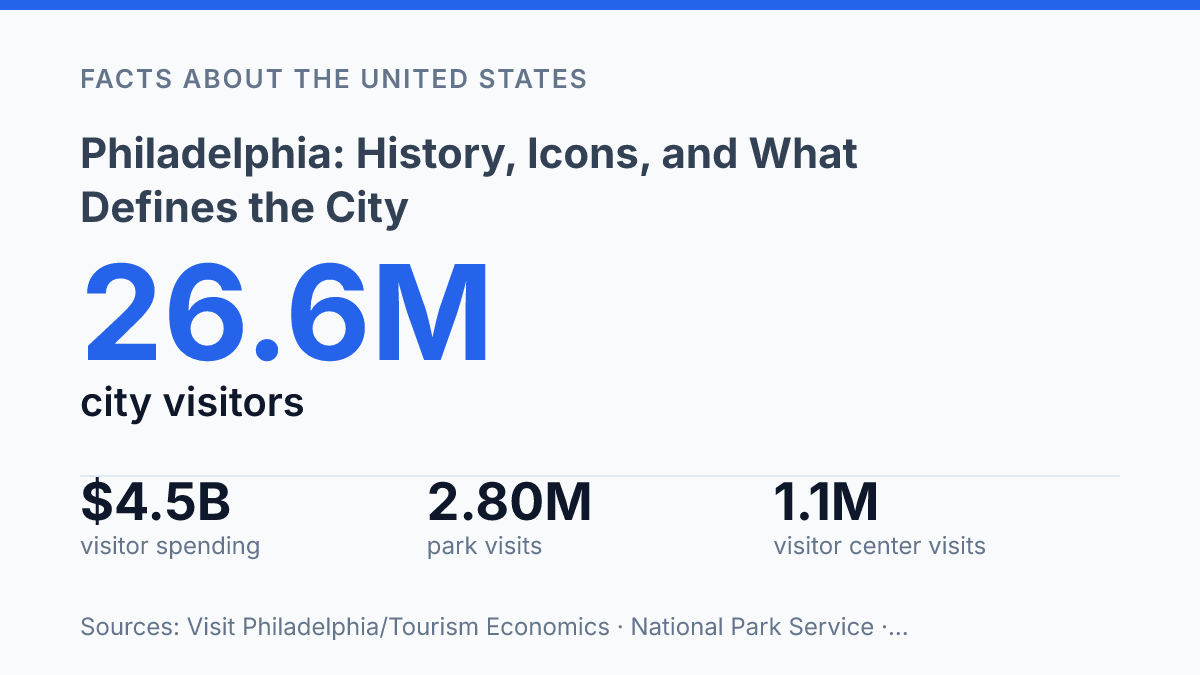
Independence National Historical Park recorded 2,798,651 recreation visits in 2024, while the museum steps made famous by Rocky attract about 4 million visits a year. The city’s identity now rests on both documentary history and public memory, shaped by sites, images, tourism, and the people who live there.
Why Philadelphia mattered in the American founding
Few American civic rooms carry as much documentary weight as Independence Hall: two texts that structured the United States were signed there within eleven years. The building’s importance is not only national memory; UNESCO says the Declaration of Independence in 1776 and the U.S. Constitution in 1787 were debated, adopted and signed there, and it highlights their influence on lawmakers worldwide, according to the UNESCO World Heritage Centre listing. That international framing helps explain why the site is treated as evidence of political origin, not simply as a preserved colonial building.
As Pennsylvania’s largest city, Philadelphia had the scale, institutions, and visibility to become a practical center of Revolutionary-era politics. Its prominence meant that decisions made in its meeting rooms could be circulated, contested, and legitimized across the colonies and later the early republic. The city’s association with the founding therefore rests on both place and function: it provided the physical setting for major political acts and the urban infrastructure that made those acts consequential.
The Liberty Bell reinforces that civic identity in a different way. Unlike Independence Hall, whose significance is tied to specific documents and formal proceedings, the bell operates mainly as a symbol of American independence and public ideals. Its meaning has expanded through later generations, but its placement in the historic district keeps it connected to the Revolutionary-era narrative that draws visitors to the city.
Those landmarks now serve two roles at once: they preserve material links to the founding period and operate as heavily visited civic symbols. Independence National Historical Park recorded 2,798,651 recreation visits in 2024, according to the National Park Service, showing that the historic core remains a major point of public engagement rather than a static commemorative zone. The result is a city identity unusually anchored in founding documents, symbolic objects, and the continuing movement of visitors through the places where national political language first took institutional form.
Which historic sites draw the most attention?
A compact group of blocks around the historic district carries a disproportionate share of the city’s heritage tourism, because several of the best-known Revolutionary-era sites sit within a short walk of one another. Independence National Historical Park is the organizing frame for that concentration, linking major civic landmarks, exhibit spaces, and public squares into a managed historic area rather than a single monument. That structure helps explain why many visits to the city’s founding-era sites feel clustered, with one landmark naturally leading to the next.
The Liberty Bell Center is the clearest example of how public access has shaped a historic object’s modern meaning. Opened in 2003, the center places the bell at the end of an exhibit sequence that interprets its history, symbolism, and later public uses, while keeping the object in a secure, highly visible setting. The result is not a casual street-side display but a carefully managed public encounter, designed to accommodate large crowds while preserving the artifact.
Visitor flow reinforces the district’s role as a tourism anchor. The Independence Visitor Center welcomed more than 1.1 million visitors in 2024, up 7% from the previous year, according to the Visitor Center Corporation’s 2025 media kit.
That figure does not capture every person walking the surrounding streets, but it shows how many visitors formally enter the heritage corridor through its main orientation point. High visibility brings a practical tradeoff: the sites are easy to combine in a single trip, yet the most famous stops often involve lines, security screening, timed access, or tightly directed movement.
Old City extends the experience beyond the park boundary by preserving the scale and texture of an older urban district. Its narrow streets, brick buildings, churchyards, and converted commercial structures make historic walking routes feel continuous rather than isolated from the surrounding city. That nearby fabric matters because the area’s appeal rests not only on individual relics, but on the ability to move through a concentrated historic environment where architecture, street pattern, and commemorative sites reinforce one another.
How the Philadelphia Museum of Art became a pop-culture symbol
The museum’s outdoor staircase attracts a tourist audience on a scale that far exceeds its indoor attendance: the Associated Press reported in 2026 that about 4 million people visit the steps each year, while the museum recorded 649,204 visitors for the fiscal year ending June 30, 2024. That gap helps explain why the front approach has become not only an entrance to an art institution, but also one of the city’s most reproduced public images.
The steps of the Philadelphia Museum of Art gained that wider identity through the training sequence in “Rocky,” in which Sylvester Stallone runs up the stairs and raises his arms over the Benjamin Franklin Parkway. The scene works visually because it turns an architectural feature into a moment of ascent: the runner moves from street level to a broad civic overlook, with the city arranged behind and below him. In that form, the museum became attached to a story of effort, endurance, and public recognition rather than only to its galleries.
That association did not replace the museum’s quieter role as a major art institution, but it changed how many visitors encounter the building. For some, the exterior is the destination, and the ritual of running the steps or posing at the top functions as a shorthand for the city itself. The image is portable in a way that museum collections usually are not: it can be repeated in photographs, sports broadcasts, tourism campaigns, and everyday visitor behavior.
The museum has also begun to treat the connection as part of civic history rather than merely a movie reference. Its announced 2026 exhibition, “Rising Up: Rocky and the Making of Monuments,” was described by the museum as bringing together more than 150 works by over 50 artists across more than 2,000 years of boxing imagery and monument-making. That framing places the “Rocky” association alongside longer traditions of public memory, bodily struggle, and urban symbolism, showing how a popular film scene can alter the meaning of a cultural landmark without exhausting it.
What the city’s identity looks like now
A city can receive 26.6 million visitors in a year and still have its public identity narrowed to a handful of founding-era images. According to a 2025 report by Tourism Economics for the city’s tourism agency, that was the scale of city visitation in 2024, showing that heritage remains a major draw while also feeding a much broader urban experience that includes food, art, sports, higher education, and neighborhood culture.
The scale matters because, as Pennsylvania’s largest city, it is not simply a preserved civic shrine. Revolutionary-era sites sit within the daily geography of municipal government, transit, schools, hospitals, residential blocks, restaurants, and office corridors. That coexistence gives the city an unusual public character: national memory is not separated into a distant monument zone, but woven into streets that also serve ordinary contemporary life.
Demographic data reinforces the point that the city’s identity is present-tense as well as historical. The U.S. Census Bureau’s QuickFacts estimate put the July 1, 2025 population at 1,574,281, and reported that 24.4% of residents age 5 and older spoke a language other than English at home. Those figures do not define culture by themselves, but they help explain why the city cannot be understood only through its eighteenth-century associations.
This creates a useful tension in the city’s image. Its best-known symbols make it one of the country’s clearest history destinations, yet the same visibility can flatten public perception of a living metropolitan center. The more accurate picture is dual: an old national capital of memory whose historic associations remain unusually prominent, and a present-day cultural city whose identity continues to be shaped by residents, institutions, and everyday civic life.
What the visitor numbers reveal about the city’s next chapter
The next question is not whether the city has enough recognizable symbols, but how those symbols are interpreted as the city changes. A tourism base of 26.6 million visitors and $4.5 billion in spending in 2024 gives civic memory real economic weight, yet the resident city is more complex than its most photographed places.
Census estimates put the 2025 population at 1,574,281, with 24.4% of residents age 5 and older speaking a language other than English at home. That contrast matters because future preservation will depend less on keeping icons frozen and more on connecting them to a living city with shifting communities, pressures, and claims on public space.
Frequently Asked Questions
Q: What is Philadelphia best known for historically?
A: Philadelphia is best known for its central role in the American Revolution and early U.S. government. Independence Hall is especially significant because the Declaration of Independence and Constitution were signed there. The city’s historic sites make its national importance especially visible.
Q: Why is the Liberty Bell associated with Philadelphia?
A: The Liberty Bell is one of the city’s best-known symbols and is closely tied to American independence. It is displayed in Philadelphia as part of the city’s Revolutionary-era heritage. Its fame comes from both its historical association and its status as a public symbol.
Q: What makes Independence Hall an important landmark?
A: Independence Hall is important because it was the setting for two defining moments in U.S. history: the signing of the Declaration of Independence and the Constitution. 1776 is the year most strongly associated with the building’s Revolutionary-era significance. That history is why it remains one of the city’s most visited sites.
Q: Why are the Philadelphia Museum of Art steps so famous?
A: The steps became widely recognized after Sylvester Stallone’s run in the film Rocky. They are now one of Philadelphia’s most photographed landmarks and are associated as much with popular culture as with the museum itself. Their fame shows how film can shape a city’s public image.
Q: What defines Philadelphia’s identity today?
A: Philadelphia is defined by the combination of its historical importance, major civic landmarks, and cultural symbolism. As Pennsylvania’s largest city, it carries both state-level prominence and national historical weight. That mix helps explain why the city remains strongly associated with American origin stories and recognizable icons.