
The September 11 attacks can be understood through a stark sequence of minutes: United Flight 93 was hijacked at 9:28 a.m., and by 10:03 a.m., 13 people on board had made 37 phone calls before the crash in Pennsylvania. Those calls show how quickly information moved inside one aircraft, while the survival data from New York show how sharply fate depended on location: NIST reports that none of the 1,355 people in or above the impact zone of WTC 1 survived, while most occupants below it escaped.
The attacks were not one event but four coordinated hijackings whose effects spread through buildings, agencies, families, and national policy. This account examines the timeline, the losses at the World Trade Center and Pentagon, the federal response, and the reasons 9/11 remains a defining point in U.S. history.
How the four hijackings unfolded
Within 102 minutes of the first impact, two skyscrapers had been struck in New York, the Pentagon had been hit outside Washington, and a fourth hijacked plane had crashed in Pennsylvania. The September 11 attacks were carried out by al-Qaeda, whose operatives used coordinated hijackings rather than conventional explosives to turn scheduled passenger flights into weapons on September 11, 2001. In total, 19 hijackers took control of four commercial airliners, all of them departing on domestic routes with enough fuel for cross-country flights.
The first two aircraft were Boeing 767s bound for California. American Airlines Flight 11 was hijacked after leaving Boston and was flown into the North Tower of the World Trade Center in New York City.
United Airlines Flight 175, also departing from Boston, was then flown into the South Tower. The use of two large wide-body aircraft against the Twin Towers made clear that the crashes were not isolated aviation disasters but part of a coordinated operation.
A third aircraft, American Airlines Flight 77, had departed from Washington Dulles International Airport before being hijacked and redirected toward the Washington, D.C., area. It struck the Pentagon in Arlington County, Virginia, bringing the attack from New York’s financial district to the headquarters of the United States Department of Defense. The choice of targets showed that the operation was aimed at symbolic centers of American economic, military, and political power.
The fourth hijacked aircraft, United Airlines Flight 93, did not reach its intended target. The National Park Service says 37 phone calls were made by 13 people aboard United Flight 93 between the hijacking at 9:28 a.m. and the crash at 10:03 a.m., a sequence that helps explain how passengers learned other planes had already been used in attacks. Their resistance disrupted the hijackers’ plan, and the aircraft crashed in a field near Shanksville, Pennsylvania, instead of continuing toward Washington.
What was lost at the World Trade Center and the Pentagon
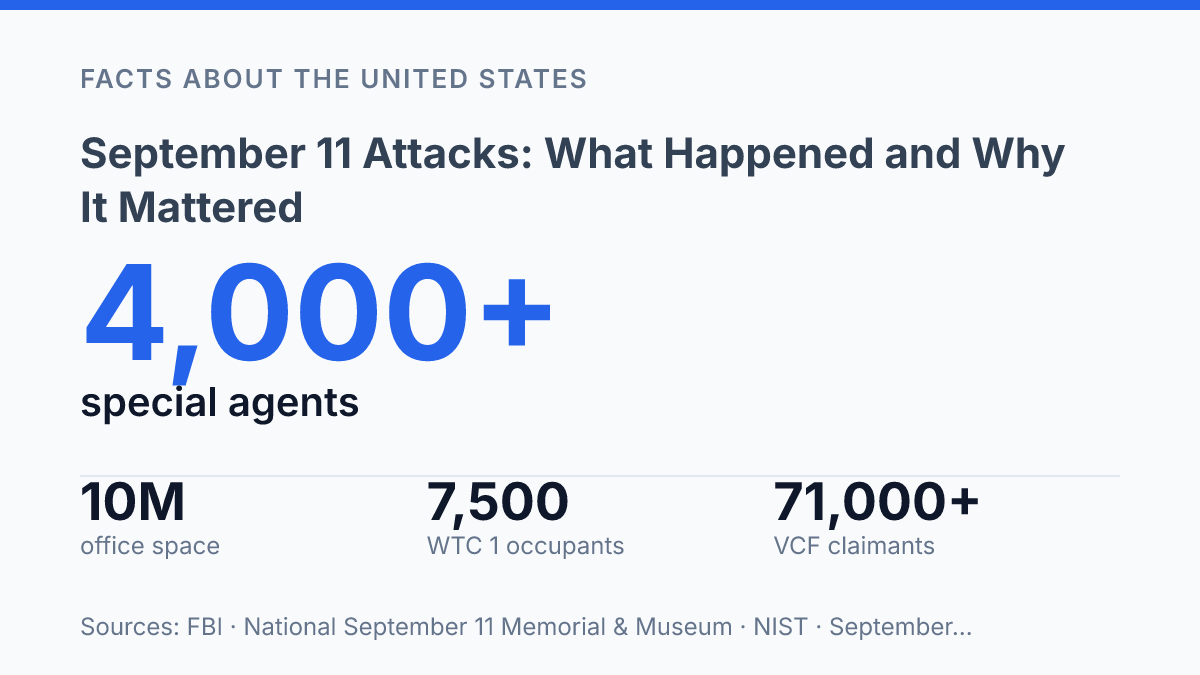
Before the morning was over, a site that had held nearly 10 million square feet of office space was reduced to a field of collapsed steel, concrete, dust, and fire. The National September 11 Memorial & Museum describes the World Trade Center as a 16-acre complex of seven buildings that had served about 35,000 people and 430 companies before the attacks. The collapse of both Twin Towers destroyed the central structures of the complex and devastated the surrounding lower Manhattan site, turning a major commercial district into an emergency zone within hours.
Survival inside the towers depended sharply on location. According to the National Institute of Standards and Technology, nearly everyone below the impact floors in both towers survived, while those at or above the impact zones faced blocked exits, fire, smoke, and structural failure.
In WTC 1, none of the 1,355 people in or above the impact zone survived; in WTC 2, 18 people above the impact zone escaped through a damaged stairwell. These figures show why the physical damage cannot be separated from the human toll: the buildings’ vertical design made floor position a decisive factor.
At the Pentagon in Arlington County, Virginia, the attack damaged the headquarters of the U.S. Department of Defense and destroyed part of one of the country’s most important military command buildings. The 9/11 Pentagon Memorial notes that the aircraft was traveling 530 miles per hour and still carried most of its original 7,256 gallons of fuel when it hit, destroying the load capacity of about 30 first-floor columns and impairing about 20 more. The result was not only a loss of life, but a direct strike on the administrative center of the American military.
The total death toll was nearly 3,000 people, including civilians at the World Trade Center and Pentagon, firefighters, police officers, emergency medical workers, and passengers and crew aboard the four planes. That number captures the scale of the loss, but not its full reach: many survivors and responders also faced injury, hazardous conditions, and long-term health consequences tied to smoke, dust, debris, and rescue work.
How the United States responded after 9/11
Within one week, Congress gave the president broad authority to use force against those responsible for 9/11 and those who harbored them. The Authorization for Use of Military Force, signed on September 18, 2001, became the legal foundation for a wider campaign that the Bush administration described as the Global War on Terror. Its purpose was not limited to punishing the planners of the attacks; it also aimed to disrupt militant networks, deny them state protection, and prevent another mass-casualty strike on U.S. soil.
The first major military response came in Afghanistan, where U.S. and allied forces began operations in October 2001 against al-Qaeda’s base of support and the Taliban government that had sheltered its leadership. That campaign showed how the response differed from ordinary law enforcement: it combined intelligence gathering, special operations, air power, alliance-building, and later a long effort to prevent extremist groups from regaining secure territory. The connection to 9/11 was direct, but the length and cost of the war later made Afghanistan central to debates over how far military force could reduce terrorist threats.
Domestic policy changed in parallel with overseas operations. The FBI’s PENTTBOM investigation illustrates the immediate scale of the response: according to the FBI, more than 4,000 special agents and 3,000 professional employees worked the case, responding to more than 500,000 leads, conducting over 167,000 interviews, and processing more than 150,000 pieces of evidence in the first 30 days. Congress also passed the USA PATRIOT Act in 2001, expanding investigative and surveillance authorities, while aviation security was reorganized through federal screening standards and the creation of the Transportation Security Administration.
Across the next two decades, counterterrorism became a standing priority rather than a temporary emergency program. Security measures included watchlists, intelligence sharing, airport screening procedures, and expanded monitoring powers; combat measures included military deployments, drone strikes, raids, and partnerships with foreign governments. These actions were designed to reduce the chance of another large attack, but they also produced sustained disputes over privacy, detention, civilian harm, public spending, and the limits of wartime authority in an open-ended conflict.
Why the attacks still shape U.S. history
In 2025, the September 11th Victim Compensation Fund still received an average of 900 new claims per month, a sign that 9/11 remains a legal, medical, and civic aftermath rather than a closed historical episode, according to the fund’s 2026 reporting. That continuing administrative record helps explain why the attacks remain present in public institutions as well as in memory: their effects are measured not only through memorial ceremonies, but through compensation systems, health claims, museum collections, and government planning documents.
Schools and public history institutions have made 9/11 a fixed reference point in modern U.S. history. Curricula often treat it as a marker separating the post-Cold War 1990s from an era shaped by counterterrorism, expanded surveillance debates, military intervention, and changes in aviation and emergency preparedness. Annual commemorations, memorial names, museum exhibitions, and moments of silence keep the event visible in civic life, while the phrase “9/11” continues to function in political and media coverage as shorthand for both the attacks and the policy era that followed.
The domestic response also became institutionalized through the creation of the Department of Homeland Security in 2002. The new cabinet department brought together functions that had previously been spread across multiple agencies, including border security, emergency management, infrastructure protection, and parts of immigration enforcement. Its creation showed that the federal government treated terrorism prevention and disaster readiness as permanent organizing priorities, not temporary emergency measures.
The legacy remains debated because the same measures can be assessed through different standards. Supporters of post-9/11 security changes often point to improved coordination, threat detection, and preparedness as necessary adaptations after a mass-casualty attack.
Critics focus on civil liberties, detention policy, surveillance authorities, discrimination concerns, and the costs of prolonged military and security commitments. That disagreement is one reason 9/11 still shapes U.S. history: it is remembered as a national trauma, but also studied as a turning point that changed how Americans argue about safety, power, rights, and the country’s role abroad.
Why the record keeps changing
The meaning of 9/11 is not fixed only by the events of that morning. It also depends on the records that keep expanding: DNA identifications, medical claims, declassified materials, and institutional reforms that continue to alter how the attacks are studied and remembered. New York City reported three newly identified World Trade Center victims on August 7, 2025, while about 1,100 victims remained unidentified, a figure that keeps the disaster present in forensic science as well as public memory.
The Victim Compensation Fund’s average of 900 new claims per month in 2025 points to another reality: the attacks created harms that did not end when the fires were extinguished. The practical consequence is that 9/11 remains both a historical event and an active administrative, medical, and legal responsibility.
Frequently Asked Questions
Q: What happened during the September 11 attacks?
A: The attacks were a coordinated series of suicide hijackings carried out by al-Qaeda in 2001. Four airliners were taken by 19 terrorists, with two flown into the Twin Towers in New York City, one into the Pentagon, and one crashing in Pennsylvania after a passenger revolt.
Q: Who was responsible for 9/11?
A: The attacks were carried out by the Islamic terrorist organization al-Qaeda. The operation was planned and executed by 19 hijackers who targeted the United States in a coordinated strike.
Q: How many planes were used in the attacks?
A: Four airliners were hijacked on September 11, 2001. Two struck the World Trade Center towers, one hit the Pentagon, and the fourth went down in a rural Pennsylvania field.
Q: Why did the 9/11 attacks change U.S. foreign policy?
A: The attacks prompted the United States to launch the Global War on Terror. That policy aimed to remove hostile groups identified as terrorist organizations and, in some cases, the governments believed to support them over the following two decades.
Q: What was the significance of the plane that crashed in Pennsylvania?
A: The fourth hijacked plane did not reach its apparent target because passengers fought back against the hijackers. It crashed in a rural Pennsylvania field, showing that resistance aboard the flight altered the outcome of the attack.