
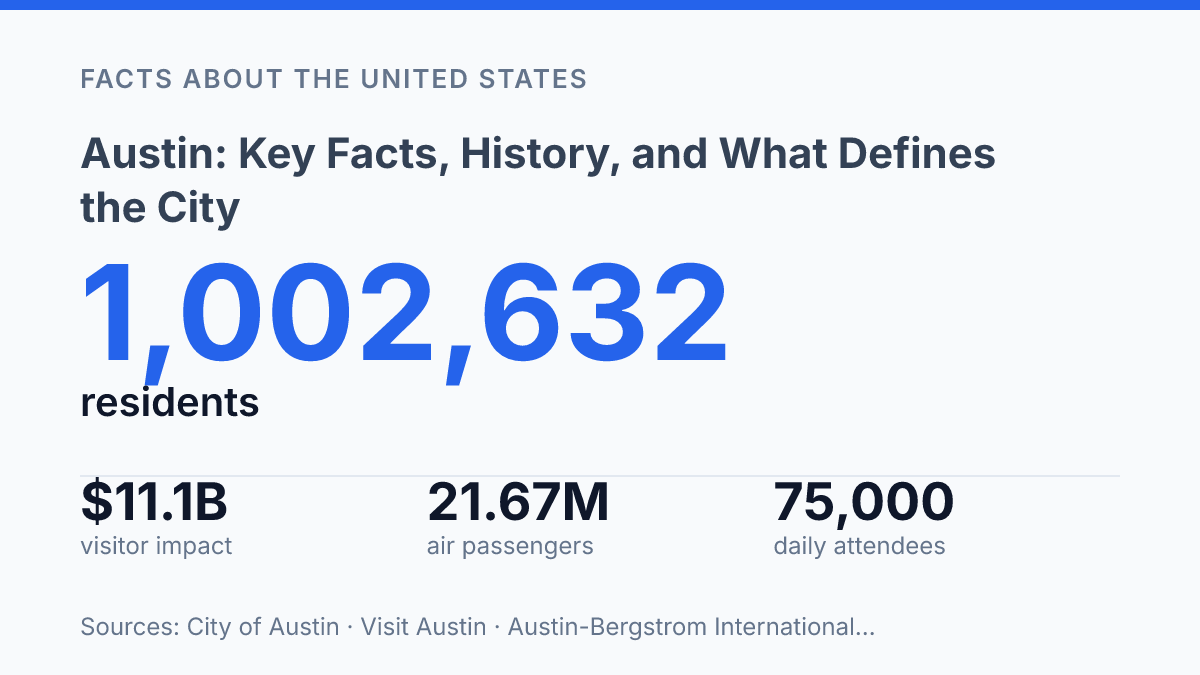
Austin passed 1 million residents in 2025, reaching 1,002,632 people and placing the city within the scale of the 12th most populous U.S. city. That milestone is only one part of a wider regional pattern: the surrounding metro added more than 58,000 residents from 2023 to 2024, while downtown employment, airport traffic, tourism, and housing construction all remained unusually active. The city’s identity is therefore shaped by more than population growth or a familiar music reputation.
It is a state capital, a university city, a technology and advanced manufacturing center, and a cultural hub whose public life has measurable economic weight. Understanding it requires looking at how geography, government, migration, music, and business investment have interacted over time. The result is a city defined by rapid expansion, but also by the pressures and adaptations that come with becoming larger, denser, and more nationally connected.
Austin at a Glance
Austin was still under one million residents in the 2020 Census, but passed that mark only five years later. The Census counted 961,855 people within the city limits, a figure that remains useful because it refers specifically to the incorporated municipality rather than the wider labor market, commuter shed, or county population.
The city is the Texas state capital and the county seat of Travis County, giving it a dual civic role in state and local government. Its physical setting is in Central Texas along the Colorado River, a location that helps explain the city’s mix of government functions, university activity, residential growth, and recreation-oriented public spaces without requiring a historical account.
Population estimates need careful labeling because local figures can describe different geographies. A city-limit count excludes many suburbs and nearby communities that are included in metropolitan-area totals, while county counts follow separate administrative boundaries. For that reason, the 961,855 figure should not be read as the size of the full regional economy or commuting area.
Recent estimates show how quickly the municipal count has changed. According to the City of Austin, the city reached 1,002,632 residents as of July 1, 2025, up 4,025 from a year earlier and ranking 12th among U.S. cities by population. That milestone places the capital in a different scale category from its 2020 baseline, while still leaving metro-area and county figures as separate measures for understanding regional growth.
How the City Grew
The city’s first durable pivot came before Texas joined the United States: the settlement known as Waterloo was selected as the seat of government for the Republic of Texas and renamed Austin in 1839. That choice tied local growth to public administration from the start. Government offices, legal work, archives, contractors, and political activity created a stable employment base that helped the settlement survive periods when frontier trade alone would have been less reliable.
A second anchor arrived with the University of Texas at Austin, founded in 1883. The university reshaped the city by bringing students, faculty, research activity, libraries, cultural institutions, and a steady demand for housing and services. Over time, it also supplied the skilled workforce that made the region more attractive to employers in engineering, software, public policy, health research, and business services.
By the late twentieth century, growth was no longer driven mainly by government and higher education. Technology manufacturing, software, semiconductors, and professional services expanded around the city’s educated labor pool and research capacity.
Dell, founded in the region and long associated with nearby Round Rock, became one of Central Texas’s best-known technology companies, while Oracle built a major local presence in enterprise software and cloud computing. According to an AQUILA Commercial analysis of regional economic-development data, 10,621 new jobs were announced in the region in 2025, with about 62% tied to relocations and nearly one quarter connected to semiconductors and advanced electronics.
These growth engines reinforced one another, but they also placed new demands on the city’s physical systems. State government supplied institutional stability, the university helped generate talent and research capacity, and technology employers brought investment and higher-wage jobs. The same expansion increased pressure on housing, traffic, utilities, and public infrastructure, forcing local planning to keep pace with a metro economy that grew faster than many older civic systems were designed to handle.
Culture, Music, and Public Life
A music festival that fills Zilker Park can function like a temporary city: in 2025, the Austin City Limits Music Festival drew 75,000 attendees per day across six days, according to FOX 7. That scale helps explain why the city’s cultural identity is also an economic force. The same report said the festival generated $557.8 million for the local economy, with more than 120 artists and 78 vendors participating, placing music at the center of hospitality, retail, and public-space use rather than treating it as a separate entertainment niche.
South by Southwest gives the city a different kind of visibility because it links music with film, technology, media, and conferences. Its value is partly reputational: it places local venues, downtown streets, and creative businesses in front of national and international audiences. Together with ACL, it supports the long-running civic slogan “Live Music Capital of the World,” a phrase that reflects both venue density and the city’s habit of using live performance as part of its public identity.
Civic life is not defined only by festivals. The Texas State Capitol anchors the government district and gives public affairs a visible architectural center, while Lady Bird Lake and Zilker Park make outdoor recreation part of everyday urban life. These spaces also shape how the city is experienced: trails, lawns, waterfront paths, and parkland create gathering places that are less dependent on ticketed events.
The same cultural strengths create practical pressures when major events concentrate visitors in a small number of districts. Hotel demand, ride-hailing prices, restaurant traffic, and local transport all become more strained during peak periods, and public spaces can feel less accessible to residents. That does not erase the cultural and economic value of these events, but it shows why the city’s public life depends on management as much as branding.
Why Austin Keeps Attracting People
A metro area can add more than 58,000 residents in a year while parts of its rental market soften, and that unusual combination explains much of the city’s current pull. The Austin–Round Rock–San Marcos area grew by 2.3% from 2023 to 2024, according to the U.S. Census Bureau, showing that regional migration and household formation remain strong even as housing supply has expanded.
The Pew Charitable Trusts reported that the city added 120,000 housing units from 2015 to 2024, a 30% increase, while median rent fell from $1,546 in December 2021 to $1,296 by January 2026. That does not mean housing is broadly inexpensive, but it does show how faster construction can relieve some pressure in a high-demand market.
The employment base is another central attraction because it is not limited to one sector. Technology companies and semiconductor-related employers draw skilled workers, while public administration and higher education provide large institutional anchors that are less tied to short-term business cycles.
Downtown also functions as a major employment district: the Downtown Alliance’s 2025–26 report counted 131,775 employees, 745 storefront businesses, 15,335 hotel rooms, and millions of square feet either under construction or planned. Those figures help explain why the city attracts both career-focused newcomers and businesses seeking access to talent, customers, and travel connections.
Visitor activity and air service add another layer to the economy. Visit Austin reported 30 million visitors in 2024, with $11.1 billion in visitor-spending impact and 148,000 hospitality and tourism jobs supported.
The airport recorded 21,666,852 arriving and departing passengers in 2025, its third-busiest year on record, while adding 21 nonstop routes, according to the city’s aviation department. Strong travel demand supports conventions, hospitality, restaurants, and professional services, widening the range of jobs beyond the technology sector.
The same growth also sharpens practical constraints. Housing demand remains high even when rents ease, and lower-cost options are unevenly distributed across neighborhoods and suburbs.
Central Texas conditions add further pressure: long hot summers, drought cycles, sudden heavy rainfall, and water-supply planning all shape infrastructure, development, landscaping, and household costs. The city’s appeal today therefore rests on a clear tradeoff: broad economic opportunity and cultural energy continue to attract people, while affordability, heat, and water concerns increasingly define how sustainable that growth feels in daily life.
What Scale Changes About the City’s Next Choices
The next test for Austin is whether scale can be managed as an asset rather than treated only as a growth statistic. A city that adds housing quickly, draws major visitor spending, and attracts new employers also faces harder choices about infrastructure, land use, public space, and cultural continuity. The data points in one direction: demand for the region remains strong, but the form that growth takes will matter as much as the pace.
Lower rents after a major housing expansion show that policy and supply can alter outcomes, not merely respond to them. The practical consequence is clear: the city’s future will be shaped less by whether people keep arriving than by how effectively institutions, neighborhoods, and markets absorb that arrival.
Frequently Asked Questions
Q: What is Austin best known for?
A: Austin is best known as Texas’s state capital and as a major center for technology, higher education, and live music. The city’s identity is shaped by government institutions, the University of Texas, and a large cluster of employers in software, semiconductors, and related services.
Q: Why has Austin grown so quickly?
A: Austin’s growth has been driven by job expansion, domestic migration, and a strong regional economy. Technology firms, university research, and state government have helped attract workers, while the broader metro area has continued to add housing and infrastructure at a fast pace.
Q: Is Austin still considered a good place for tech jobs?
A: Austin remains one of the strongest tech markets in the United States. It supports a mix of large companies, startups, and supplier networks, which creates a broader job base than a single-industry market. That diversity has helped the city stay resilient even when hiring slows in parts of the sector.
Q: What makes Austin different from other Texas cities?
A: Austin is more closely associated with government, education, and technology than with oil, shipping, or heavy industry. It also has a distinct cultural identity built around live music, outdoor recreation, and a younger population profile than many other large Texas cities.
Q: How did Austin become the state capital?
A: Austin was selected as the capital of Texas in the 19th century as the state was organizing its government and choosing a more central inland location. The decision helped shape the city’s long-term development by concentrating political institutions, public employment, and related services there.