
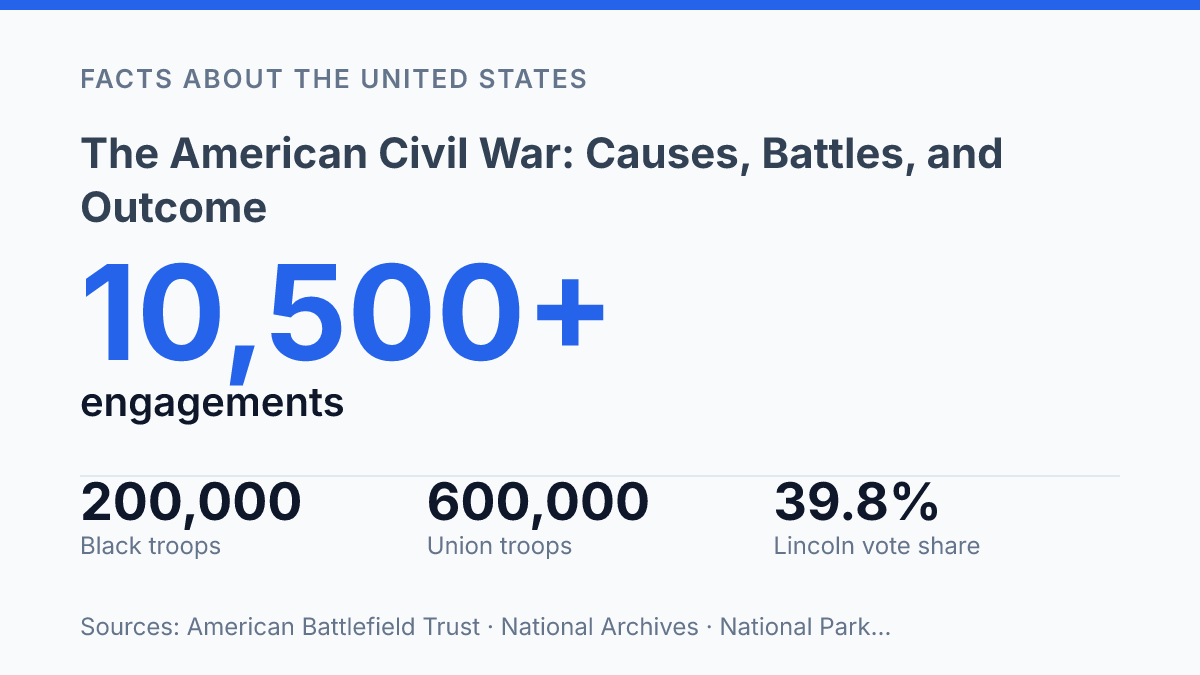
The American Civil War emerged from an election in which Abraham Lincoln won only 39.8% of the popular vote, while his name was absent from ballots in most Southern states. That narrow national mandate, combined with the Deep South’s dependence on slavery, turned politics into a secession crisis within weeks. South Carolina, where 57.2% of the population was enslaved in 1860, left the Union on December 20, followed by six more states before February 1861.
The conflict that followed was not a single march from Fort Sumter to Appomattox, but a war of shifting aims, expanding armies, and more than 10,500 military engagements. Its outcome depended on leadership, manpower, strategy, emancipation, and the service of nearly 200,000 Black Union soldiers and sailors, whose role changed both the war effort and the meaning of Union victory.
Why the Union and Confederacy split in 1861
Lincoln’s victory exposed a sectional fracture so deep that the first wave of secession began before he took office. Abraham Lincoln won the 1860 election with only 39.8% of the popular vote in a four-way race, and his name did not appear on the ballot in most Southern states, according to the American Battlefield Trust, updated. That result gave secessionists a powerful argument that the federal government had fallen under the control of a party hostile to slavery’s expansion, even though Lincoln had campaigned mainly against extending slavery into western territories rather than abolishing it where it already existed.
Slavery was the central issue behind the split because it shaped Southern wealth, labor systems, political power, and fears about the future balance between slave and free states. The first seven states to leave the Union were South Carolina, Mississippi, Florida, Alabama, Georgia, Louisiana, and Texas, all of which seceded between December 20, 1860, and February 1, 1861.
Their declarations and debates repeatedly connected secession to the protection of slavery, even when public arguments also invoked state sovereignty, constitutional rights, or resistance to Northern political dominance. The states’ rights language mattered politically, but it usually referred to the claimed right of states to preserve and expand an enslaved labor system.
The demographic weight of slavery in the Deep South helps explain why secession moved fastest there. In the 1860 Census, enslaved people made up 57.2 percent of South Carolina’s population and 55.1 percent of Mississippi’s, making slavery not a peripheral institution but a foundation of the region’s social and economic order. A national administration opposed to slavery’s spread therefore appeared to many Southern leaders as a long-term threat to plantation agriculture and to the political influence that slaveholding states had exercised in Congress and the presidency.
By 1861, the initial Confederate bloc had formed around the Deep South, and four more states later joined: Virginia, Arkansas, Tennessee, and North Carolina. The Union consisted of the states that remained loyal to the United States, including Northern free states and the slaveholding border states of Delaware, Maryland, Kentucky, and Missouri. This opening alignment meant the conflict was not simply North versus South in a neat geographic sense; it was a constitutional and political rupture over whether secession was lawful and whether slavery would continue to define the nation’s expansion and federal power.
How the war unfolded from Fort Sumter to Appomattox
Confederate artillery fire on Fort Sumter turned a constitutional crisis into open war on April 12, 1861. The small federal garrison in Charleston Harbor surrendered after bombardment, and the attack gave the conflict a clear military starting point even though the political break had already occurred. Within weeks, mobilization on both sides made clear that the fighting would not be a brief show of force but a sustained war over armies, territory, supply lines, and national authority.
The conflict lasted four years, from 1861 to 1865, and its course was uneven rather than linear. In the East, repeated campaigns focused on the route between Washington and Richmond, where armies fought for political capitals as well as strategic advantage.
In the West, Union operations gradually opened rivers, divided Confederate territory, and placed pressure on interior rail and supply networks. This difference matters because a simple start-and-end timeline can make the war seem like one continuous movement toward surrender, when in practice momentum shifted by region and by campaign.
The war’s scale also resists a narrow battle-list summary. According to the American Battlefield Trust, more than 10,500 military engagements occurred, though historians generally classify only about 50 as major battles and roughly 100 more as significant. That distinction helps explain why familiar battle names represent only part of the conflict: raids, sieges, naval operations, cavalry actions, and clashes over transportation routes all shaped what the larger armies could do.
By 1864 and early 1865, Union pressure had become more coordinated across multiple theaters, while Confederate resources and manpower were increasingly strained. The decisive symbolic endpoint came at Appomattox Court House in Virginia, where Robert E. Lee surrendered the Army of Northern Virginia to Ulysses S. Grant in April 1865. Other Confederate forces capitulated afterward, but Appomattox is widely treated as the effective end of the Civil War because it removed the Confederacy’s most prominent field army and signaled that organized resistance could no longer be sustained.
Key leaders, armies, and turning points
The decisive year was 1863, when emancipation, battlefield reverses for Lee, and Union gains in the West began to point in the same strategic direction. The war still depended on armies in the field, but its political meaning and its material balance were changing at the same time. That convergence helps explain why several events from that year are treated as turning points rather than isolated victories or policy decisions.
Political leadership set the boundaries within which military strategy operated. Abraham Lincoln, as president of the Union, increasingly linked victory to the destruction of slavery as a war power measure. Jefferson Davis, as president of the Confederacy, had to defend a new government while coordinating armies that often depended on regional priorities, strained transport, and shrinking reserves. The contrast was not simply personal; the Union government had deeper financial, industrial, and logistical resources to sustain a long war.
Grant and Lee became the best-known military commanders because they represented different strategic pressures on each side. Ulysses S. Grant’s rise came through operations that emphasized persistence, coordination, and control of river and rail corridors, especially in the western theater. Robert E. Lee’s reputation rested on tactical skill and aggressive movement in Virginia, but his army could not easily replace losses.
By 1863, Union forces outnumbered Confederate forces by 2 to 1, according to the National Park Service, with more than 600,000 Union troops in January of that year against a Confederate force that declined sharply by the final year. Leadership mattered, but numbers, supply, and transport increasingly limited what Confederate commanders could achieve.
Turning points shifted momentum because they changed options available to both governments. The Emancipation Proclamation, issued in final form on January 1, 1863, declared enslaved people in areas under rebellion to be free. Its immediate legal reach was limited by military control, but its strategic effect was broad: it made emancipation an explicit Union war aim, opened a larger path for Black enlistment, and made European recognition of the Confederacy diplomatically harder.
Military events reinforced that shift. Gettysburg blunted Lee’s attempt to carry the war into the North, while Vicksburg gave the Union control of the Mississippi River and divided Confederate territory. Together, these developments did not end the war quickly, but they narrowed Confederate possibilities and strengthened the Union’s ability to fight on its own terms.
Costs, emancipation, and the war’s legacy
A war fought before antiseptic surgery and modern antibiotics killed an estimated 620,000 to 750,000 people, a loss that exceeded the total American deaths in several later wars combined. Disease, infection, malnutrition, and exposure accounted for a large share of the dead, so the cost cannot be measured only by battlefield casualties. Prison camps added another severe dimension: according to the National Park Service, 30,218 of 211,411 captured Union soldiers died in captivity, as did 25,976 of 462,634 captured Confederate soldiers.
Emancipation changed the meaning of Union victory from restoration alone to the legal destruction of slavery. The decisive constitutional step was the ratification of the 13th Amendment in 1865, which abolished slavery throughout the United States rather than only in places covered by wartime executive action. This mattered because constitutional abolition made slavery’s end national, permanent in law, and binding on states that had not been directly reached by earlier military or presidential measures.
Black military service also shaped the outcome and its legacy. By the end of the conflict, almost 200,000 Black soldiers and sailors had served the Union, and African Americans made up about 10% of the Union Army, according to the National Archives and the American Battlefield Trust. Their service linked emancipation to citizenship claims, because formerly enslaved and free Black Americans had not only been subjects of federal policy but also participants in preserving the nation.
The war also enlarged the practical authority of the federal government. Secession’s defeat affirmed that states could not unilaterally leave the Union, while wartime mobilization strengthened national power over taxation, currency, military organization, and constitutional enforcement. That shift did not settle the future of civil rights, but it created the framework within which later disputes over citizenship, equal protection, voting, and federal intervention would be argued.
Freedom therefore arrived as a defining outcome, not as immediate equality or safety. The abolition of slavery ended legal ownership of human beings, but it did not by itself guarantee land, political power, personal security, or equal treatment under law. That gap between emancipation and full civil rights became one of the central unresolved legacies of the conflict.
Why the war’s records still change the questions
The war is hardest to understand when treated as a single moral drama or a sequence of battles. Its meaning comes into focus when political documents, census tables, enlistment records, prison rolls, and emancipation policy are read together. That evidence keeps two truths in view: slavery was not incidental to the crisis, and military outcome depended on material capacity, state power, and the people newly able to fight for freedom.
A practical next step for deeper study is to follow one county, regiment, or family across those records. The national conflict then becomes measurable at human scale, where law, labor, combat, and loss met in ordinary lives.
Frequently Asked Questions
Q: What caused the American Civil War?
A: The war grew out of long-standing disputes over slavery, state authority, and federal power. Tensions intensified after Abraham Lincoln’s election in 1860, which accelerated secession in the South and helped trigger armed conflict. These political and economic conflicts had been building for decades before fighting began.
Q: When did the Civil War start and end?
A: The American Civil War was a four-year conflict fought from 1861 to 1865. It began after secession and the opening of hostilities between the Union and the Confederate states. The war ended in 1865 with the Confederate surrender and the preservation of the United States.
Q: Who fought in the American Civil War?
A: The war was fought between the United States, known as the Union, and 11 Southern states that seceded to form the Confederate States of America. Both sides fielded large armies made up mainly of volunteer and later conscripted soldiers. The conflict also affected civilians across much of the country.
Q: What was the most important battle in the Civil War?
A: No single battle decided the war, but Gettysburg is often treated as a turning point because it ended Confederate offensives in the North. Antietam also mattered because it gave the Union a strategic opening and helped shape the later Emancipation Proclamation. Military, political, and economic pressure combined over time rather than one engagement ending the conflict.
Q: What was the outcome of the Civil War?
A: The Union won, secession was defeated, and the United States remained intact. The conflict also led to the abolition of slavery through the 13th Amendment, though Reconstruction left major political and social disputes unresolved. Its effects reshaped federal authority and American society for generations.