
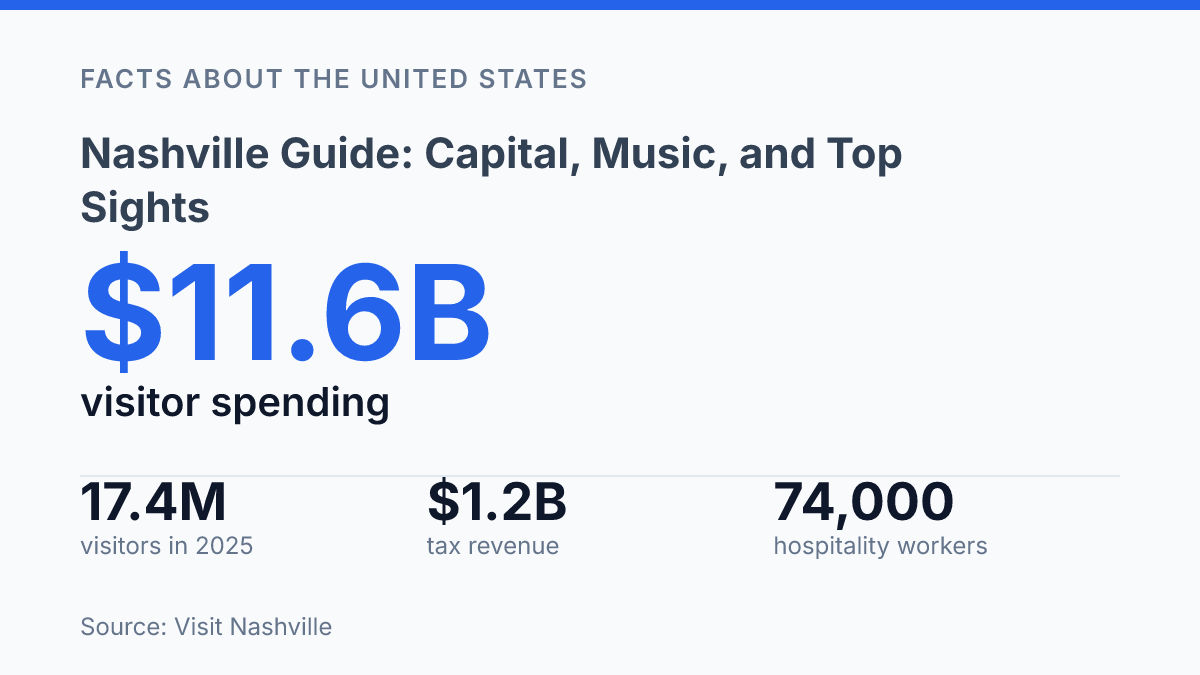
Nashville drew 17.4 million daily and overnight visitors in 2025, yet its influence is not measured only in honky-tonks, recording history, or weekend crowds. The city is also the seat of Tennessee government, where a $58.3 billion state budget moved through the 2026 legislative session, and a major institutional economy shaped by Vanderbilt University and Vanderbilt University Medical Center.
That combination makes the city unusually layered: a capital where public finance, higher education, tourism, and music institutions all occupy the same urban core. This guide explains why the city matters politically, how landmarks such as the Grand Ole Opry, the Ryman, and the Country Music Hall of Fame anchor its cultural identity, and what Downtown and the District reveal about the visitor experience beyond the familiar soundtrack.
Why Nashville matters as Tennessee’s capital
A $58.3 billion state budget passed in 2026 makes the capital’s role concrete: statewide priorities are debated, funded, and administered from here. As Tennessee’s state capital, Nashville is the seat of state government, bringing the governor’s office, the legislature, state agencies, policy staff, lobbyists, courts, and public-interest organizations into the same civic orbit. According to the Tennessee Governor’s Office, the 2026 budget figure reflects the scale of decisions made through the capital, from transportation and education to public safety and health programs that affect communities far beyond Davidson County.
Civic influence in the city is also reinforced by Vanderbilt University, one of Tennessee’s major research and education anchors. Vanderbilt University and Vanderbilt University Medical Center generated $22.13 billion in economic activity in 2024, according to Vanderbilt University’s 2025 reporting, with nearly $10 billion in direct spending occurring locally. That footprint links higher education, medical care, research employment, student activity, and institutional purchasing to the city’s broader economic base, making Vanderbilt a structural force rather than a campus isolated from public life.
This capital-and-institutional role helps explain why the city matters within Middle Tennessee, not only as a stop for visitors. State government concentrates political decision-making there, while universities, medical systems, professional services, and public agencies draw workers, patients, students, and advocates from the surrounding region. The national reputation may often begin with entertainment, but the city’s lasting influence rests just as much on its administrative and educational functions, which shape policy, employment, infrastructure, and regional access to services across central Tennessee.
The country music institutions that define the city
Few American music institutions are still anchored by a weekly radio show after a century, yet the Grand Ole Opry reached that mark in 2025, according to Ryman Hospitality Properties’ 2026 SEC filing. The Grand Ole Opry House gives that broadcast tradition a large-scale performance home, with seating for about 4,400. Its significance rests on the combination of stage and transmission: the Opry is not only a concert, but a continuing radio format that helped country music circulate nationally while keeping a fixed association with the city that hosts it.
The Country Music Hall of Fame and Museum in Downtown Nashville serves a different role by preserving the genre’s artifacts, recordings, biographies, and industry history. The museum reported that it welcomed nearly 1.4 million visitors in 2025 and celebrated its 20 millionth visitor since moving downtown in 2001 in April 2026, according to the Country Music Hall of Fame and Museum.
Those figures show that country music heritage functions as a major museum draw, not only as live entertainment. The institution gives visitors a structured account of the genre’s development, from performers and songwriters to recording practices and business networks.
Ryman Auditorium adds the historical layer that connects performance with memory. With about 2,200 seats, according to Ryman Hospitality Properties, it is smaller than the Opry House, but its importance lies in its long association with country music’s public image and institutional history. The venue’s downtown location and preserved character make it more than a performance hall; it operates as a physical link to earlier eras of the Opry and to the city’s reputation as a place where country music moved from regional sound to national culture.
Taken together, these institutions explain why the city’s music identity is unusually durable. The Opry House emphasizes continuing performance, the museum emphasizes preservation, and the Ryman emphasizes historical memory. Their purposes overlap, but they do not duplicate one another, which is why they remain central to how country music is presented, studied, and experienced in the city.
What to see Downtown and in the District
A short walk in the downtown core can shift from curated music history to neon-lit barrooms where bands play from morning into late night. Downtown Nashville contains two of the city’s best-known cultural anchors, the Country Music Hall of Fame and Museum and Ryman Auditorium, placing archival interpretation and live-performance heritage within the same compact visitor area. That proximity helps explain why the center functions less as a single attraction zone than as a layered music district, with museums, historic venues, event spaces, bars, and pedestrian traffic reinforcing one another.
The District is the louder counterpart to those heritage sites, best known for honky-tonks offering live music throughout the day and evening. Its density is measurable: downtown had 393 dining spots and 191 nightlife venues, according to NASHtoday and the Nashville Downtown Partnership in 2026. The figure does not describe musical quality or style by itself, but it does show why the area can absorb large numbers of visitors while keeping entertainment concentrated in a walkable setting rather than dispersed across the wider city.
The Johnny Cash Museum adds a more biographical form of storytelling to the central circuit. Its exhibits focus on Cash’s life and career, making it a useful stop for visitors interested in one artist’s development rather than the broader institutional history presented nearby.
In practical terms, the same central area serves different expectations: daytime visitors can prioritize museums and historic venues, while evening crowds often move toward honky-tonks and nightlife. That overlap is part of the downtown district’s appeal, but it also means the atmosphere can change noticeably by time of day.
How Nashville’s music identity shapes a visit
Country music’s public history becomes unusually legible when the Grand Ole Opry, Ryman Auditorium, and the Country Music Hall of Fame are read as a connected sequence rather than as separate stops. The Opry represents the genre as an ongoing stage tradition, Ryman Auditorium supplies the historical setting where that tradition gained much of its national symbolism, and the Hall of Fame turns artists, recordings, instruments, and industry memory into a permanent archive. Taken together, they show how a regional sound became a commercial genre, a shared historical record, and a recurring live experience.
That structure also explains why the city’s music culture is not contained inside one landmark. Formal institutions provide context, but the surrounding performance circuit makes music part of ordinary visitor movement through downtown streets, bars, theaters, and museum spaces. The effect is cumulative: a museum visit can clarify the lineage, a historic auditorium can make that lineage spatially concrete, and a live set can show how the tradition continues to be interpreted rather than simply preserved.
The scale of visitation reinforces the point. The city-county recorded 17.4 million daily and overnight visitors in 2025, according to Visit Nashville / Nashville Convention & Visitors Corp, which indicates that the music identity functions as a major tourism engine rather than a narrow heritage niche. The appeal rests less on a single famous stage than on the concentration of related places that allow visitors to move between performance, memory, and commercial entertainment in a compact area.
The city is often simplified into one country-music image, but that shorthand misses its dual role. It is both Tennessee’s capital and a concentrated cultural center, so a visit connects civic importance with cultural tourism rather than treating them as separate identities. Its government role explains why the city matters statewide, while its music institutions explain why it occupies such a distinctive place in American popular culture.
Why the city’s identity depends on more than music
The city’s next challenge is not attracting attention; the evidence shows that demand is already substantial. The more useful question is how a capital with 22,000 downtown residents, major public-sector responsibilities, and dense entertainment districts manages growth without reducing its identity to a visitor product.
Music will remain the most visible entry point, but the durability of that appeal depends on practical systems: preservation of historic venues, public investment, crowd management, housing, and transportation. A trip centered on the Opry or Broadway therefore also reveals a working capital city making choices about how culture, commerce, and civic life share the same streets.
Frequently Asked Questions
Q: What is Nashville best known for?
A: Nashville is best known as the capital of Tennessee and as a major center for country music. The city is associated with the Grand Ole Opry, the Country Music Hall of Fame and Museum, and historic live-music venues that shape its cultural identity.
Q: Is Nashville the capital of Tennessee?
A: Yes. Nashville is the capital of the U.S. state of Tennessee. It also functions as a major civic and cultural center, with institutions such as Vanderbilt University located there.
Q: Where is the Grand Ole Opry in Nashville?
A: The Grand Ole Opry is hosted at the Grand Ole Opry House. This venue is closely tied to the famous radio show and stage performance tradition that helped define country music in the city.
Q: What are the top music attractions downtown?
A: Downtown Nashville includes the Country Music Hall of Fame and Museum, historic Ryman Auditorium, and the District’s honky-tonks with live music. The Johnny Cash Museum is also in this area and focuses on the singer’s life and career.
Q: Is Vanderbilt University located in Nashville?
A: Yes. Vanderbilt University is in Nashville, where it is one of the city’s best-known academic institutions. Its presence adds a major educational dimension to a city that is also strongly identified with music and tourism.